

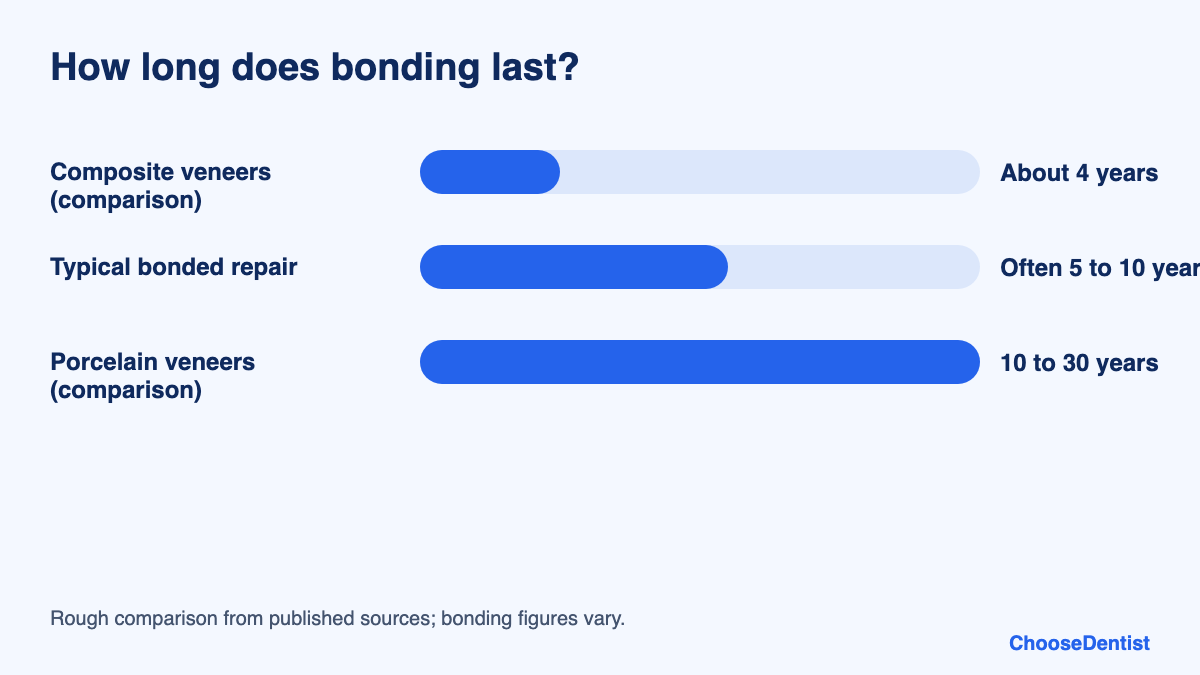
Composite bonding commonly lasts several years, and a figure of around five to ten years is often quoted, though there is no single published number and the real answer depends on where the bonding is placed, how it is looked after and the habits of the person who wears it. Bonding on a front tooth’s biting edge faces more stress than a repair on a flatter surface, and the resin is softer than porcelain, so it wears, stains and chips sooner. The advantage is that it is easy to repair.
Anyone considering composite bonding should expect to maintain it, and ideally to budget for occasional polishing, repair and eventual replacement. This guide explains what influences longevity, how to keep bonding looking good and what the NHS and private options involve.
What we know about lifespan
Published sources give little on bonding specifically, so it helps to look at related restorations. The Wikipedia article on dental veneers says composite veneers last approximately four years, and veneers in general, with modern bonding agents, typically last ten to thirty years, with porcelain at the longer end. The Wikipedia article on cosmetic dentistry describes bonding as tooth-coloured composite that is sculpted, hardened and polished, and notes that modern materials such as nanofill composites are used for a smooth, high-polish finish on front teeth.
Composite material wears more quickly than porcelain, so repair or replacement within a few years is common for bonded edges, and many dentists describe a typical life of around five to ten years for well-placed bonding.
| Factor | Effect on lifespan | What helps |
|---|---|---|
| Biting edge of a front tooth | Chips sooner | Avoid biting hard objects |
| Grinding or clenching | Wears and chips the resin | Wear a night guard |
| Tea, coffee, red wine, tobacco | Stains the resin | Rinse with water; polish at hygiene visits |
| Skilled technique and isolation | Stronger, longer-lasting bond | Choose an experienced dentist |
| Regular check-ups | Small chips repaired early | Ask about repair costs |
What shortens the life of bonding
Grinding and clenching are the main enemies, because they chip and wear the resin. Biting nails, chewing pens or ice and opening packets with the teeth have the same effect. Stain is a second factor: resin absorbs pigment from tea, coffee, red wine and tobacco more readily than enamel or porcelain, so bonded areas can darken or look dull over time.
The preparation matters too. Bonding relies on a strong bond to the tooth surface, and poor technique, moisture contamination or a tooth with thin enamel can lead to early failure. A skilled dentist who isolates the tooth carefully and builds the resin in layers is more likely to produce durable work.
Caring for bonded teeth
Daily care is straightforward. Brush twice a day with fluoride toothpaste, ideally a non-abrasive one, and clean between the teeth. Regular hygiene visits include a polish of the bonded surfaces to remove stain and restore shine. Limiting staining drinks, rinsing with water after them and avoiding smoking keep the resin looking fresh.
Protect the bonding from damage by not biting hard objects, and consider a night guard if you grind your teeth. The dentist can check at each visit for chips, rough edges and staining and put them right early.
Repair and replacement
Small chips are easily repaired by adding more resin, often in a short visit, and stained or dull areas can be repolished. When bonding is badly stained, worn or fractured, it can be removed and replaced. Because little or no tooth is usually removed in the first place, the tooth is generally left in good condition, which is a distinct benefit compared with porcelain restorations.
Ask what the practice charges for repairs, whether a guarantee applies and whether repairs within a certain period are free. Policies vary.

Bonding on different teeth
Where the resin sits makes a large difference. Bonding on the biting edge of an upper front tooth meets repeated contact with the lower teeth, so it is the most likely to chip. Bonding used to close a gap between front teeth, or to reshape the side of a tooth, is under less load and tends to last longer. Bonding on the surface of a tooth that is not in contact with others lasts longest of all. A dentist who understands your bite can say which of your teeth are likely to need more attention.
Signs that bonding needs attention
Bonded areas that look dull, stained or rough, a visible line at the edge, a small chip or a sharp spot that catches the tongue are all signs that bonding needs a visit. A change in how the teeth meet when you bite is also worth reporting. Acting early keeps repairs small and cheap, and it protects the tooth from decay at an edge that has begun to leak.
Costs of keeping bonding looking good
Over several years, bonding has running costs: regular hygiene visits, polishing, repairs and eventual replacement. Many practices charge less for repairing their own work, and some offer a limited guarantee, but policies vary and should be checked in writing. Budgeting for maintenance from the start avoids unpleasant surprises, and helps you to compare bonding fairly with veneers, which cost more initially but often need less upkeep.
Questions worth asking your dentist
Before you commit, it helps to have a short list of questions. Ask what the treatment will involve, how many visits it needs, what the realistic outcome is, what could go wrong and what it will cost in total, including any follow-up. Ask what you would need to do at home and how to reach the practice if something worries you. A dentist who answers clearly, without pressure, and puts the plan in writing, is giving you what you need to make an informed choice, and you are free to compare more than one practice before deciding.
Keeping a record for the future
Keep a note of the date of treatment, the dentist who carried it out, the materials used and the cost. If you later need a repair, a second opinion or a different practice takes over your care, this record saves time and helps with any questions about guarantees. Photographs taken before and after treatment, where relevant, are also a useful reference for you and for any dentist who sees your teeth in future years.
NHS and private options across the UK
Bonding done to improve appearance is private, as the NHS says that cosmetic treatment will usually have to be paid for privately, on its page about why an NHS dentist may charge for private treatment. Tooth-coloured fillings and repairs to a broken tooth that are clinically needed can be provided on the NHS. Charging for NHS dentistry differs across the four nations. England has three bands and an urgent charge, Wales numbered bands and an urgent charge with a contract reform under way, Scotland free examinations and free treatment under 26 with a capped share of the cost for other adults, and Northern Ireland a percentage of the dentist’s fee up to a ceiling per course.
Private bonding commonly costs from about £150 to £400 per tooth, and repairs are usually cheaper than the original. A written estimate should say how repairs are handled.
Planning for the long term
It is sensible to see bonding as a treatment with a maintenance cycle: polish regularly, repair as needed and replace every few years. Compared with veneers, it costs less upfront and requires less tooth removal, and it can be a good first step. Patients who want something that lasts longer may later move to porcelain, and our guide to porcelain and composite veneers explains the differences.
The ChooseDentist directory of composite bonding practices can be searched by postcode, with CQC and Google ratings shown where available. Two practices can be compared side by side, and costs and repair policies should be confirmed directly with the practice.
