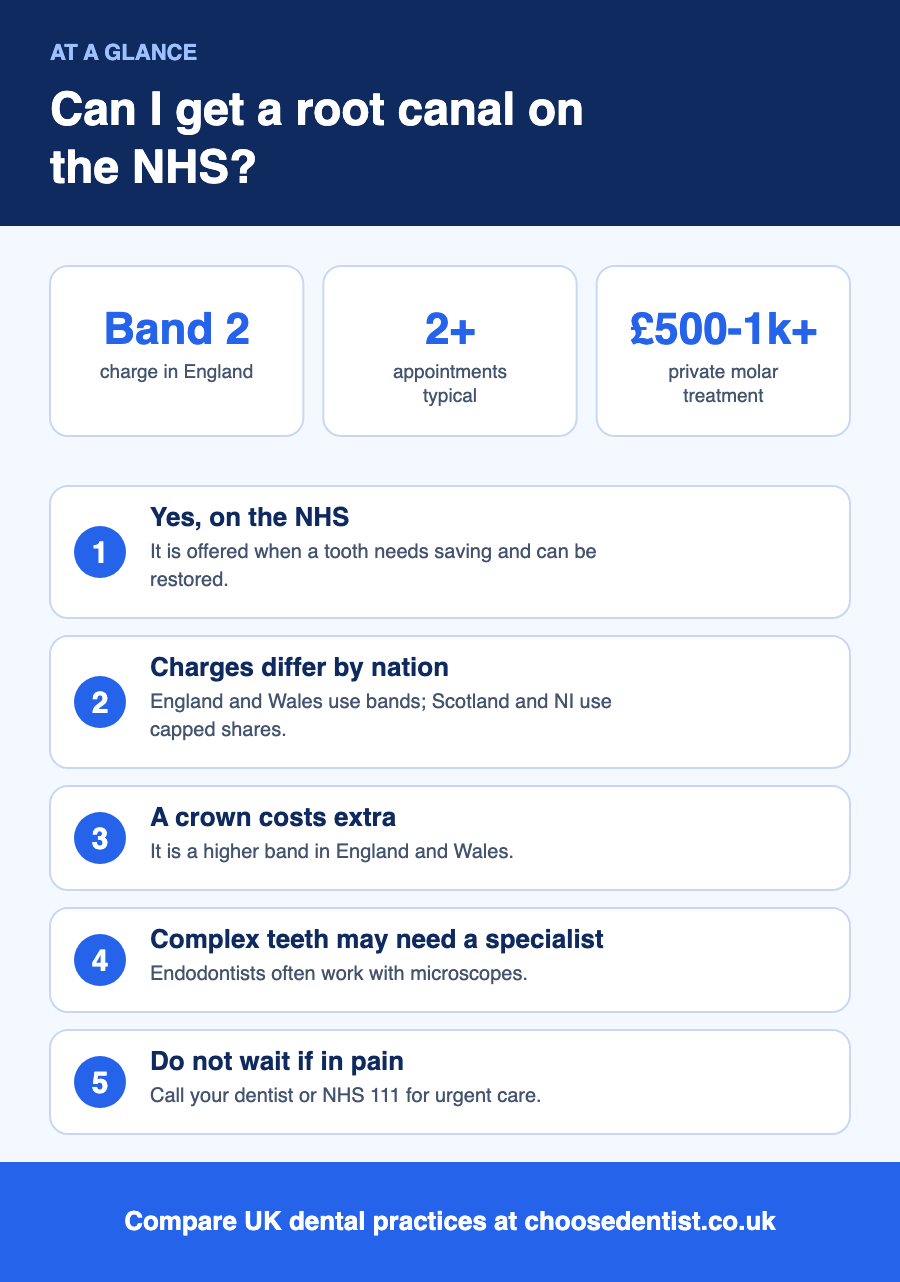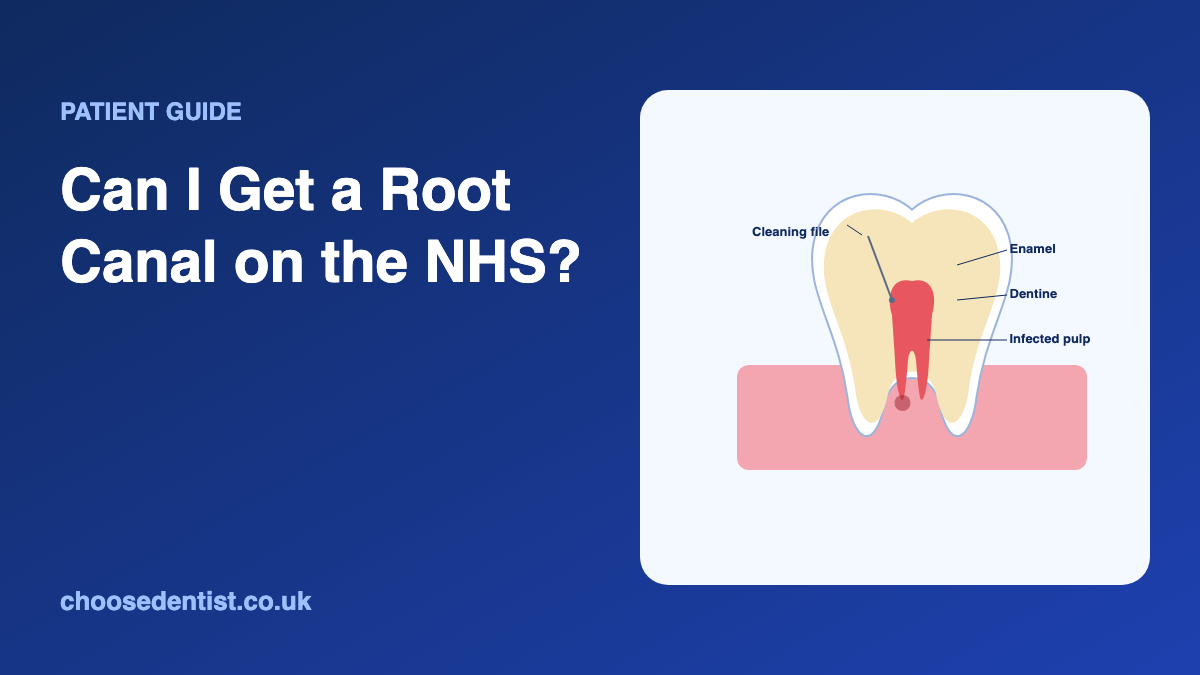
Yes. Root canal treatment is available on the NHS throughout the United Kingdom when it is needed to save a tooth, and most people who need it can have it done by an NHS dentist if they can find one with capacity. The NHS website says it is offered by NHS or private dentists, with an endodontist sometimes involved, and that in England it is a band 2 charge.
The practical questions are how much it will cost, how quickly it can be done and what happens if the tooth is too difficult for a general dentist. The answers differ across the four nations, and several of the details have changed in recent years, so it is worth checking official sources before relying on a figure.
What the NHS provides
The NHS describes root canal treatment as removing infection from inside a tooth, cleaning and filling the canals to prevent reinfection, and says that it is usually recommended where infection of the pulp is causing pain. It says that without treatment an infected tooth may need to be extracted. Treatment usually takes two or more appointments of an hour or two each, and a crown may be needed afterwards if the tooth was badly infected.
NHS dentistry covers treatment that is clinically necessary to keep teeth, gums and mouth healthy, so a tooth that can be saved by a root canal and is worth saving is generally a candidate. The dentist will weigh up whether the tooth can be restored, how much healthy tooth remains and the patient’s overall oral health, and may explain that extraction is the more appropriate course in some cases.
| Nation | How NHS dental charges work | Root canal treatment |
|---|---|---|
| England | Three bands plus an urgent charge | Band 2; a crown is band 3 |
| Scotland | Free examinations; free treatment under 26; others pay a share up to a maximum | Charged within the capped share for adults who are not exempt |
| Wales | Three bands plus an urgent charge; contract reform under way | Middle band, as in England |
| Northern Ireland | Generally 80 per cent of the dentist's fee up to a ceiling per course | Charged within the ceiling |
How charges work in England
In England, root canal treatment falls into band 2, the middle of three charge bands, according to the NHS page on how much NHS dental treatment costs. Band 2 also covers fillings, extractions and other oral surgery, sealants and extensive gum treatment, and a single charge covers the full course of treatment within it, however many visits it takes. If the treatment includes items from a higher band, such as a crown, the patient pays the higher charge instead, and further work within two months in the same or a lower band costs nothing extra.
An urgent charge applies where emergency treatment is needed, for example for a painful infected tooth, and the NHS lists emergency root canal work among the things it can cover. Children, some young people, pregnant women and people on certain benefits are exempt from charges.
Scotland, Wales and Northern Ireland
In Scotland, NHS Inform says that NHS examinations are free for everyone and treatment is free for people under 26. Adults over 26 who are not exempt pay a share of the cost of treatment, up to a maximum for each course, so a root canal and crown would be charged within that cap.
In Wales, the Welsh Government describes numbered bands and an urgent charge, as well as a programme of reform to the dental contract, in its information on NHS dental charges. Root canal treatment sits in the middle band, as in England, and children and various benefit groups are exempt.
In Northern Ireland, nidirect explains that Health Service dental charges are generally 80 per cent of the dentist’s fee up to a ceiling per course of treatment, with free care for certain groups. Rules and amounts are updated periodically, so it is sensible to look at the current figures.
When a specialist is involved
Most root canal treatment is carried out by general dentists. Some teeth are more difficult: molars with several canals, teeth with curved or calcified canals, and teeth that have already been treated and have become infected again. The Wikipedia article on the root canal notes that unusual canal shapes and complex branching are the main causes of failure, so these cases may be referred to an endodontist, a dentist who has completed further training in the specialty and often works with a microscope.
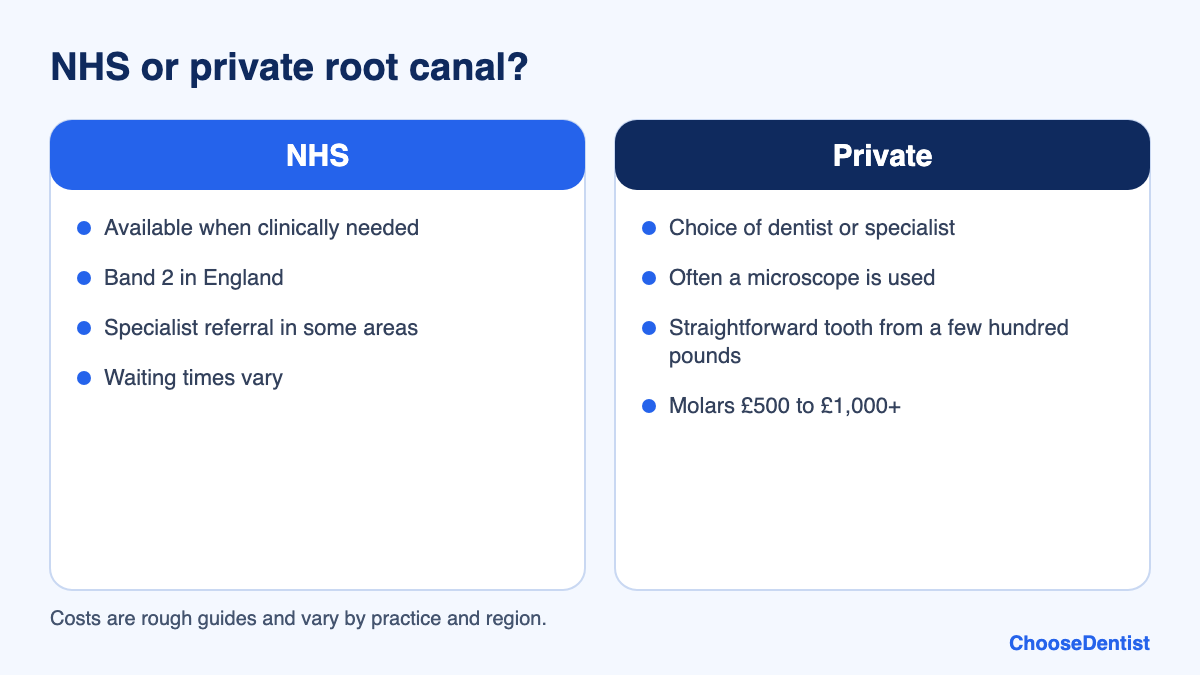
Specialist care is available on the NHS in some areas, usually by referral and often with a waiting list, and more commonly privately. A dentist who thinks a tooth is beyond their experience should say so and discuss the options. Referral is not a sign of failure, but a way of improving the odds of keeping the tooth.
Private root canal treatment
Private fees are set by each practice and vary with the type of tooth, the complexity and the level of expertise. As rough guides, a straightforward front tooth might cost from a few hundred pounds, a molar from about £500 to £1,000 or more, and treatment by a specialist more again, and these figures differ across regions. A crown is normally an additional cost.
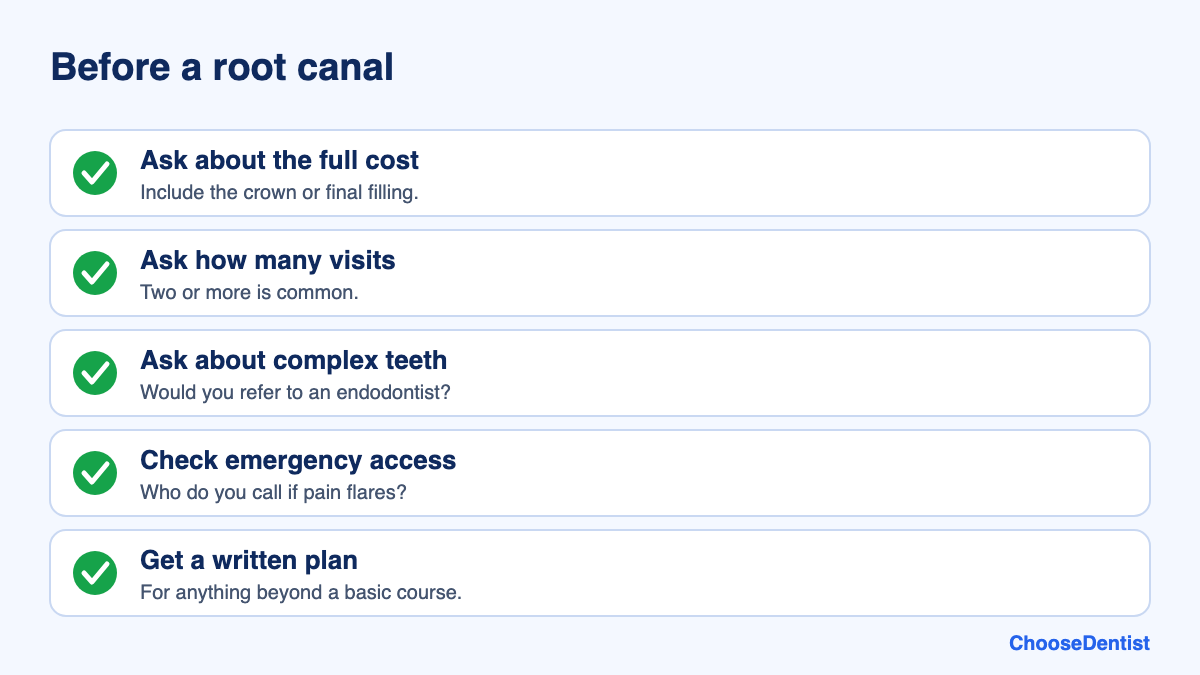
Reasons for choosing private treatment include shorter waiting times, access to a specialist or microscope, a preference for a particular dentist or being unable to find an NHS practice with space. A written estimate should set out the root treatment, the final restoration and any specialist referral, together with what is covered if the tooth needs further work.
Dealing with waiting lists
NHS waiting times for root canal treatment vary widely, and a patient in pain cannot wait for a routine slot. The usual route is to ask for an emergency appointment, which typically deals with the pain by opening the tooth, draining any infection and placing a dressing, and to book the full treatment afterwards. If the practice cannot offer this, NHS 111 can direct patients to an urgent dental service. It is worth asking to be placed on a cancellation list for the complete treatment, and asking the practice how long the wait is likely to be.
What to ask about the crown
The crown or final restoration is easily overlooked in the estimate, but it matters for the tooth’s survival. Patients should ask whether the tooth will need a crown, which type is recommended and what it will cost, and whether the NHS or private plan includes it. A back tooth that has had a root canal is more likely to fracture without cuspal protection, so the dentist may recommend a crown on a molar even when the filling seems sound.
Finding urgent help
A painful infected tooth should not wait. The NHS advises contacting a regular dentist, and if they are closed or cannot see you, calling NHS 111 for advice on an emergency dental appointment, and notes that you may have to pay for an urgent appointment. Facial swelling that spreads, difficulty breathing or swallowing or a high temperature need immediate medical attention, and patients should call 999 or go to A&E. A GP cannot provide dental treatment.
Making the most of an NHS appointment
Patients can help by arriving with a list of any medicines, mentioning any history of difficult anaesthetics and asking how many visits are expected. It is worth asking whether the NHS plan includes the final filling or crown and what the charge will be, since the dentist should provide a written plan for substantial courses of treatment. Attending the follow-up appointments matters because the long-term success of a root canal depends on the quality of the final restoration.
Finding a practice
Availability of NHS root canal treatment depends on the practice’s contract and capacity, so asking about waiting times and emergency access is sensible. For private work, comparing experience, equipment and fees helps.
The ChooseDentist directory of root canal practices can be searched by postcode, with CQC and Google ratings shown where available, and two practices can be compared side by side. NHS availability and costs should be confirmed directly with the practice.