

Enamel reshaping, also called enameloplasty or tooth contouring, is a quick cosmetic procedure in which a dentist removes a very small amount of enamel to smooth a rough edge, shorten a pointed tooth, even out the length of neighbouring teeth or slightly alter the shape of a tooth. It involves no needles in most cases, takes minutes per tooth and gives an immediate result, which makes it popular for minor imperfections.
The qualification is that enamel does not grow back. Because the change is permanent, the procedure suits only certain teeth and only small adjustments, and it is a good example of a cosmetic dentistry treatment where restraint matters.
What enamel reshaping is
The Wikipedia article on cosmetic dentistry describes reshaping as the removal of enamel to correct chips or to alter the length, shape or position of a tooth, and notes that the enamel is irreplaceable and that removal can expose the underlying dentine. It also notes that the results are fast.
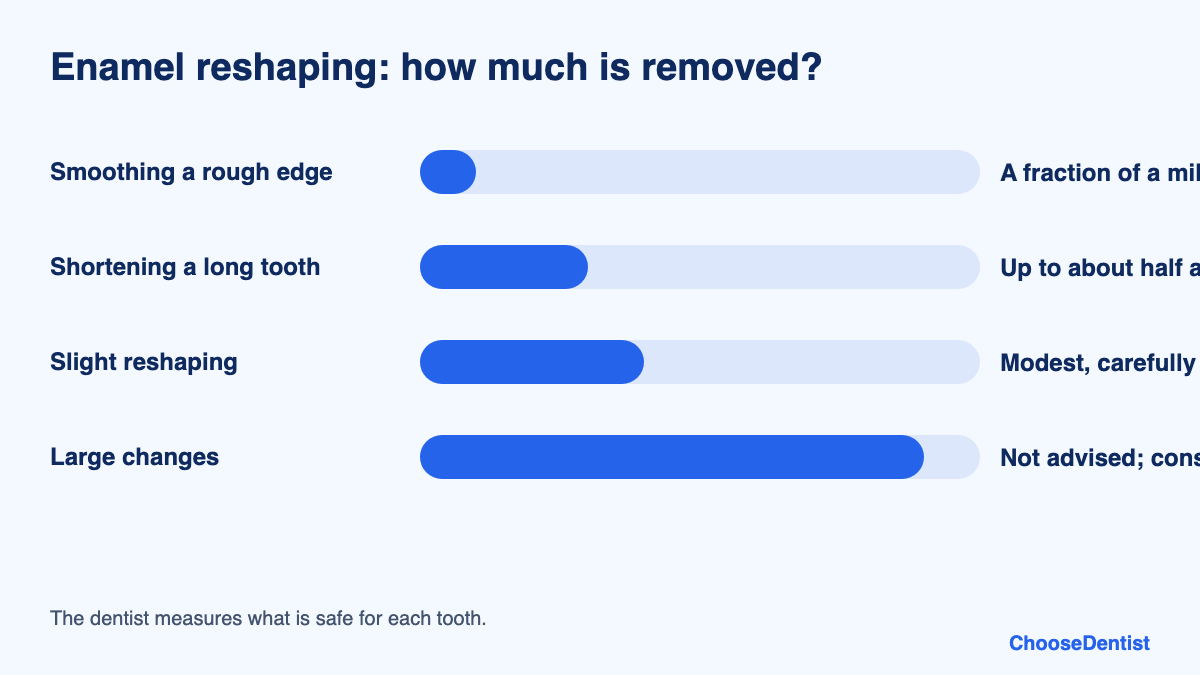
The dentist uses fine instruments, discs or burs to remove a fraction of a millimetre from the tooth, and then polishes the surface smooth. The amount removed is judged carefully, with measurements and X-rays where needed, so that a safe thickness of enamel remains.
| Feature | Enamel reshaping | Composite bonding |
|---|---|---|
| What it does | Removes a little enamel to smooth or shorten | Adds resin to build up or reshape |
| Reversible? | No; enamel does not grow back | Often yes, in part |
| Good for | Small chips, pointed or uneven edges | Chips, small gaps, short teeth |
| Typical private cost | About £50 to £200 per tooth | About £150 to £400 per tooth |
| Anaesthetic | Rarely needed | Rarely needed |
What it can and cannot do
Reshaping is suitable for small irregularities: a slightly pointed canine, a chipped edge, a tooth that is a little longer than its neighbours or two teeth that overlap very slightly. Used sparingly, it can improve the look of the smile and the way the teeth fit together.
It cannot do what other treatments can. It will not close gaps, lengthen a short tooth, change the colour of a tooth or correct significant crowding, and it is not a substitute for orthodontics where teeth are markedly out of line. Pushing it beyond a modest adjustment risks exposing dentine and creating sensitivity.
Is it painful?
Because enamel contains no nerves, reshaping is normally painless, and local anaesthetic is rarely needed. Patients may notice a vibration or a mild sensitivity to the cooling water, and the sound of the instruments can be unsettling for those who are anxious. If a patient is sensitive, the dentist can stop, apply a desensitising agent or use local anaesthetic.
Most people can eat and drink immediately afterwards, though the newly polished edges may feel unfamiliar to the tongue for a day or two.
Risks and considerations
The main risk is removing too much. Enamel is thin, and the front teeth have only about a millimetre or so in places, so excessive reshaping can lead to sensitivity, a greater tendency to staining and an increased risk of chipping, since dentine is softer. Once removed, enamel cannot be replaced, so the dentist may mark the planned changes and show a mock-up before beginning.
A related issue is the bite. Reshaping can alter how the teeth meet, which in some cases may affect comfort or wear, so the dentist will check the bite carefully. Teeth that are already thin or worn, or patients who grind heavily, may be better suited to bonding or other treatments.
Combining reshaping with other treatments
Enamel reshaping is often used together with other work. A little reshaping can improve the shape of teeth before whitening, harmonise a tooth after a small chip is repaired with bonding or prepare a tooth to receive a veneer. It is also sometimes used in orthodontics to create tiny amounts of space, where it is called interproximal reduction.

Caring for reshaped teeth
Aftercare is simple. Good brushing with fluoride toothpaste and regular check-ups protect the remaining enamel, and desensitising toothpaste helps if there is mild sensitivity. Patients should limit acidic drinks, which can erode enamel, and avoid habits such as grinding, which a night guard can help to manage.
Who is a good candidate?
The best candidates have healthy teeth with a good thickness of enamel and a small, specific imperfection. Teenagers and young adults often have rounded or slightly pointed edges that can be smoothed, and adults with minor chips benefit from tidying. Teeth that are already thin, heavily worn, sensitive or discoloured are poorer candidates, since removing more enamel would expose the darker, softer dentine. A careful examination, sometimes with X-rays, establishes how much can safely be taken.
What to expect afterwards
Most people notice nothing apart from the improved appearance. Mild sensitivity to cold may occur for a few days and usually settles, and the polished surface may feel slightly smoother than before. A fluoride treatment or desensitising paste can help if the teeth are tender. The dentist will review the result at the next check-up and may suggest protective measures, such as limiting acidic drinks, to keep the remaining enamel healthy.
Reshaping compared with other options
For a small imperfection, reshaping is the quickest and cheapest route, but it is worth considering how it compares with the alternatives. Bonding adds material instead of removing it, so it can lengthen a short tooth or fill a chip, and it is often reversible. Veneers and crowns give more control over shape and colour but involve much more tooth reduction and cost. Orthodontics straightens crooked teeth without cutting them. A dentist can set out the options, and the most conservative one that achieves the goal is usually the best.
Reshaping in children and teenagers
Dentists are cautious about reshaping the teeth of young patients, because the pulp, or nerve chamber, is larger and the enamel may be thinner, and because the shape of the teeth and gums changes as they mature. Small adjustments, such as smoothing the rough edges that often remain on new front teeth, are generally harmless, but anything more extensive is usually postponed until growth is complete. Parents who are concerned about their child’s smile can ask the dentist what is appropriate at each age.
NHS and private options across the UK
Reshaping carried out for appearance is private, as the NHS says that cosmetic treatment will usually have to be paid for privately, according to its page on private treatment charges. A dentist may smooth a sharp edge that is cutting the tongue or cheek as part of clinical care, and that can be an NHS matter. Charging for NHS dentistry differs across the four nations. England has three bands and an urgent charge, Wales numbered bands and an urgent charge with a contract reform under way, Scotland free examinations and free treatment under 26 with a capped share of the cost for other adults, and Northern Ireland a percentage of the dentist’s fee up to a ceiling. Private fees are modest for minor reshaping, often from about £50 to £200 per tooth, and may be included in a larger treatment plan.
Getting a second view
Because the procedure is irreversible, it is reasonable to ask the dentist what the alternatives are and what would happen if nothing were done. A second opinion costs little and may confirm that a minor adjustment is all that is needed, or suggest that a different approach would be better.
The ChooseDentist directory of cosmetic dentistry practices can be searched by postcode, with CQC and Google ratings shown where available. Two practices can be compared side by side, and the details of treatment and cost should be confirmed directly with the practice.
