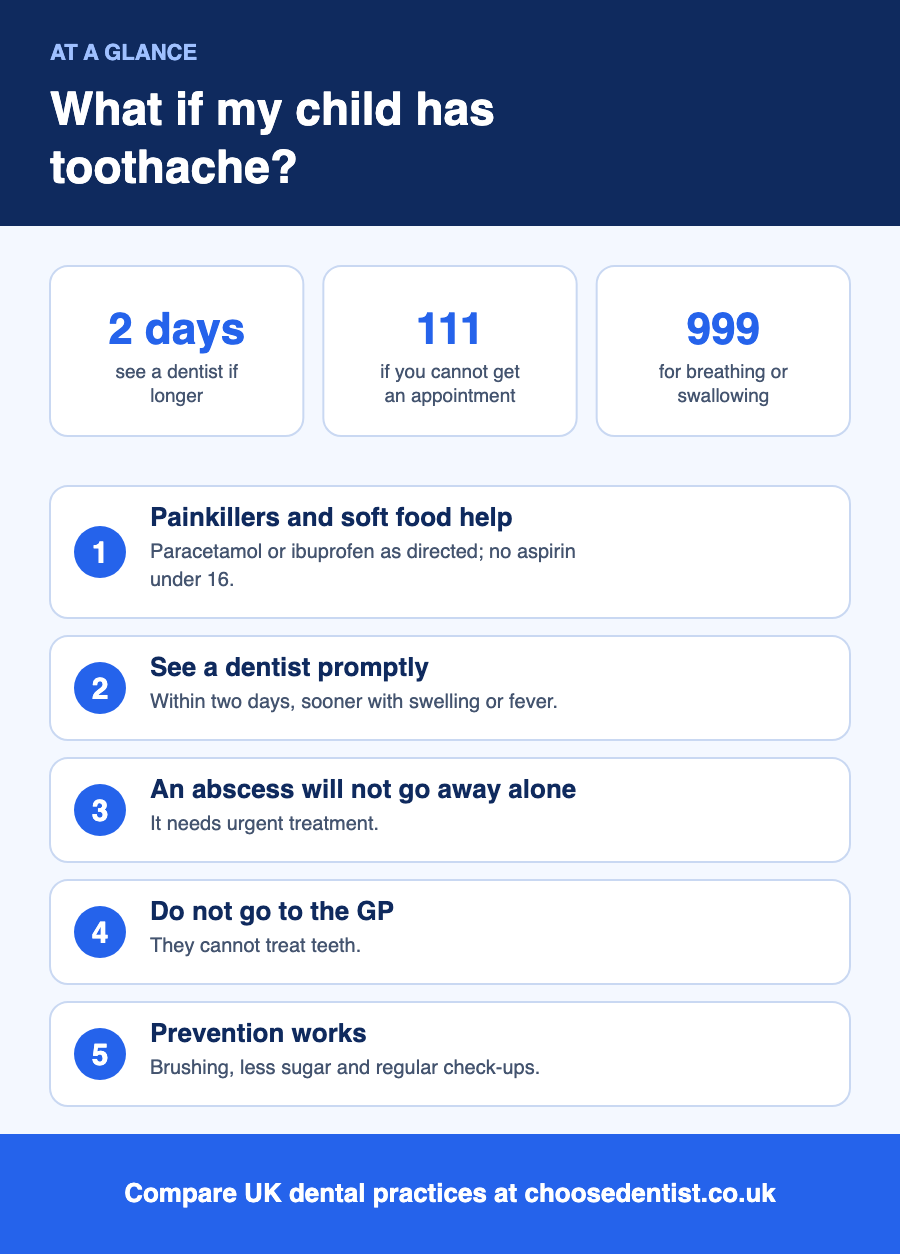
If a child has toothache, arrange to see a dentist as soon as possible. Meanwhile, give an age-appropriate painkiller such as paracetamol or ibuprofen as directed, offer soft food and avoid very hot, cold or sweet things. The NHS advises seeing a dentist if toothache lasts more than two days or does not ease with painkillers, and calling 999 or going to A&E if there is swelling that affects breathing, swallowing or vision.
Toothache in a child is distressing for everyone, and it is usually a sign that something needs treatment, most often decay. Acting promptly keeps the problem small and spares the child unnecessary pain, and it is worth knowing in advance how to get urgent care through a children’s dentist or NHS services.
Common causes
The NHS lists the usual causes of toothache as tooth decay, a dental abscess, a cracked or damaged tooth, a loose or broken filling and gum disease, and notes that infection can occur when a wisdom tooth erupts without enough room. In children, the commonest cause is decay in a baby or adult tooth, which exposes the sensitive layer beneath the enamel or reaches the nerve.
Other causes include a knock to the tooth, food trapped between teeth, a tooth that is coming through, an orthodontic brace that is rubbing and sometimes sinus infection, which can make upper teeth ache. Because several things can cause similar pain, it is best to have the tooth examined.
| Situation | What to do | Where to go |
|---|---|---|
| Mild toothache | Painkillers, soft foods; see a dentist if it lasts over 2 days | Regular dentist |
| Toothache with swelling, fever or a bad taste | Urgent dental care | Dentist or NHS 111 |
| Swelling affecting breathing, swallowing or sight | Emergency | 999 or A&E |
| No dentist or practice closed | Ask for advice | NHS 111 or NHS 111 online |
What to do at home
While waiting for an appointment, several measures help. Painkillers such as paracetamol or ibuprofen can be given in the dose recommended for the child’s age and weight, following the pack or a pharmacist’s advice. The NHS notes that children under sixteen should not take aspirin. Soft foods help, and the child should avoid chewing on the sore side and avoid very hot, very cold or sugary food and drink.
Older children can rinse with warm salt water, half a teaspoon of salt in a glass of water, and spit it out, though the NHS says children should not do this if they are too young to spit reliably. A pain-relieving mouth gel suitable for the child’s age is available from pharmacies, and a pharmacist can advise. Gentle brushing with a soft brush keeps the area clean.
When to see a dentist
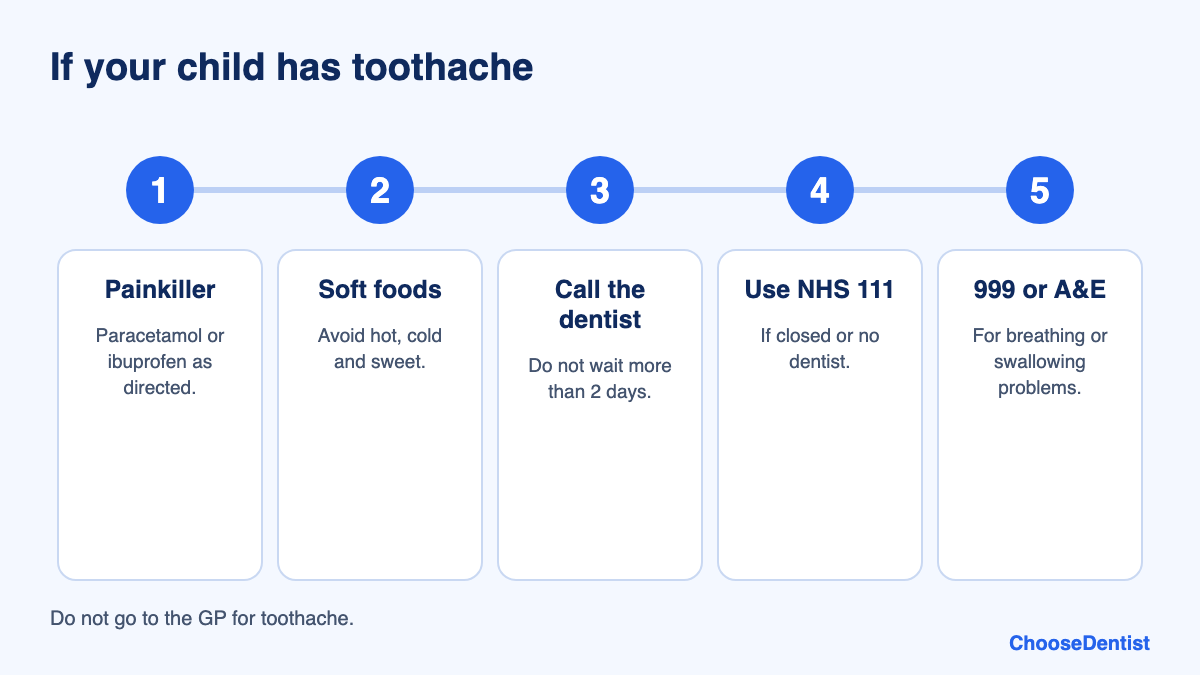
The NHS says to see a dentist if toothache lasts more than two days or does not ease with painkillers, or if there is a high temperature, pain on biting, red gums, a bad taste or a swollen cheek or jaw. For a child, it is sensible to ring the dentist sooner, because children cannot always describe their symptoms, and infection in a baby tooth can spread.
Do not go to the GP, which the NHS points out cannot provide dental treatment. Call the child’s regular dentist, and if they are closed, listen to the answerphone, which should say what to do. If there is no regular dentist, or no emergency appointment is available, call NHS 111 or use NHS 111 online for advice.
Warning signs of a dental abscess
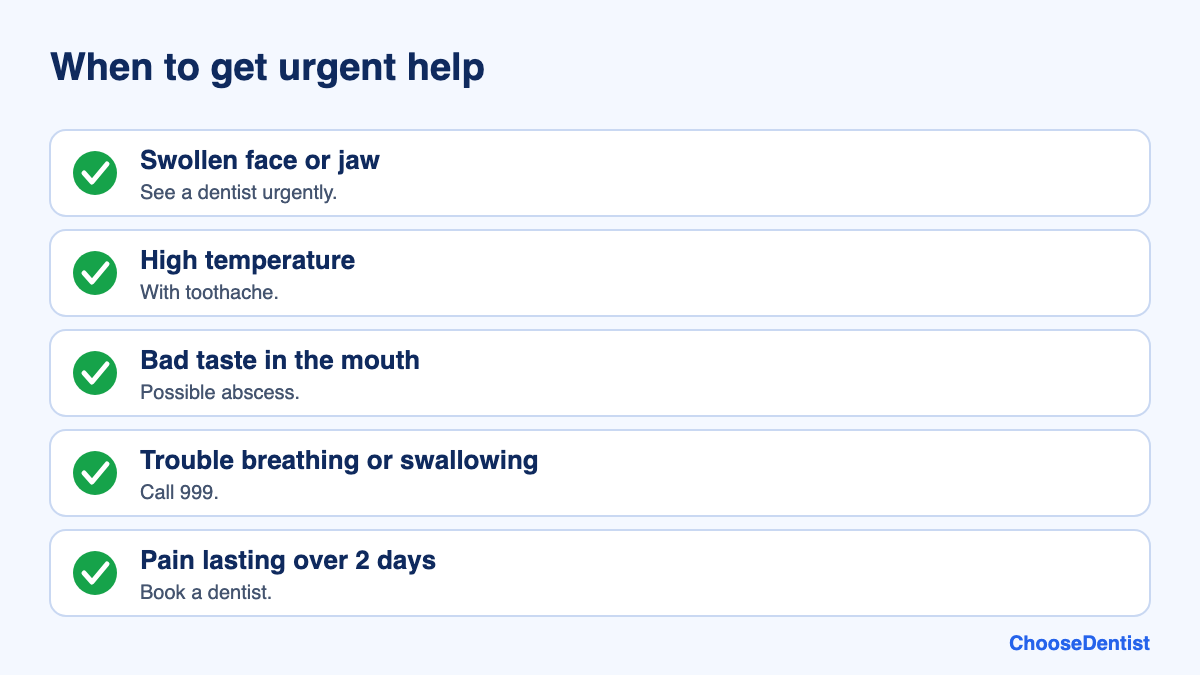
An abscess is a collection of pus caused by infection and needs urgent treatment. The NHS lists its symptoms as intense toothache or gum pain, redness inside the mouth or on the face or jaw, sensitivity to hot or cold, a bad taste in the mouth, difficulty opening the mouth and chewing, a swollen face or jaw, swollen glands in the neck and a high temperature, and it says an abscess will not go away on its own.
The NHS advises calling 999 or going to A&E if there is trouble breathing, speaking or swallowing, a swollen or painful eye or changes in eyesight, a lot of mouth swelling or difficulty opening the mouth. These are uncommon but serious, and a parent should not drive the child themselves if they are unwell.
What the dentist will do
The dentist will examine the tooth, take an X-ray if needed and identify the cause. Decay is treated with a filling. Where the infection has reached the nerve of a baby tooth, the tooth may be treated or removed, and in an adult tooth a root canal may be needed. An abscess is drained, and antibiotics are sometimes prescribed alongside treatment. Children who are very anxious may be referred to a specialist service, where sedation can be offered.
Treatment of baby teeth matters even though they are temporary, because untreated infection can cause pain, affect eating and sleeping and damage the permanent teeth beneath.
Preventing future problems
Most toothache in children is preventable. Brushing twice a day with fluoride toothpaste, limiting sugary snacks and drinks, regular check-ups and prompt attention to early signs of decay protect against it. Following the NHS advice to take a child to the dentist when the first teeth appear, and to have regular check-ups, builds a pattern of care.
What not to do
A few well-meant remedies can do more harm than good. Placing an aspirin against the gum can burn the tissue, and the NHS advises that children under sixteen should not take aspirin at all. Applying heat to a swollen cheek can make an infection worse, whereas cool compresses are safer for comfort. Delaying an appointment because the pain has eased is risky, since the pain of an infected tooth often subsides when the nerve dies while the infection carries on.
Toothache from a knock
If the pain follows an injury, the approach changes. A chipped or loosened tooth needs prompt attention, and a knocked-out permanent tooth is an emergency: pick it up by the crown, rinse briefly if dirty, put it back in the socket if possible or keep it in milk and see a dentist at once. A knocked-out baby tooth should not be replanted. Bleeding can be controlled by pressing on the area with clean gauze, and ice wrapped in a cloth helps with swelling.
NHS and private options across the UK
Emergency and routine dental care for children is free on the NHS in all four nations, with different age limits. Charging for NHS dentistry differs across the four nations, but treatment for children is free everywhere, with different age limits. England provides free treatment for those under 18, and under 19 in full-time education, Scotland for those under 26, Wales for children under 18 and Northern Ireland for children and certain other groups, while adults pay bands in England and Wales, a capped share of the cost in Scotland and a percentage of the fee up to a ceiling in Northern Ireland. The NHS notes that an emergency appointment may have a charge for adults, but children who are entitled to free care should not be charged. Waiting for an emergency appointment can be difficult, so NHS 111 is the route to urgent dental services in many areas.
Private practices may offer same-day emergency appointments, with fees set by the practice. Parents should ask about the cost of an emergency examination and treatment, and whether a child under the practice’s NHS contract can be seen without charge.
Finding a practice
A practice that offers emergency appointments, has experience with children and is easy to reach reduces stress when a problem arises. It helps to find one before it is needed.
The ChooseDentist directory of practices for children and families can be searched by postcode, with CQC and Google ratings displayed where available. Two practices can be compared side by side, and emergency availability should be confirmed directly with the practice.