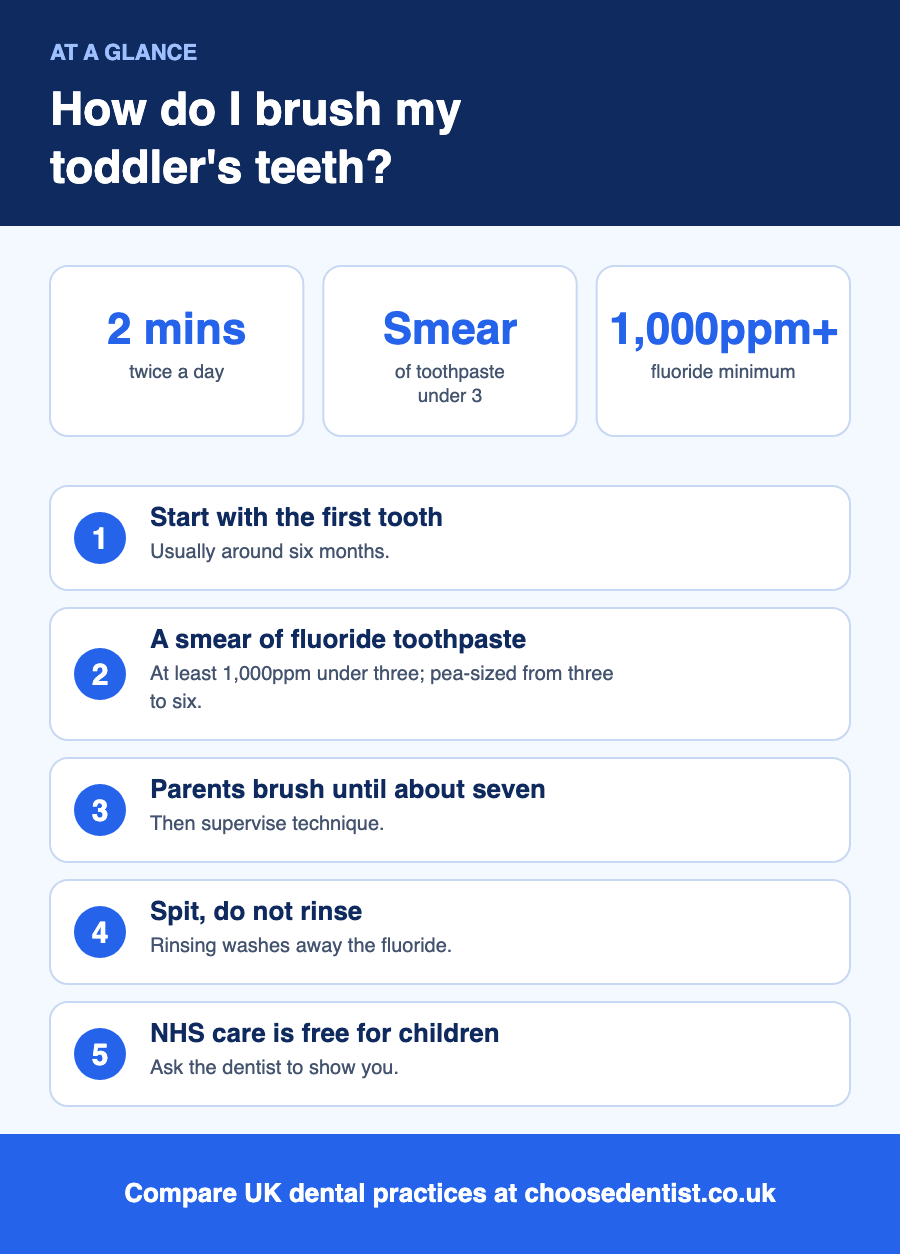
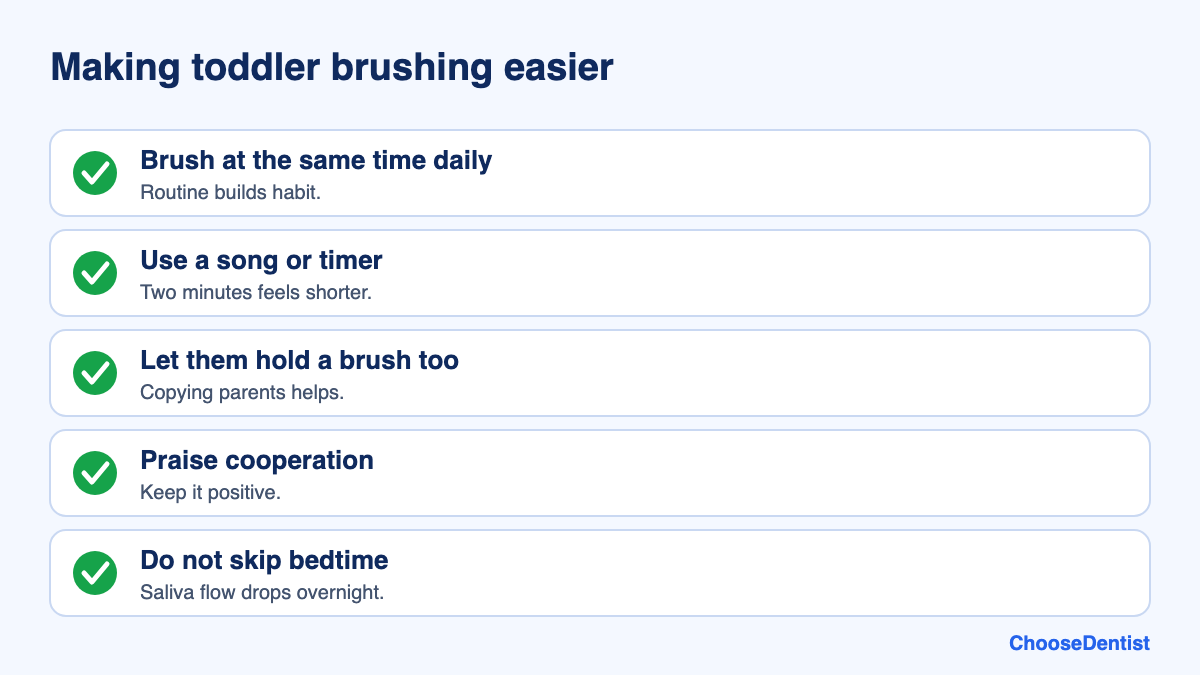
Brushing a toddler’s teeth is the responsibility of a parent or carer, and it should begin as soon as the first milk tooth appears, usually at around six months. The NHS advises brushing twice a day for about two minutes with a smear of fluoride toothpaste for children under three, spitting out afterwards without rinsing. A little patience and a regular routine are what make it work, since toddlers are often reluctant.
Good habits established early protect against tooth decay, which is common in young children and largely preventable. A visit to a children’s dentist can also reinforce the message, and the dentist can demonstrate technique and answer questions.
What the NHS recommends
The NHS guidance on taking care of children’s teeth is clear. For children under three, the parent or carer should brush the teeth twice a day for about two minutes, using only a smear of toothpaste containing at least 1,000 parts per million of fluoride, unless a dentist recommends a higher-strength family toothpaste of 1,350 to 1,500 parts per million. Between three and six, a pea-sized amount of toothpaste with 1,000 to 1,500 parts per million of fluoride is used, with the parent supervising.
After brushing, the child should spit out the toothpaste and not rinse, since rinsing reduces the effect of the fluoride. For toddlers who cannot spit yet, wiping away the excess with a clean cloth is a reasonable approach.
| Child's age | Who brushes | How much toothpaste |
|---|---|---|
| From first tooth (about 6 months) to age 3 | Parent or carer, twice a day for about 2 minutes | A smear with at least 1,000ppm fluoride |
| Ages 3 to 6 | Parent supervises, twice a day for about 2 minutes | A pea-sized amount with 1,000 to 1,500ppm fluoride |
| Age 7 and over | Child brushes; parent checks technique and time | 1,350 to 1,500ppm fluoride |
| All ages | Spit out; do not rinse | Brush last thing at night |
Starting early
Brushing begins with the first tooth. At the earliest stage, a soft, small-headed brush designed for babies and a smear of toothpaste are enough, and the teeth can be cleaned gently as part of the bedtime routine. Even before teeth appear, wiping the gums with a clean damp cloth after feeds helps a baby to become used to having their mouth cleaned.
The NHS says that the dentist should see a child when their first milk teeth appear, or before they are twelve months old, which is also a good moment to ask for a demonstration of toothbrushing. Early visits help the child to become comfortable at the dentist as well.
Technique
A toddler can be held on a lap or lie back with their head supported, so the parent can see into the mouth. The brush is angled towards the gum line, and short, gentle circular or back-and-forth strokes clean the outer surfaces, the inner surfaces and the chewing surfaces of each tooth. A parent should pay attention to the back teeth, which are harder to reach and more prone to decay.
Two minutes is a long time for a toddler, so many parents break it into quarters, spending thirty seconds on each part of the mouth, or use a song or a sand timer to keep track. Making it a game and praising the child helps.
Making it easier
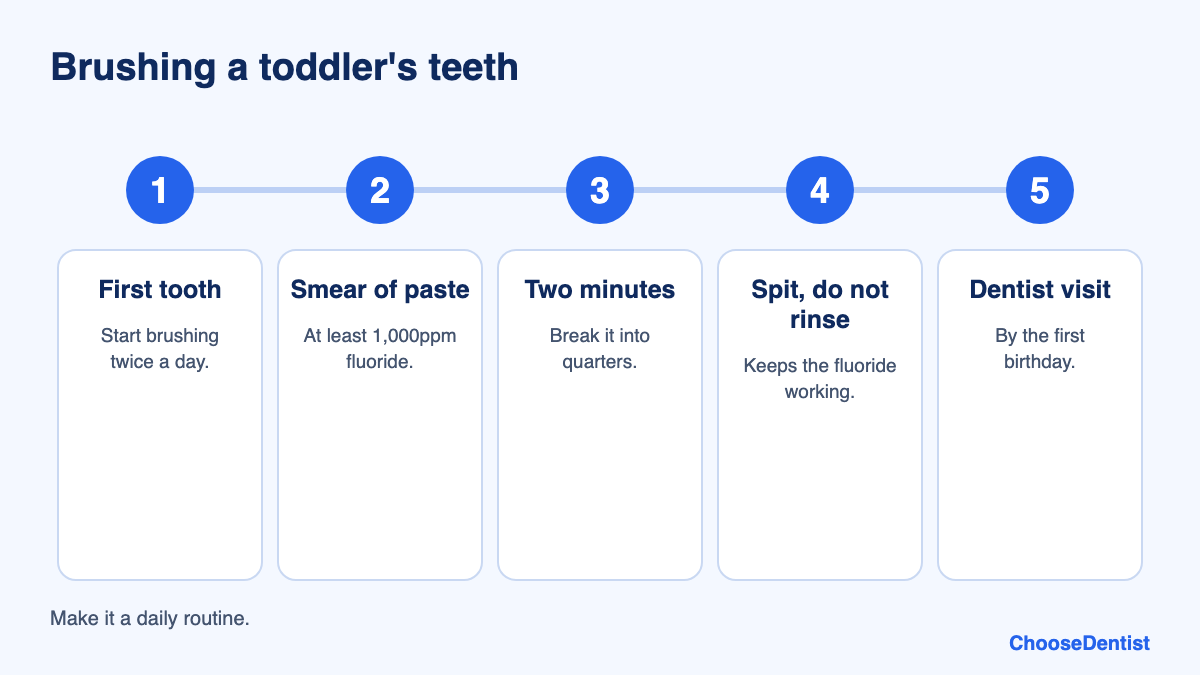
Toddlers often resist brushing, so a few tactics help. Letting the child hold a second brush while the parent brushes, brushing in front of a mirror, using a favourite song and keeping to the same time each day all make it feel normal. A child who clamps their mouth shut may open it if they see the parent brushing their own teeth, or if the brush is introduced as a game.
Patience matters more than perfection. If a child is distressed, it is better to finish quickly and kindly than to turn it into a battle, because the aim is to build a lasting habit. Bedtime brushing is the most important, since saliva flow drops overnight.
Toothpaste choices
Toothpaste labels list the fluoride concentration, expressed in parts per million, usually on the back of the tube. Family toothpastes typically contain 1,350 to 1,500 parts per million, which the NHS notes is appropriate from age seven, and can be used earlier on dental advice. Children’s toothpastes aimed at under-threes should contain at least 1,000 parts per million, and low-fluoride products marketed for babies may not give adequate protection. Parents can ask the dentist or health visitor which to choose.
Other habits that protect teeth
Brushing is only part of the picture. The NHS describes decay as mostly linked to frequent sugary food and drink and not cleaning teeth regularly, so cutting down on sugary snacks and drinks, keeping them to mealtimes and offering water or milk between meals matters. Avoiding putting a baby to bed with a bottle of anything other than water, and limiting fruit juice, also protect teeth.
Common mistakes
A few errors crop up often. Using too much toothpaste is one, since a toddler may swallow it, and a smear is all that is needed under three. Letting a child brush alone at this age is another: toddlers do not have the dexterity to clean their teeth effectively, and the NHS advises that a parent or carer does the brushing. Rinsing the mouth with water immediately afterwards washes away the fluoride, and skipping the night-time brush leaves the teeth unprotected during the long period when saliva flow is lowest.
Electric and manual toothbrushes
Both work well if used properly, and the choice depends on what the child will tolerate. Small-headed manual brushes with soft bristles are suitable for babies and toddlers, and some children like the novelty of a battery brush designed for young children. The most important points are that the brush is soft, that the head is small enough to reach the back teeth and that it is replaced when the bristles splay, usually every three months or after an illness.
Dummies, bottles and teething
The brushing routine goes alongside other habits. A baby should not be put to bed with a bottle of anything other than water, and sugary drinks should be avoided, because they bathe the teeth in sugar overnight. Teething can make gums sore and brushing uncomfortable, and a cold teething ring or a clean finger on the gum can help before brushing. If the child has a dummy, regular cleaning and weaning around the age of one to two years helps to protect the developing teeth.
NHS and private options across the UK
NHS dental care for children is free, according to the NHS, and a dentist or hygienist can demonstrate brushing, apply fluoride varnish and advise on toothpaste at check-ups. Charging for NHS dentistry differs across the four nations, but treatment for children is free everywhere, with different age limits. England provides free treatment for those under 18, and under 19 in full-time education, Scotland for those under 26, Wales for children under 18 and Northern Ireland for children and certain other groups, while adults pay bands in England and Wales, a capped share of the cost in Scotland and a percentage of the fee up to a ceiling in Northern Ireland. The challenge is usually finding a practice with space for new NHS patients, and parents should phone several practices.
Private practices also offer check-ups and preventive care for children, and some have family membership plans that spread the cost across a household. Fees for private check-ups and hygiene visits are set by each practice.
When to seek advice
Parents should arrange a dental check-up if they notice white, brown or black spots on a child’s teeth, if the child complains of toothache or if the gums bleed or look swollen. The NHS also advises seeing a dentist as soon as possible if tooth decay is suspected.
The ChooseDentist directory of practices for children and families can be searched by postcode, with CQC and Google ratings displayed where available. Two practices can be compared side by side, and NHS availability and appointment times should be confirmed directly with the practice.