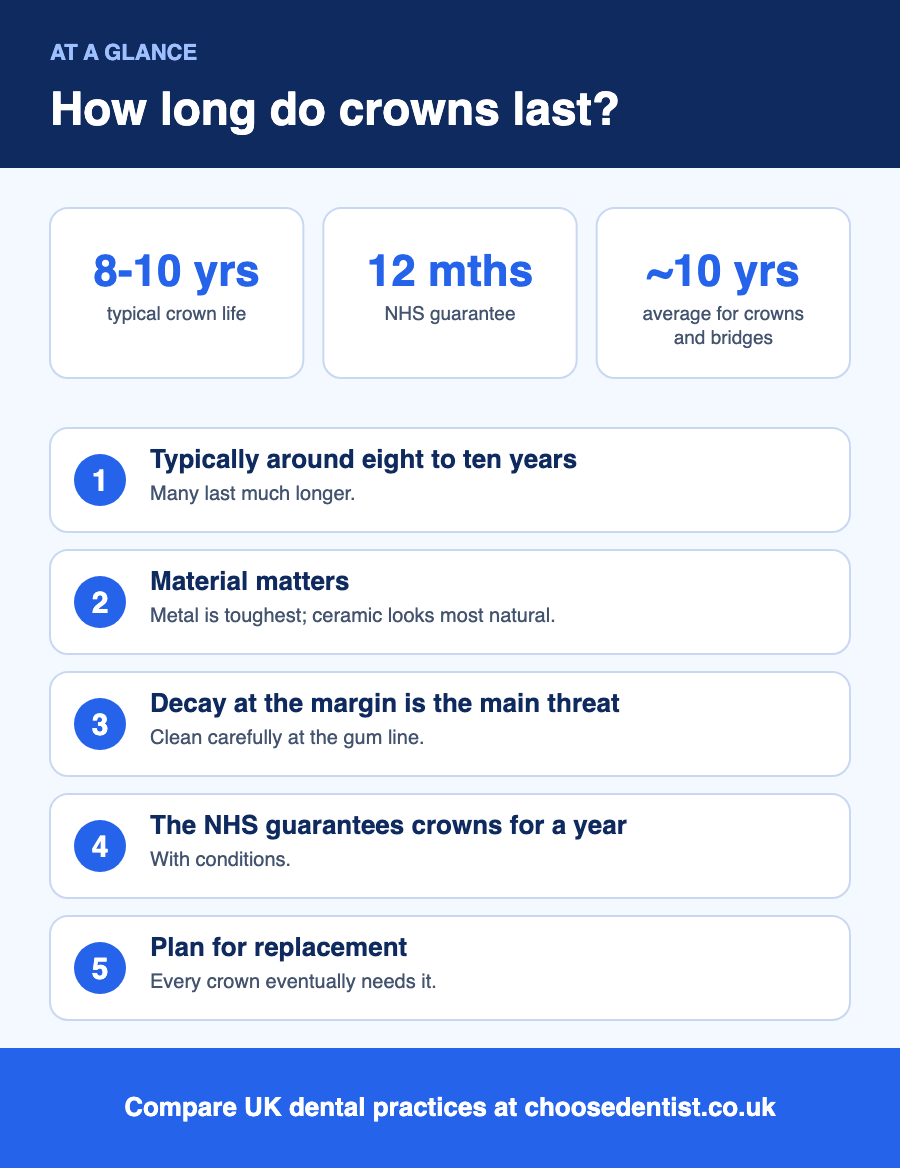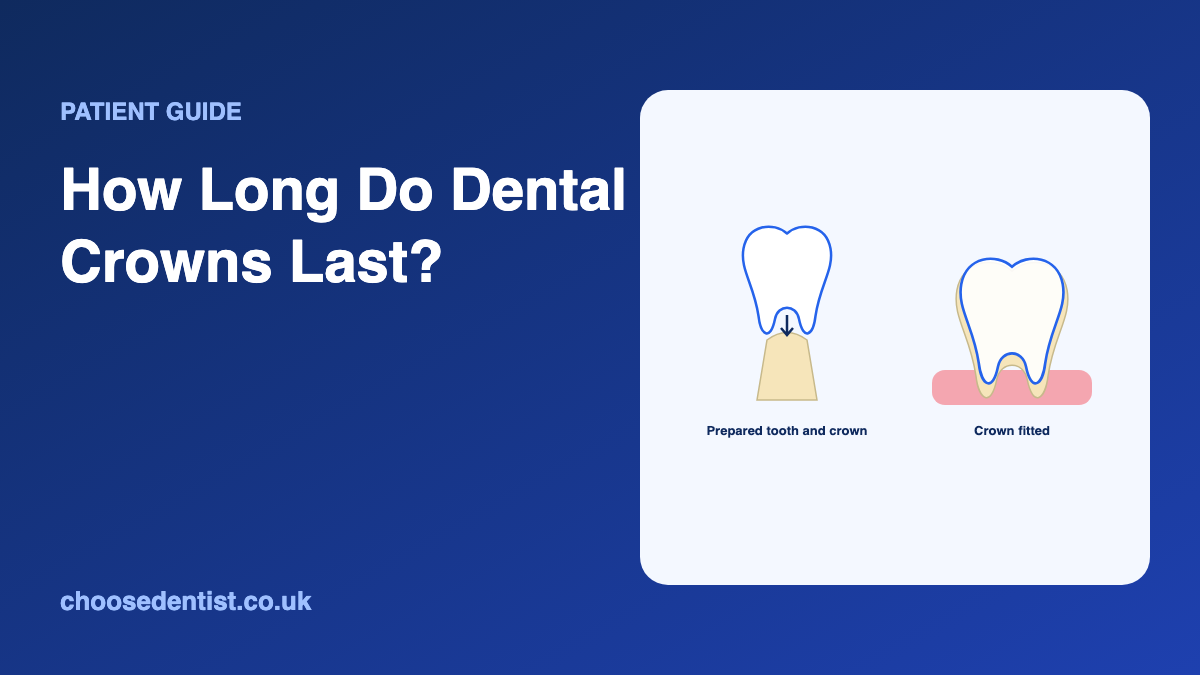
A dental crown normally lasts around eight to ten years with good care, according to hospital patient information, and many last a good deal longer. The actual lifespan depends on the material, the health of the tooth underneath, how well the crown is cleaned, the forces it is put under and the skill with which it was made. A crown is a durable restoration, but not a permanent one, and most will need repair or replacement at some point.
Looking after a crown is largely a matter of looking after the tooth beneath it. This guide explains what the evidence says about dental crown lifespans, what shortens them and how the NHS guarantee works.
What the figures say
The Leeds Teaching Hospitals leaflet on crowns states that a crown or veneer should normally last around eight to ten years, and that how long depends on regular check-ups, good brushing and flossing technique and a low-sugar diet. The Wikipedia article on cosmetic dentistry gives an average of nearly ten years for crowns and bridges.
Many crowns last twenty or thirty years, especially metal ones on back teeth, while others fail within a few years because of decay at the margin or a fracture. The averages hide a wide spread.
| Crown type | Typical use | Notes on durability |
|---|---|---|
| Metal alloy (gold or silver mix) | Back teeth that are out of sight | Very strong and long-lasting |
| Porcelain fused to metal | Teeth needing strength and good appearance | Strong; metal edge can show at the gum |
| All-ceramic or porcelain | Visible teeth with a gentle bite | Natural-looking; can chip under heavy load |
| Average crown | Most situations | Around 8 to 10 years; many last longer |
| NHS guarantee | Crowns fitted on the NHS | Free repair or replacement within 12 months, with conditions |
Materials and durability
The Leeds leaflet describes porcelain bonded to a metal lining, which combines strength with a good appearance, metal alloys of gold or silver with other metals where strength is needed, usually where the tooth does not show when smiling, and all-ceramic crowns for visible teeth where the bite is not heavy. The NHS says that crowns are usually made from metal, ceramic or porcelain fused to metal, in its page on what NHS fillings and crowns are made of.
Gold and metal alloys are the toughest, ceramics are the most natural-looking but can chip under heavy biting, and porcelain fused to metal sits in between. A dentist chooses the material based on position, bite and appearance.
What shortens a crown's life
The main threat is decay at the edge of the crown, where it meets the tooth, because plaque collects there and the root surface below is vulnerable. Gum recession can expose the margin. Other causes include grinding or clenching, which can chip porcelain or loosen the cement, chewing hard objects, a poorly fitting crown, and a tooth that fractures or whose nerve dies, which may need root canal treatment. The leaflet lists clenching or grinding, poor oral hygiene, high decay rates and active gum disease among situations in which a crown may not be suitable.

Looking after a crown
The leaflet advises brushing twice a day with fluoride toothpaste, cleaning between the teeth with floss or interdental brushes, limiting sugar, and attending regular check-ups and hygienist visits. Special attention to the gum line, where crown meets tooth, matters most, and a night guard protects crowns in people who grind. Avoid biting hard objects such as ice or pen tops, and report any looseness, sensitivity or sharp edge promptly.
Signs of trouble
Warning signs include a crown that feels loose or rocks, a gap or dark line at the edge, a bad taste, pain when biting or with hot and cold, a crack or chip and bleeding gums around it. A loose crown should not be left, because the tooth beneath can decay quickly and the crown can be swallowed. The NHS lists a broken or loose crown among urgent dental problems for which you can ask for an appointment.
The NHS guarantee
On the NHS, crowns are guaranteed for twelve months. The NHS Business Services Authority explains on its page about guaranteed items that if a crown needs to be repaired or replaced within twelve months of being fitted, you will not be charged, including if it has been lost. The same page lists the conditions: the replacement must be the same treatment at the same practice, and the guarantee does not apply if private treatment has been carried out on the same tooth, if the restoration was meant to be temporary, if a different restoration was advised or if the problem is due to trauma.

Crowns on root-treated teeth
A tooth that has had root canal treatment is more brittle, which is why the NHS notes that a crown may be needed afterwards. Such crowns protect the tooth against fracture and are particularly important on back teeth that take heavy chewing loads. The success of the root treatment and the quality of the crown together determine how long the tooth survives. Our guide to root canal treatment explains how root canal care fits with the rest of the treatment plan.
What happens when a crown reaches the end of its life
Crowns that wear out are replaced. The dentist removes the old crown, checks the tooth underneath for decay, prepares it again if needed and fits a new one, with a temporary in between. If the tooth under the crown has decayed badly or fractured, it may not be possible to save it, and the dentist will discuss other options. Early replacement of a failing crown, before decay has progressed far, gives the best chance of keeping the tooth.
Temporary versus permanent
A temporary crown is not meant to last. It is designed to protect the tooth for a couple of weeks and is held with weak cement, so it can come loose, and the NHS guarantee does not apply to restorations that were meant to be temporary. A patient who finds that a temporary has come off should phone the practice promptly, and should not leave it for weeks, because the tooth can move and become sensitive.
Gum recession and crowns
As gums recede with age or gum disease, the edge of a crown can become visible and the root surface beneath exposed. Roots are softer than enamel and decay more readily, so careful cleaning at this junction is important. A fluoride toothpaste, a soft brush and interdental brushes help, and the dentist may apply fluoride varnish or suggest a mouthwash. Gum health therefore influences crown lifespan as much as the crown itself.
NHS and private options across the UK
Crowns are available on the NHS where a tooth needs one and fall in the highest band in England. Charging for NHS dentistry differs across the four nations. England has three bands and an urgent charge, with crowns, bridges and dentures in the highest band, Wales numbered bands and an urgent charge with a contract reform under way, Scotland free examinations and free treatment under 26 with a capped share of the cost for other adults, and Northern Ireland a percentage of the dentist’s fee up to a ceiling per course. Private crowns are priced by the practice and commonly cost from about £500 to £1,000 or more per tooth, with metal-free and zirconia crowns at the higher end, and a private guarantee should be in writing.
Planning for replacement
Because every crown will eventually need replacing, it is worth asking at the start how long the dentist expects it to last, what the guarantee covers and what replacement would cost. A crown that has done its job for fifteen years is a success, even though it eventually needs replacing.
The ChooseDentist directory of practices providing crowns can be searched by postcode, with CQC and Google ratings shown where available. Two practices can be compared side by side, and details of guarantees and costs should be confirmed directly with the practice.