
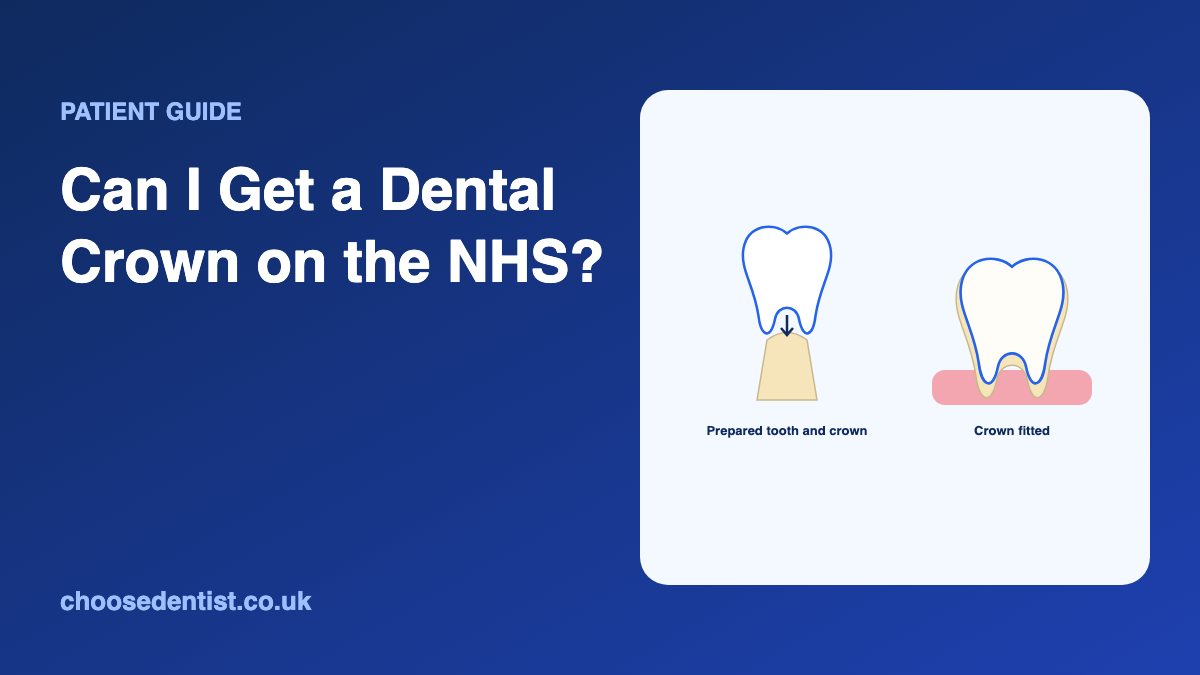
Yes. A dental crown is available on the NHS when a tooth needs one for health or function, such as after root canal treatment or when a tooth is badly broken or decayed. In England a crown is charged under band 3, the highest of the three charge bands, as a single charge for the whole course of treatment, and many people pay nothing because they are exempt. Purely cosmetic crowns, where a crown is wanted only to change appearance, are generally private.
The details of what is provided, which material you get and what happens if the crown fails depend on the nation you live in and on the practice. This guide sets out what the NHS says about a dental crown, how the charge works and what private care adds.
What the NHS says
The NHS says in its page on what NHS fillings and crowns are made of that crowns are usually made from metal, ceramic or porcelain fused to metal, that they cover a real tooth where it has broken, decayed or been damaged, or simply to improve its appearance, and that they are usually available on the NHS. Its page on dental treatments adds that crowns are usually available on the NHS, though you will probably wear a temporary one while the permanent one is made.
The NHS guide to how much NHS dental treatment costs places crowns, bridges and dentures in band 3, with orthodontic treatment, and says that if you need treatments from different bands you pay the charge for the highest.
| Nation | How NHS charges work | Crowns |
|---|---|---|
| England | Three bands plus an urgent charge | Band 3; guaranteed for 12 months with conditions |
| Scotland | Free examinations; free treatment under 26; others pay a share up to a maximum | Charged within the capped share for adults who are not exempt |
| Wales | Numbered bands plus an urgent charge; contract reform under way | Highest band, as in England |
| Northern Ireland | Generally a percentage of the dentist's fee up to a ceiling per course | Charged within the ceiling |
When the NHS provides a crown
A dentist offers a crown on the NHS when it is clinically necessary, for example after a root canal, where a large filling would not hold, where a tooth has cracked or where a tooth is worn down. The NHS says that a dentist will offer the most appropriate treatment according to your clinical needs. A crown requested only to improve the look of a healthy tooth is a cosmetic matter and is likely to be private.
The dentist decides on the material that is clinically appropriate on the NHS, and tooth-coloured options are commonly used on visible teeth, though the material is chosen by clinical need.

The 12-month guarantee
NHS crowns are guaranteed for twelve months. The NHS Business Services Authority explains on its page about guaranteed items that if a crown needs repair or replacement within twelve months of being fitted, you will not be charged, including if it is lost. The conditions include that it is the same treatment at the same practice, that there has been no private treatment on the same tooth, that the crown was not meant to be temporary, that no different restoration was advised and that the problem is not due to trauma.
After twelve months, repairs and replacement are charged under the usual rules, so a crown that fails in year three would be a new course of treatment.
Differences across the UK
Charging differs. England and Wales use numbered bands, and Wales is reforming its contract. Scotland provides free NHS examinations and free treatment for people under 26, while adults over 26 who are not exempt pay a capped share of the cost, as NHS Inform explains. Northern Ireland charges adults a percentage of the dentist’s fee up to a ceiling per course. Charging for NHS dentistry differs across the four nations. England has three bands and an urgent charge, with crowns, bridges and dentures in the highest band, Wales numbered bands and an urgent charge with a contract reform under way, Scotland free examinations and free treatment under 26 with a capped share of the cost for other adults, and Northern Ireland a percentage of the dentist’s fee up to a ceiling per course. The guarantee and the materials may also differ, so ask the practice what applies where you live.
Who pays nothing
In England, many people are entitled to free NHS dental treatment: children, young people in full-time education under 19, pregnant women, mothers of babies under twelve months, and people receiving certain benefits or on a low income. The NHS says that adults aged 18 or over usually pay an NHS contribution, and some groups may be exempt. It is worth checking before the appointment, and bringing proof.

Crown or large filling?
Dentists sometimes have a choice between a large filling and a crown. A filling is cheaper and removes less tooth, but a heavily filled tooth can crack, whereas a crown protects the whole tooth. On the NHS the dentist chooses the treatment that is clinically appropriate, and in England a filling falls in band 2 while a crown is band 3, which affects the charge. Asking why a crown is preferred, and whether a filling would do, is reasonable.
Temporary crowns and repairs
An NHS crown is usually preceded by a temporary one, which protects the tooth for about two weeks. If the temporary comes off before the fitting, phone the practice. After the permanent crown is in, the twelve-month guarantee covers repair or replacement under the conditions set by the NHS, and the practice should explain what to do if the crown loosens or breaks.
Is a cosmetic crown ever on the NHS?
Where a crown is needed to restore a broken or decayed tooth, the improved appearance is a bonus, not a reason for it to be private. The NHS describes crowns as covering teeth that have broken, decayed or been damaged, or to improve appearance, and says they are usually available on the NHS. Where the only reason is cosmetic, such as changing the colour or shape of a healthy tooth, the practice is likely to offer it privately, and the dentist should explain which applies.
Keeping your paperwork
After treatment, keep any treatment plan, receipt and note of the date the crown was fitted. If the crown fails within twelve months, this makes it easy to show that the guarantee applies, and to check that you are not charged. If you move practices, the guarantee requires the replacement to be done by the practice that carried out the original work, so you should return there where possible and ask for help if there is a dispute.
Private crowns
Private crowns are priced by the practice. As a rough guide, a crown commonly costs from about £500 to £1,000 or more per tooth, and zirconia, all-ceramic and gold crowns are at the higher end. Private care may offer more choice of material and appearance, digital impressions and same-day crowns, and the practice will set its own guarantee, which should be in writing.
Some patients have the clinical treatment on the NHS and pay a supplement for a more attractive material, if the practice offers that. The dentist must state clearly which part is NHS and which is private.
What to ask
Useful questions include why a crown is needed, which material is offered, whether it is NHS or private, what the charge is, how many visits it will take, what the guarantee is and what happens if it comes loose. A written treatment plan lets you compare.
The ChooseDentist directory of practices providing crowns can be searched by postcode, with CQC and Google ratings shown where available. Two practices can be compared side by side, and NHS availability and costs should be confirmed directly with the practice.
