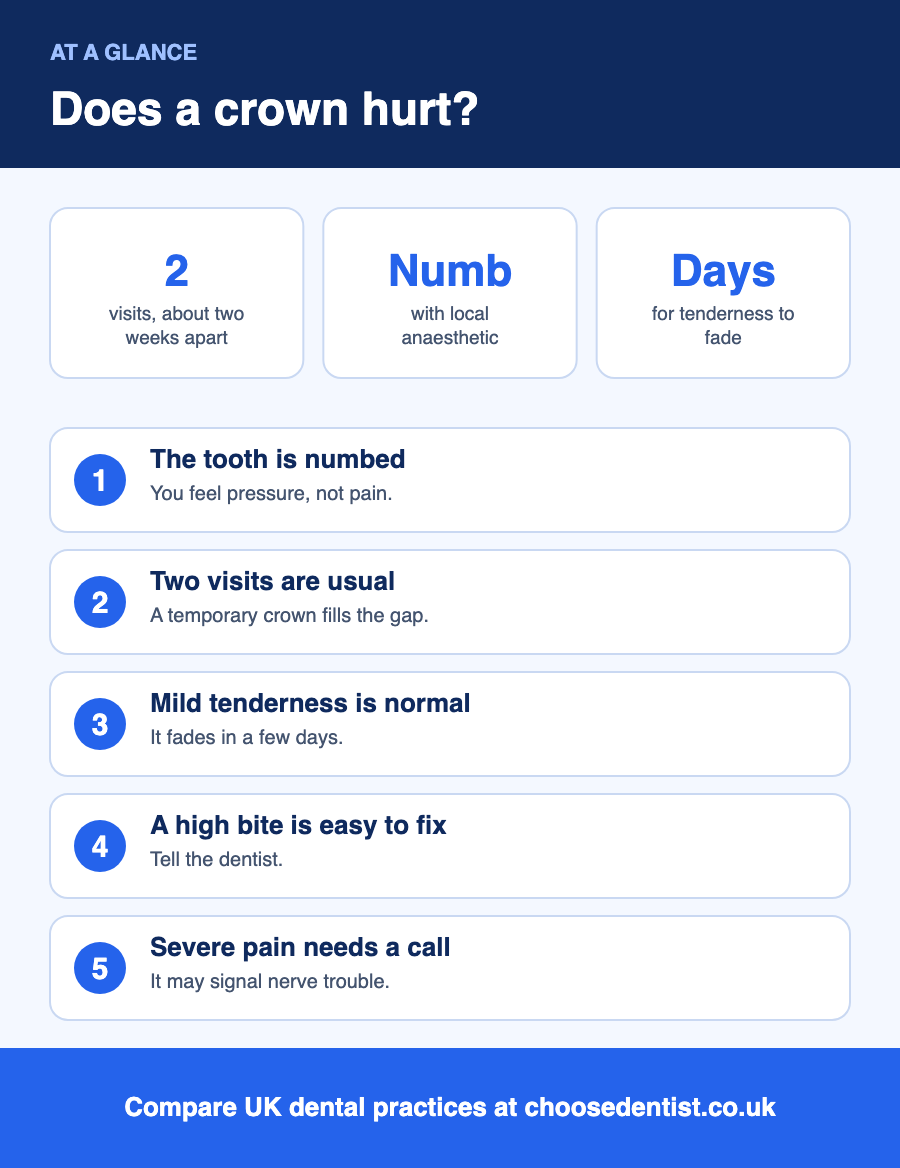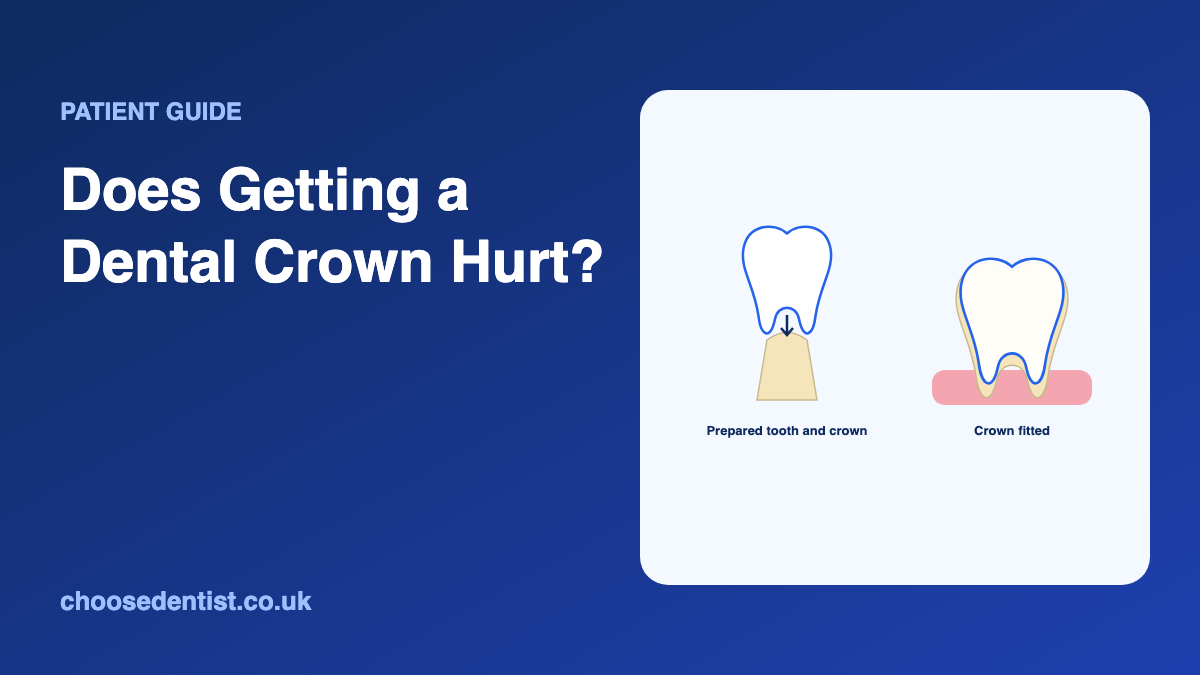
Getting a dental crown should not hurt, because the tooth and the surrounding gum are numbed with local anaesthetic before it is reshaped. The injection can sting for a moment, and you may feel pressure and vibration during the preparation, but not pain. The tooth and gum are often tender or sensitive for a few days afterwards, and a temporary crown can feel a little different from your own tooth, but these effects usually settle quickly.
Fear of the unknown makes the procedure seem worse than it is, and knowing the steps helps. This guide describes what happens at each visit for a dental crown, what you can expect to feel and what to do if something is not right.
The two visits
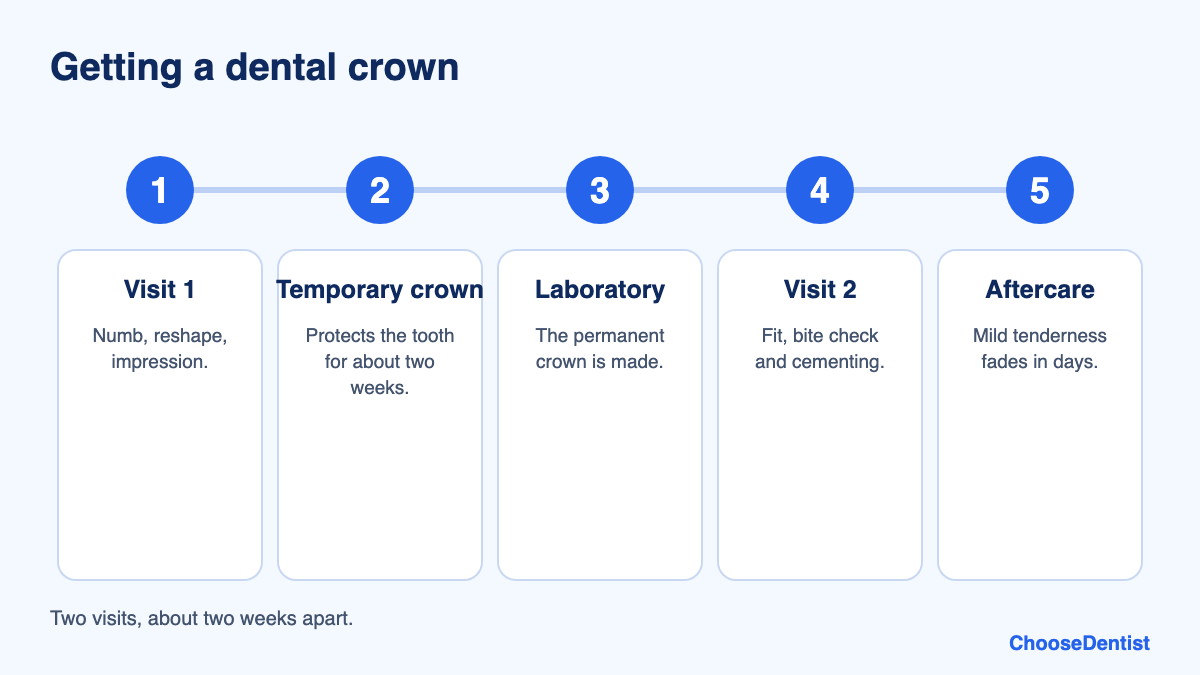
The Leeds Teaching Hospitals leaflet on crowns explains that two visits are usually needed. At the first, the tooth is reshaped, an impression is taken and a temporary crown is fitted. About two weeks later, the permanent crown is ready to be fitted, and the dentist checks the fit, shape, colour and bite before cementing it.
The leaflet notes that making a crown does involve the removal of some tooth structure, which is why the tooth is numbed. A crown improves a tooth’s appearance, strength and function.
| Stage | What you may feel | What helps |
|---|---|---|
| Anaesthetic injection | A brief sting | Numbing gel and a slow injection |
| Reshaping the tooth | Pressure, vibration and noise; no pain | Stop signal; breaks if needed |
| Temporary crown | Slightly bulky or sensitive | Avoid sticky and hard food; floss gently |
| Fitting the final crown | Pressure; bite feels different at first | Dentist adjusts the bite |
| First few days | Mild tenderness or sensitivity | Painkillers and desensitising toothpaste |
The first visit: preparation
After the anaesthetic has taken effect, the dentist uses a drill to reshape the tooth, removing decayed or weak parts and trimming the sides and top so that the crown will fit over it. You will feel vibration, hear the noise and may feel pressure, and water is sprayed to keep the tooth cool. If the nerve of the tooth is badly inflamed or the tooth has been root treated, the dentist adjusts accordingly, and the NHS notes that a crown may be needed after root canal treatment if the tooth was badly infected.
Next, an impression or digital scan records the shape for the laboratory, and a temporary crown, usually made of plastic, is fitted with weak cement. The visit commonly lasts around an hour.
The temporary crown
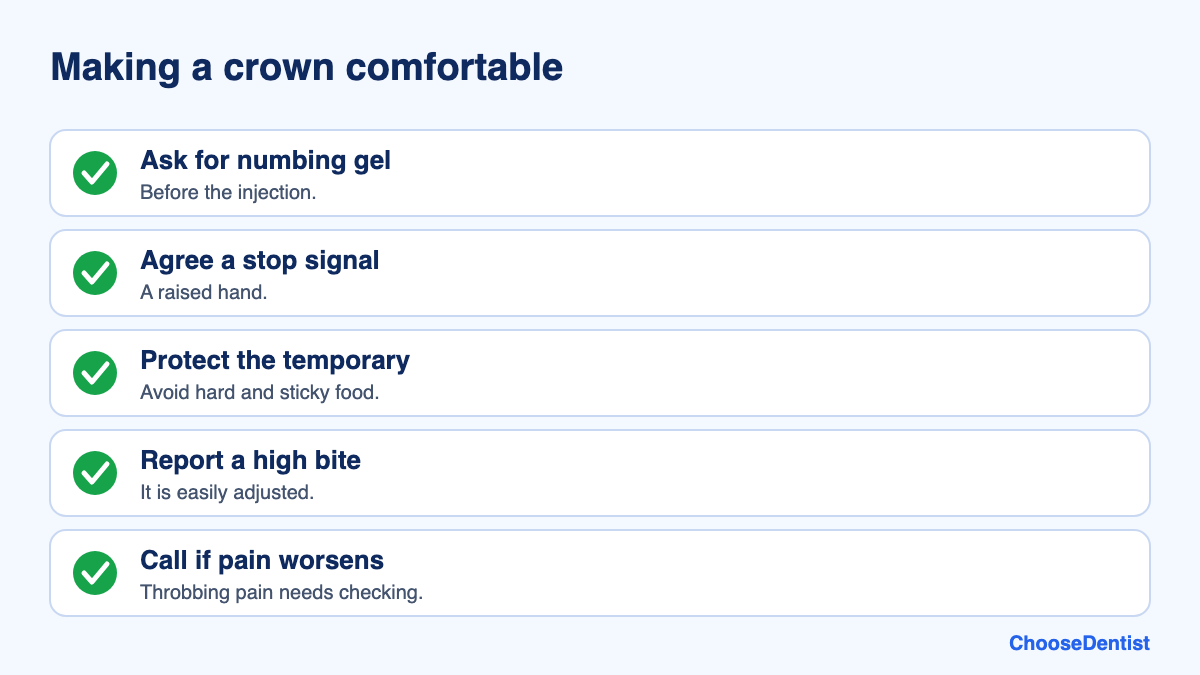
The temporary crown protects the prepared tooth and gum while the laboratory makes the final crown. It can feel slightly bulky and may be a little loose or sensitive, and it is less strong than the final one. Patients are advised to avoid sticky or hard food on that side, to brush carefully and to floss gently, pulling the floss out sideways, so as not to dislodge it.
If the temporary comes off, contact the practice promptly. Leaving the tooth uncovered can make it sensitive, and the tooth can shift so that the final crown does not fit.
The second visit: fitting
At the fitting visit, the temporary crown is removed, and the permanent crown is tried in. Local anaesthetic is sometimes not needed if the tooth is root-treated or not sensitive, but is often given. The dentist checks the fit, the contact with neighbouring teeth, the colour and how you bite, and adjusts as needed before cementing it. Biting feels slightly different for a short time as you adjust.
You can eat once the anaesthetic has worn off, though the dentist may advise avoiding very hard food for a day while the cement sets fully.
What you may feel afterwards
After the visit, mild tenderness around the gum and sensitivity to hot or cold are common for a few days, and the tooth may feel high or different when you bite. These normally fade. Painkillers such as paracetamol or ibuprofen, taken as directed, help, and desensitising toothpaste can ease sensitivity. If the crown feels high, the dentist can adjust it in minutes, and it is better to have it checked than to live with it.
When something is wrong
Contact the dentist if pain is severe, throbbing or getting worse, if the crown feels loose, if you have swelling or a bad taste, or if sensitivity lasts beyond a couple of weeks. Throbbing pain may mean the nerve of the tooth is inflamed or infected, and may call for root canal treatment. The NHS advises seeing a dentist urgently, or calling NHS 111, if a dental abscess is suspected.
Crowns for nervous patients
People who dread the procedure have options. Explaining the fear to the dentist allows them to go slowly, use numbing gel, agree breaks and explain each step. Some practices offer sedation, from laughing gas to intravenous sedation, and some offer same-day crowns made with digital scanning, which avoids messy impressions and a second visit. Our guide to inhalation sedation describes the gentlest option.
Eating and drinking
Once the numbness wears off, normal eating usually resumes. Avoid hot drinks and chewing until feeling returns, to prevent biting your cheek or tongue. With a temporary crown, choose soft food and avoid chewing gum and sticky sweets, which can pull it off. After the permanent crown is cemented, the dentist may suggest avoiding very hard foods for a day. Within a few days, most people forget which tooth was crowned.
Does a crown on a root-treated tooth hurt?
A tooth that has had root canal treatment has no living nerve in the canals, so it may feel less sensation during preparation, though the surrounding gum and ligament still feel pressure. These teeth are usually still numbed for comfort. If a tooth is painful before a crown is placed, or throbs afterwards, the dentist should check whether the root filling is sound, because problems under a crown can be hard to see. Reporting persistent pain early allows it to be treated.
Questions to ask beforehand
It helps to ask what will be done at each visit, how long each will take, whether the tooth will be numbed, what the temporary crown will be like and what to do if it comes off. Asking for the stages to be explained as you go makes the visit less daunting, and the dentist will normally pause whenever you need. A written aftercare sheet, with an out-of-hours number, is a sign of a well-organised practice.
NHS and private options across the UK
Crowns are available on the NHS where they are clinically needed, and the NHS says that crowns, with fillings, are usually available on the NHS, according to its page on dental treatments. In England a crown falls in the highest band. Charging for NHS dentistry differs across the four nations. England has three bands and an urgent charge, with crowns, bridges and dentures in the highest band, Wales numbered bands and an urgent charge with a contract reform under way, Scotland free examinations and free treatment under 26 with a capped share of the cost for other adults, and Northern Ireland a percentage of the dentist’s fee up to a ceiling per course. Anaesthetic is normally part of the treatment, and sedation, where available, may be charged separately.
Private crowns commonly cost from about £500 to £1,000 or more, and a practice may offer longer appointments, digital scans that avoid messy impressions, and same-day crowns made in the practice. Same-day crowns avoid a temporary stage, though not every tooth is suitable.
Easing the experience
If you are nervous, tell the dentist, agree a stop signal and ask about numbing gel and breaks. Sedation can be an option for anxious patients, and our guide to dental phobia explains the options.
The ChooseDentist directory of practices providing crowns can be searched by postcode, with CQC and Google ratings shown where available. Two practices can be compared side by side, and details of treatment and cost should be confirmed directly with the practice.