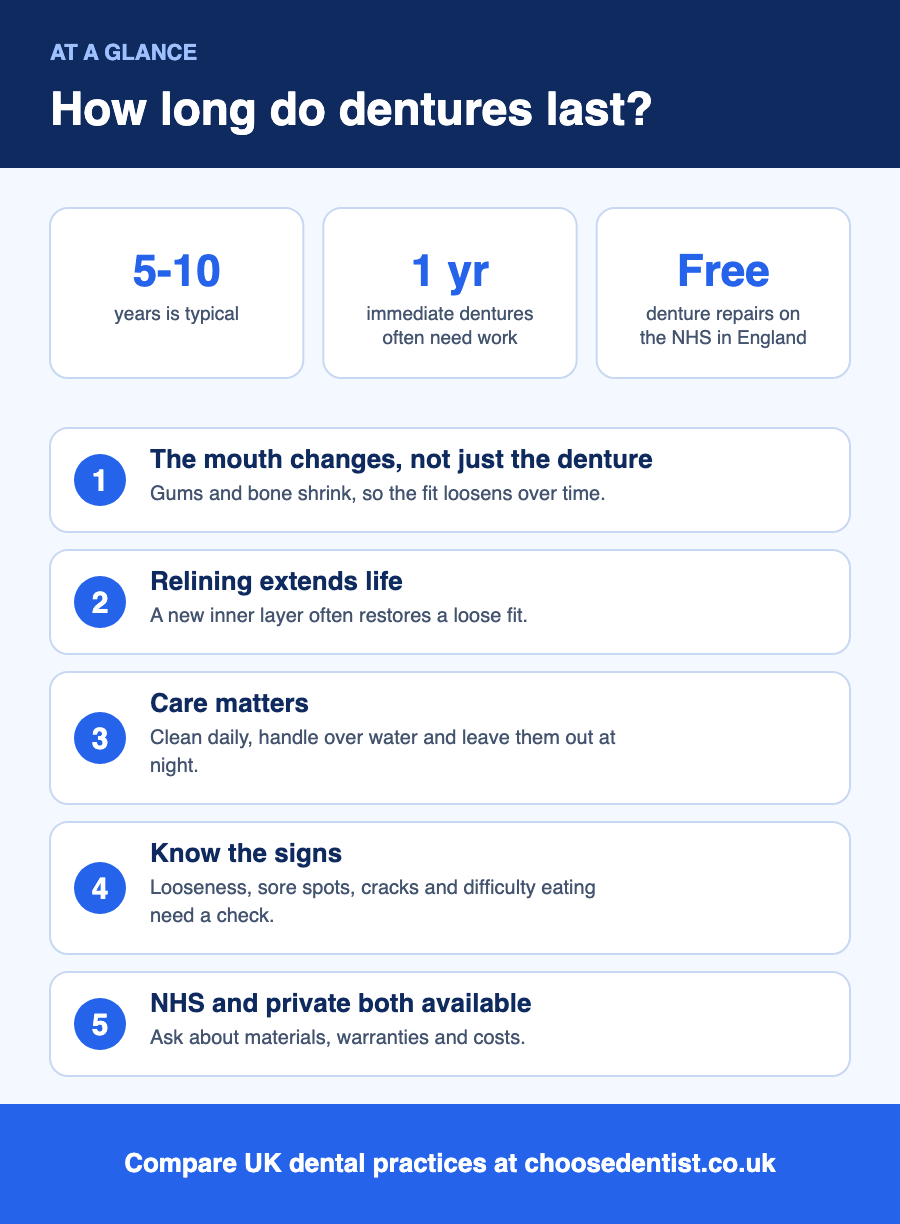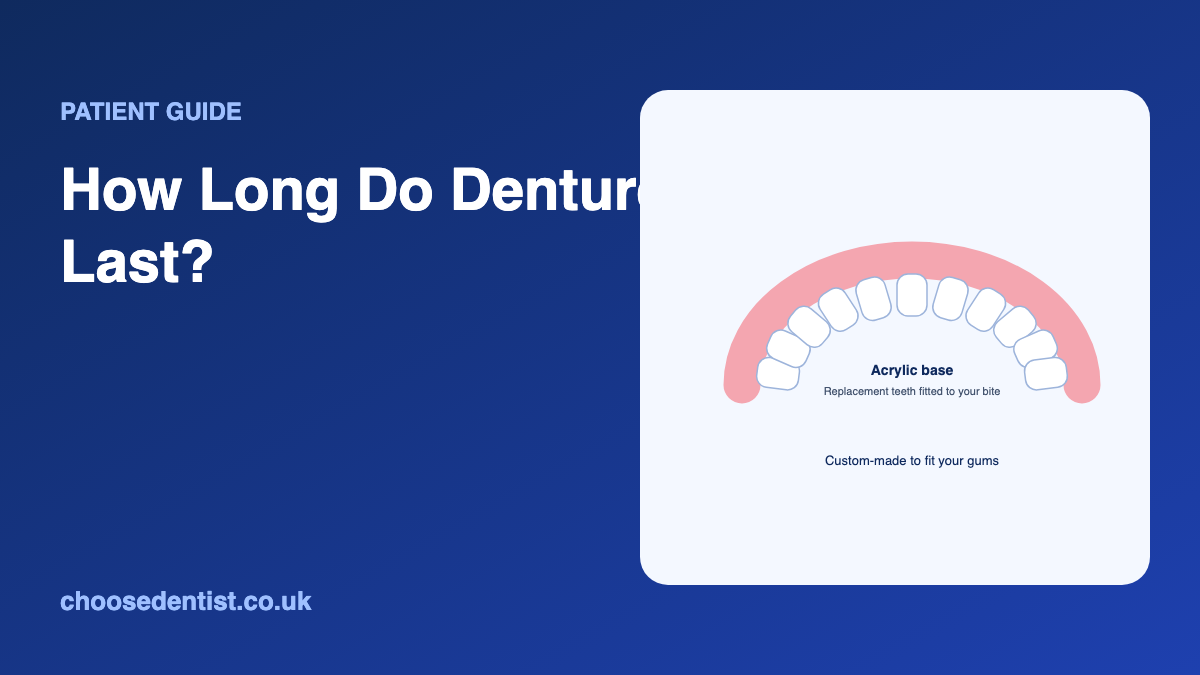
Well-made dentures commonly last for five to ten years before they need replacing, though some give good service for longer and others need attention much sooner. The denture itself is rarely what limits its life. It is the mouth that changes: gums shrink, the jawbone gradually remodels and the fit that was comfortable at the start slowly loosens, so that a denture can be in perfect condition and yet no longer suit the person wearing it.
That is why dentists talk in terms of review and adjustment as much as lifespan. A denture that is relined, repaired and checked at sensible intervals will usually outlast one that is left unattended, and wearing a loose denture for years can do more harm than good. This page explains what influences how long dentures last, how to look after them and what to expect on cost.
What the NHS says about lifespan
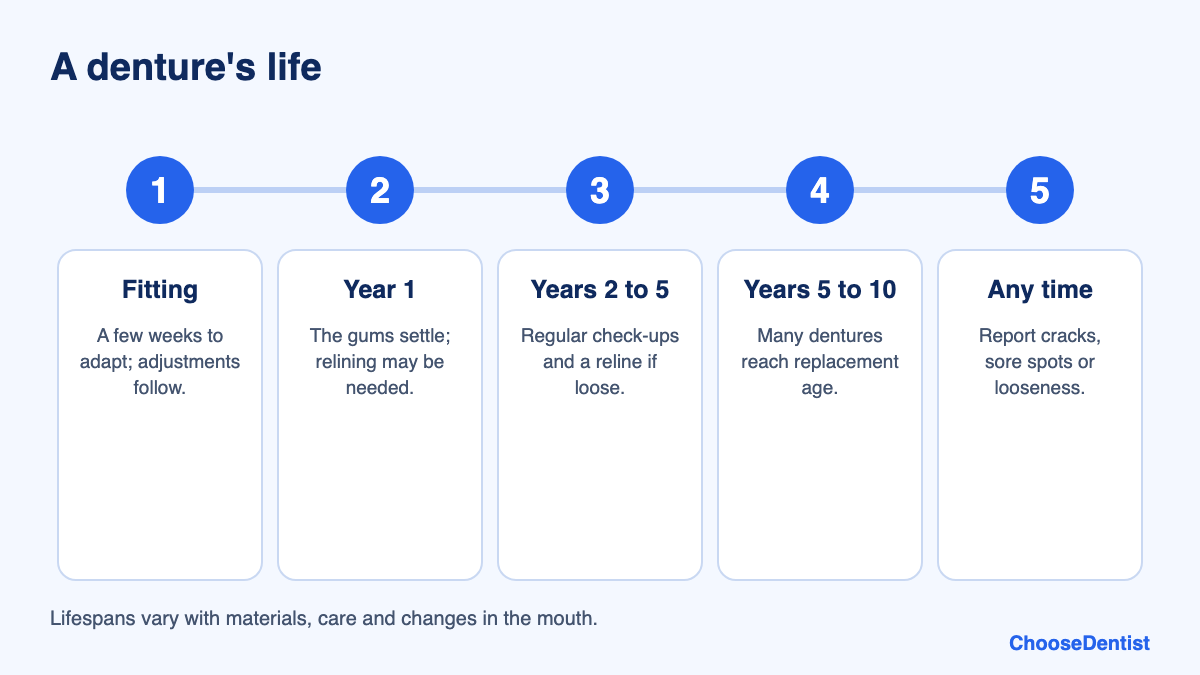
The NHS website states that, with proper care, dentures can last for years, and that gums and jawbone can shrink or change shape with age, so dentures may loosen, wear or become damaged. It stresses that regular dental visits are important so that problems are picked up. It also notes that so-called immediate dentures, which are made quickly to be fitted on the day teeth are removed, often need adjusting or replacing within a year, because the mouth changes shape as it heals.
The Wikipedia article on dentures adds some detail. It says heat-cured acrylic dentures are described as lasting for many years, whereas cold-cured ones are temporary and prone to cracking, and that premium heat-cured dentures are often warrantied against chipping and cracking for five to ten years. It also notes that well-fitting dentures can stay comfortable for decades, while poorly fitting ones speed up bone loss.
| Type of denture | Typical lifespan | Comments |
|---|---|---|
| Standard acrylic denture | Often 5 to 10 years with good care | Fit changes as gums and bone shrink; relines extend its life |
| Immediate denture | Often needs adjusting or replacing within a year | The mouth changes shape as it heals |
| Premium heat-cured denture | Warranties of 5 to 10 years are common | More durable and less likely to chip |
| Implant-supported denture | Fixtures often last for many years; attachments wear | Clips or attachments need periodic replacement |
| Cold-cured temporary denture | Short term only | Prone to cracking; used while waiting for a final denture |
Why the fit changes
Teeth do more than chew. Their roots stimulate the bone around them, and once the teeth are lost the bone that supported them gradually shrinks. The Wikipedia article says that edentulous jaw ridges tend to resorb progressively over the years, especially the lower jaw. The process is fastest in the first year or two after extractions and continues more slowly after that.
As the ridge shrinks, the denture sits lower and moves more, rubbing the gums and becoming harder to keep in place. Weight changes can alter the fit as well, and so can changes in saliva flow caused by medication. Lower dentures tend to be less stable than upper ones, because the tongue pushes against them and there is less surface for suction.
Relining, rebasing and repair
Fortunately, many of these changes can be dealt with without making an entirely new denture. A reline adds a fresh layer of acrylic to the inner surface so that it fits the gums as they are now, and this can often be done in a day or two at a dental laboratory. A rebase replaces the pink acrylic while keeping the teeth, which is useful when the base is worn but the teeth are in good shape. Cracks and broken teeth can usually be repaired, and the NHS notes that repairing dentures is always free on the NHS in England, though replacements are charged.
A denture that is chipped or loose, or that causes sore spots, should be seen promptly instead of being fixed at home with glue, which can damage it and the mouth. Home repair kits are not recommended.
Signs it is time for a new denture
A denture may need replacing when it is persistently loose despite relining, when the teeth are worn flat so that chewing is inefficient, when the acrylic is cracked or stained beyond cleaning, or when the appearance has changed with the shape of the face. Recurrent sore areas, fungal infections under the denture or difficulty eating are all reasons to book a check. The dentist will assess the gums, the bite and the denture itself, and will often take new impressions.
Many people simply stop wearing a poorly fitting denture, which can lead to a reduced diet and a loss of confidence, so it is better to ask for help than to put up with it.
Looking after dentures
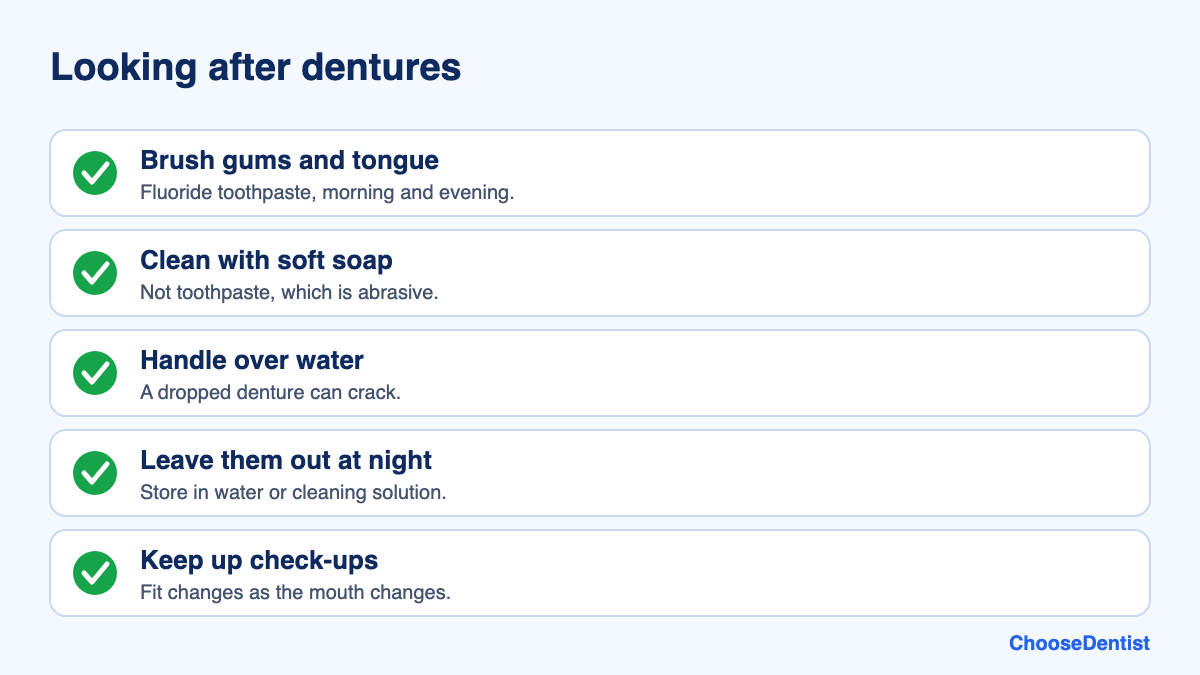
Daily care prolongs the life of a denture and protects the mouth. The NHS advises brushing gums, tongue and any remaining teeth with fluoride toothpaste morning and evening, cleaning the dentures themselves with soft soap or washing-up liquid and rinsing them after meals. Dentures should be handled over a basin of water or a folded towel in case they are dropped, taken out at night and stored in water or a denture-cleaning solution. They should not be cleaned with toothpaste, which is abrasive, and they should not be worn overnight unless the dentist has said so.
The Wikipedia article adds that plaque and tartar build up on dentures and that denture stomatitis, an inflammation of the tissue beneath, is a common complication, which is another reason for keeping them clean and leaving them out at night.
Habits that shorten a denture's life
Some everyday habits cause avoidable damage. Dropping a denture on a hard surface is the commonest way of cracking one, which is why handling it over a basin of water or a towel is advised. Cleaning with hot water can warp the acrylic, and abrasive toothpaste or stiff brushes scratch the surface, making it easier for stain and plaque to take hold. Using the denture to open bottles or crack nuts puts a strain on it that it was not designed for. Patients who grind their teeth may wear the artificial teeth down faster, and the dentist can suggest a protective approach.
What relines and replacements cost
On the NHS in England, a replacement denture is charged in the same band as a new one, whereas repairs are free, and the other nations have their own rules; the dentist can say how a reline would be charged. Privately, a reline commonly costs from around £100 to £300 and a replacement denture from a few hundred pounds upwards, depending on the type, and these figures vary by region. Asking whether the price of a new denture includes a reline in the first year is worthwhile, since the mouth is changing most quickly then.
NHS and private options across the UK
Dentures are available both on the NHS and privately. The NHS says an NHS dentist may offer dentures if they are needed to treat a dental problem, and that in England they fall under charge band 3, with some people qualifying for free treatment. Private dentures vary in cost depending on the type and materials, and private care offers a wider choice. Some NHS dentists offer upgraded types for an extra fee.
The other nations have their own systems. Wales uses numbered bands and an urgent charge, with a contract reform under way, Scotland provides free examinations and charges adults over 26 a share of the cost up to a maximum, and Northern Ireland charges a percentage of the dentist’s fee up to a ceiling. Private prices range from a few hundred pounds for a basic acrylic denture to several thousand for premium or implant-supported designs, and are set by each practice.
Getting the best from a denture
Replacing a denture on a regular schedule, whether through the NHS or privately, helps to keep chewing efficient and the mouth healthy. It is worth asking at the outset how long the denture is expected to last, what warranty applies, whether relines and repairs are included and what the cost of a replacement is likely to be.
The ChooseDentist directory of denture practices can be searched by postcode, with CQC and Google ratings shown where they are available, and two practices can be compared side by side. Details of NHS availability, costs and appointments should be confirmed with the practice.