
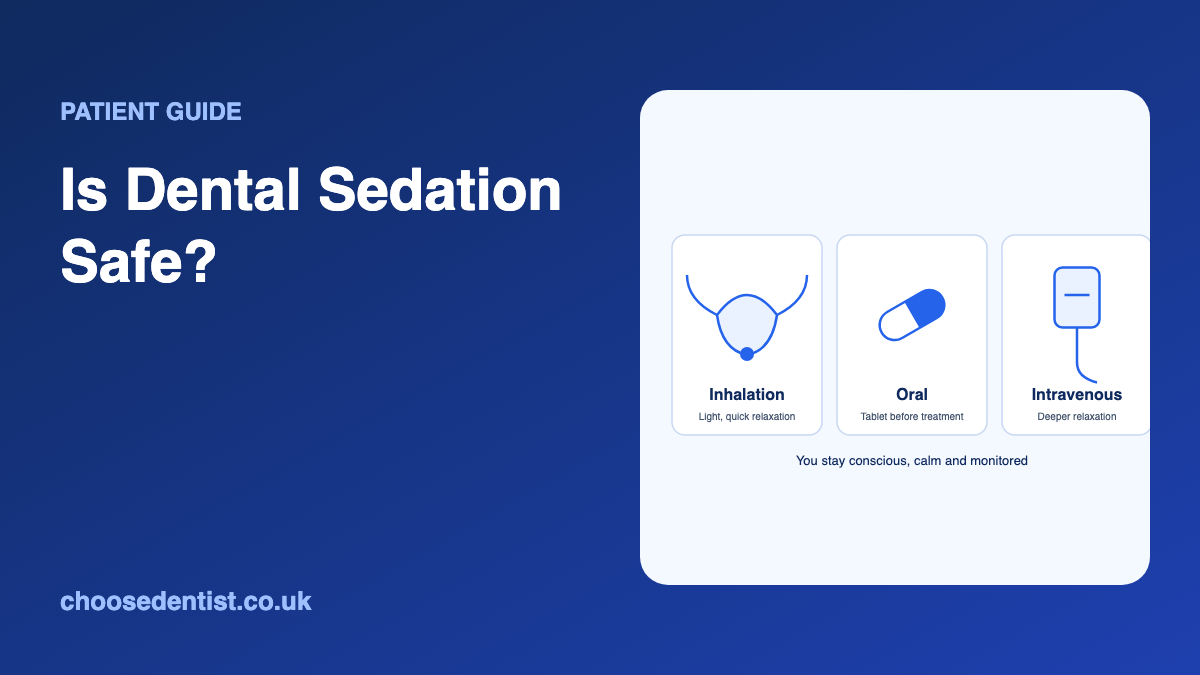
Dental sedation has a good safety record when it is provided by properly trained clinicians to patients who have been assessed beforehand, but no sedation is risk-free. The medicines used act on the central nervous system and can affect breathing and blood pressure, so safety depends less on the drug itself than on who gives it, how the patient is selected and how closely they are watched. That is why guidance places such emphasis on training, staffing, monitoring and emergency preparedness.
For a nervous patient, the risk of sedation also has to be weighed against the risk of avoiding care. The Wikipedia article on dental fear estimates that roughly one in six people is highly anxious about dental treatment, and avoidance leads to painful problems and emergency visits that in turn reinforce the fear. For many such people, dental sedation is what makes regular, safe care possible.
Possible side effects
Most side effects are minor and temporary. The Wikipedia article on sedation dentistry lists drowsiness, nausea, vomiting, dry mouth, headache and dizziness as the common ones. Less common effects include temporary memory loss, allergic reactions, bruising at the injection site and changes in breathing, heart rate or blood pressure. Inhalation sedation generally has the mildest profile and the quickest recovery, while intravenous sedation, which is deeper, has more potential for effects on breathing and therefore demands closer monitoring.
Memory loss, or amnesia, is often seen as a benefit by anxious patients but it can be disconcerting, and it means that a patient may not recall instructions given after the appointment. This is one reason why written aftercare advice is given to the patient and to the person who accompanies them.
| Safeguard | What it involves | Why it matters |
|---|---|---|
| Medical assessment | Health history, medicines, allergies and anxiety level | Identifies patients who need a hospital setting |
| Trained team | A suitably trained clinician and dental nurse | Someone can focus on the patient throughout |
| Monitoring | Pulse oximeter, blood pressure and observation | Detects changes in breathing or heart rate early |
| Emergency readiness | Oxygen, emergency drugs and life-support training | Allows a rapid response if something goes wrong |
| Aftercare | Escort, written advice and no driving that day | Keeps the patient safe while the effects wear off |
What makes sedation safer
The first safeguard is a proper assessment. Before sedation, the dentist should take a detailed medical history, ask about medicines, allergies, alcohol use and previous experiences with anaesthesia, and decide whether sedation in a dental practice is appropriate. The Wikipedia article notes contraindications such as upper airway obstruction and severe systemic illness affecting breathing or circulation, and patients with complex medical conditions may be better treated in a hospital setting.
The second is monitoring. The article stresses that continuous monitoring of vital signs is crucial during sedation and during recovery, covering consciousness, oxygen saturation, breathing, heart rate and blood pressure, using equipment such as a pulse oximeter and a blood pressure monitor. It also says that facilities should have emergency equipment available and staff who are trained in basic life support.
The third is a suitably trained team. The guidance from the Scottish Dental Clinical Effectiveness Programme sets out the staffing, training and environment expected for conscious sedation, and is widely used by clinicians across the UK as the standard to work to.

Preparing for sedation
Patients play a part in keeping sedation safe. They will be asked to follow instructions about fasting, which the Wikipedia article gives as generally six hours after a light meal and eight hours after a fatty one for techniques where this applies, although the practice’s own advice takes priority. Medicines should be taken as directed by the dentist, alcohol avoided and any change in health, such as a cold or a chest infection, reported before the appointment, since it may be wiser to postpone.
For oral and intravenous sedation, a responsible adult should accompany the patient and stay with them for the rest of the day. Driving, operating machinery, signing legal documents and drinking alcohol should be avoided until the following day, and patients should rest at home.
Regulation and inspection
Sedation is overseen by the same bodies that regulate dentistry in general. Every dentist must be registered with the General Dental Council, and dental practices in England are regulated and inspected by the Care Quality Commission, which publishes its reports and ratings online. The other nations have their own inspectorates: Healthcare Inspectorate Wales, Healthcare Improvement Scotland and the Regulation and Quality Improvement Authority in Northern Ireland. Reading these reports gives an independent view of how a practice operates.
A practice that offers sedation should be happy to explain who will carry it out, what training they hold, what monitoring is used and how emergencies are handled. Hesitancy about any of these points is a warning sign.

Who needs extra care
Some groups need particular attention. Older patients, people with heart or lung conditions and those who are significantly overweight or have sleep apnoea may be more sensitive to the breathing effects of sedatives, and a dentist may choose a lighter technique or refer to a hospital setting. Combining sedation with alcohol or with other sedating medicines, including some sleeping tablets and painkillers, can increase the effect. Pregnant patients are generally advised to avoid elective sedation, and any treatment that can safely wait is often deferred.
If you feel unwell afterwards
Mild drowsiness, a headache or slight nausea can follow sedation and usually wear off within hours. Patients are given a contact number and should use it if they feel unusually sleepy, are repeatedly sick, have difficulty breathing or are very dizzy. Resting, sipping water and eating something light help most people, and it is best not to make important decisions until the following day. A responsible adult staying with the patient is the best safeguard in the first hours.
Sedation alongside other support
Sedation treats the symptom of anxiety on the day, not its cause. The Wikipedia article on dental fear describes cognitive behavioural therapy as appearing to reduce dental fear and to increase how often people attend, and notes that short-term methods alone often fail because many patients return to avoidance. Some people therefore combine sedation for a necessary course of treatment with talking therapy or a gradual approach to routine visits, so that they are eventually able to attend without it. A dentist can advise on local services, and some practices work with clinical psychologists.
NHS and private options across the UK
Sedation is available through both routes. Private practices commonly charge a separate fee for sedation on top of the dental treatment, and prices differ with the technique, the length of the appointment and the practice. Within the NHS, patients with severe anxiety, medical complexity or special needs are often seen by community or hospital dental services after referral from a general dentist, and the availability of sedation in ordinary NHS practices varies.
The charges for NHS dental treatment differ between nations: England and Wales use numbered bands and an urgent charge, Scotland provides free examinations and charges a share of the cost up to a limit to most adults over 26, and Northern Ireland charges a percentage of the dentist’s fee up to a ceiling. Patients should ask whether any extra fee applies for sedation and how long the wait for a referral is likely to be.
Choosing a practice you trust
A practice that treats safety seriously is generally transparent about it. It will assess a patient properly, explain risks without minimising them and give clear before-and-after instructions. Patient comments on review sites can show whether nervous patients felt looked after.
The ChooseDentist directory of sedation practices lets visitors search by postcode, check CQC and Google ratings where they are available and compare two practices side by side. Details of the sedation service, the team and the cost should be confirmed directly with the practice.
