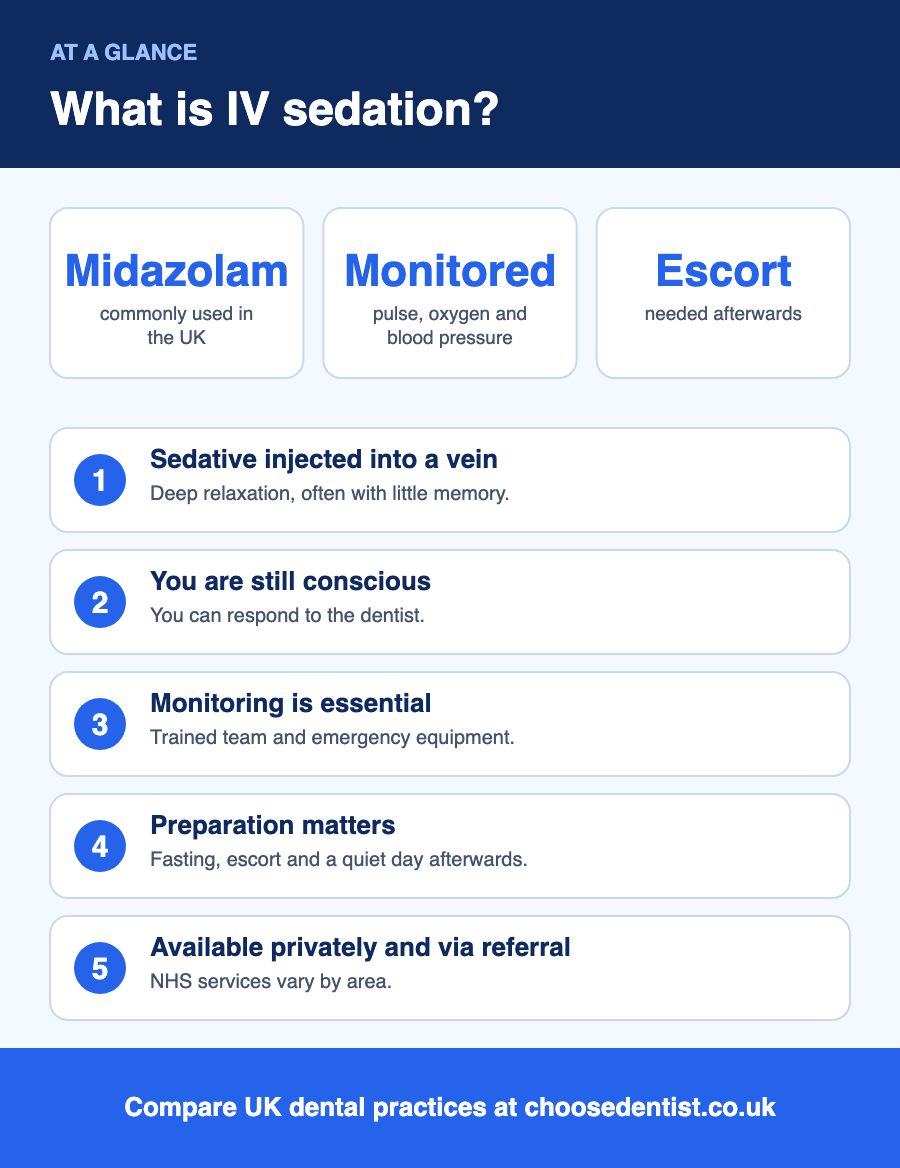
Intravenous sedation, or IV sedation, is a form of conscious sedation in which a sedative medicine is injected through a small needle into a vein in the hand or arm. It produces a deeper level of relaxation than inhalation sedation, usually leaves patients with little memory of the treatment and can be adjusted during the appointment. Patients remain able to respond, so it is not a general anaesthetic, but many feel as though they have slept through the visit.
It is used for people with moderate to severe dental anxiety, for longer or more complex procedures and for those who cannot cope with treatment in any other way. Because it is a stronger technique, it carries additional safety requirements, and it is dental sedation that should be provided only by suitably trained clinicians.
How it works
The Wikipedia article on sedation dentistry explains that intravenous sedation uses mainly midazolam in the UK, a benzodiazepine that depresses the central nervous system and induces relaxation and amnesia. The dentist or sedationist places a small cannula in a vein, delivers a carefully measured dose and then adds small amounts until the patient reaches the desired level. Because it is given directly into the bloodstream, it acts within a minute or two.
The article defines conscious sedation as a state of depression of the central nervous system that enables treatment to be carried out, with verbal contact with the patient maintained throughout. In practice, the patient may be drowsy and slow to respond, but can answer questions and follow instructions.
| Feature | IV sedation | Notes |
|---|---|---|
| How it is given | Midazolam injected into a vein | Dose adjusted during treatment |
| Level | Deeply relaxed; often little memory | Patient can still respond |
| Monitoring | Oxygen, pulse and blood pressure continuously | Trained team and emergency equipment |
| Before | Fasting advice; escort arranged | Follow the practice's instructions |
| After | Drowsy for hours; no driving that day | Responsible adult should stay |
| Typical private cost | From a few hundred pounds per session | Additional to treatment |
What it feels like
Most people describe a heavy, drifting feeling, followed by a hazy memory of the appointment. They may feel sleepy, their speech may become slow and the dental work often seems to pass in an instant. Because midazolam causes amnesia, many patients remember very little afterwards, which is considered a benefit for those with a history of fear.
Local anaesthetic is still given to numb the teeth, and sedated patients are generally unaware of the injection. The only part many remember is the cannula, which can pinch briefly. Afterwards, patients feel groggy and should expect to rest for the remainder of the day.
Monitoring and safety
IV sedation affects breathing and blood pressure, so careful monitoring is essential. The Wikipedia article states that continuous monitoring of vital signs is crucial during sedation and recovery, covering consciousness, oxygen saturation, ventilation, heart rate and blood pressure, using equipment such as a pulse oximeter and a blood pressure monitor, and that emergency equipment and staff trained in basic life support should be available.
The standards for the team and the environment are set out in guidance such as that of the Scottish Dental Clinical Effectiveness Programme, which is widely used across the UK. A practice offering IV sedation should be able to explain who will give the sedation, who will monitor the patient, what training they have and how emergencies are handled.

Who may not be suitable
The same article lists upper airway obstruction and severe illness affecting breathing or circulation among the contraindications, and other medical conditions, medicines and alcohol use also matter. Patients who are pregnant, who have certain lung, heart or kidney conditions, or who take other sedating medicines may need a different approach or hospital care. A full medical history is taken beforehand, and honesty is essential.
Before the appointment
Preparation is more involved than for laughing gas. Patients are usually given fasting instructions, commonly several hours without food, though the practice’s own advice takes precedence, and are asked to take their regular medicines unless told otherwise. They must arrange for a responsible adult to take them home and stay with them, avoid alcohol and not plan to drive, work or make important decisions that day.
Recovery and aftercare
After treatment, the patient rests in the surgery until the dentist is satisfied that it is safe to leave. They will feel drowsy for several hours and may be unsteady. They should not drive, use machinery, drink alcohol or sign legal documents until the next day, and a responsible adult should stay with them. Most people feel normal by the following day, and written aftercare instructions are normally provided.

Types of treatment it is used for
IV sedation is often chosen for longer or more demanding procedures, such as wisdom tooth removal, implant surgery, multiple extractions or several fillings in one visit, as well as for patients whose fear makes any treatment difficult. Because the effect lasts for the duration of the appointment and many patients remember little, it can allow a whole course of treatment to be completed in fewer visits. It is not usually necessary for simple check-ups, and a dentist should consider less intensive options first.
The role of the sedation team
A safe IV sedation service involves more than one person. The clinician who provides the sedation must be trained in the technique, and a second suitably trained person, usually a dental nurse, assists and monitors the patient, so that the operating dentist can concentrate on treatment. The practice should have appropriate monitoring equipment, emergency drugs and oxygen and should rehearse emergency procedures. Patients can ask who will be performing each role and what training they hold.
How much memory is lost
Amnesia varies between patients. Many remember nothing of the treatment, some recall parts of it as a blur and a few remember a good deal. The memory loss is usually a benefit for anxious patients, though it also means that instructions given on the day may be forgotten, so written aftercare is vital. If a patient is anxious about losing awareness or control, discussing this at the assessment helps, and a trial or a lighter level of sedation can be considered.
NHS and private options across the UK
Intravenous sedation is available privately in many practices and through some NHS services. Sedation within the NHS is mainly provided through referral to community or hospital dental services for patients with severe anxiety, medical complexity or special needs, and availability in ordinary NHS practices varies, so it is worth asking the dentist and checking whether any extra charge applies. Charging for NHS dentistry differs across the four nations. England has three bands and an urgent charge, Wales numbered bands and an urgent charge with a contract reform under way, Scotland free examinations and free treatment under 26 with a capped share of the cost for other adults, and Northern Ireland a percentage of the dentist’s fee up to a ceiling. Private fees vary with the length of the appointment and the practice, and IV sedation commonly costs from a few hundred pounds per session, on top of the cost of the dental treatment.
Questions to ask
Useful questions include who will provide the sedation and what training they hold, how the patient will be monitored, whether an escort is required, what the fasting instructions are, how the cost is calculated and what happens if the sedation is not deep enough. A good practice offers a pre-assessment appointment and is happy to answer each of these.
Finding a practice
Practices that offer IV sedation should be registered with the relevant regulator, and in England the Care Quality Commission publishes inspection reports. Reviews from other anxious patients give a good picture of how the team behaves.
The ChooseDentist directory of sedation practices can be searched by postcode, with CQC and Google ratings displayed where available. Two practices can be compared side by side, and the details of the sedation service should be confirmed with the practice.