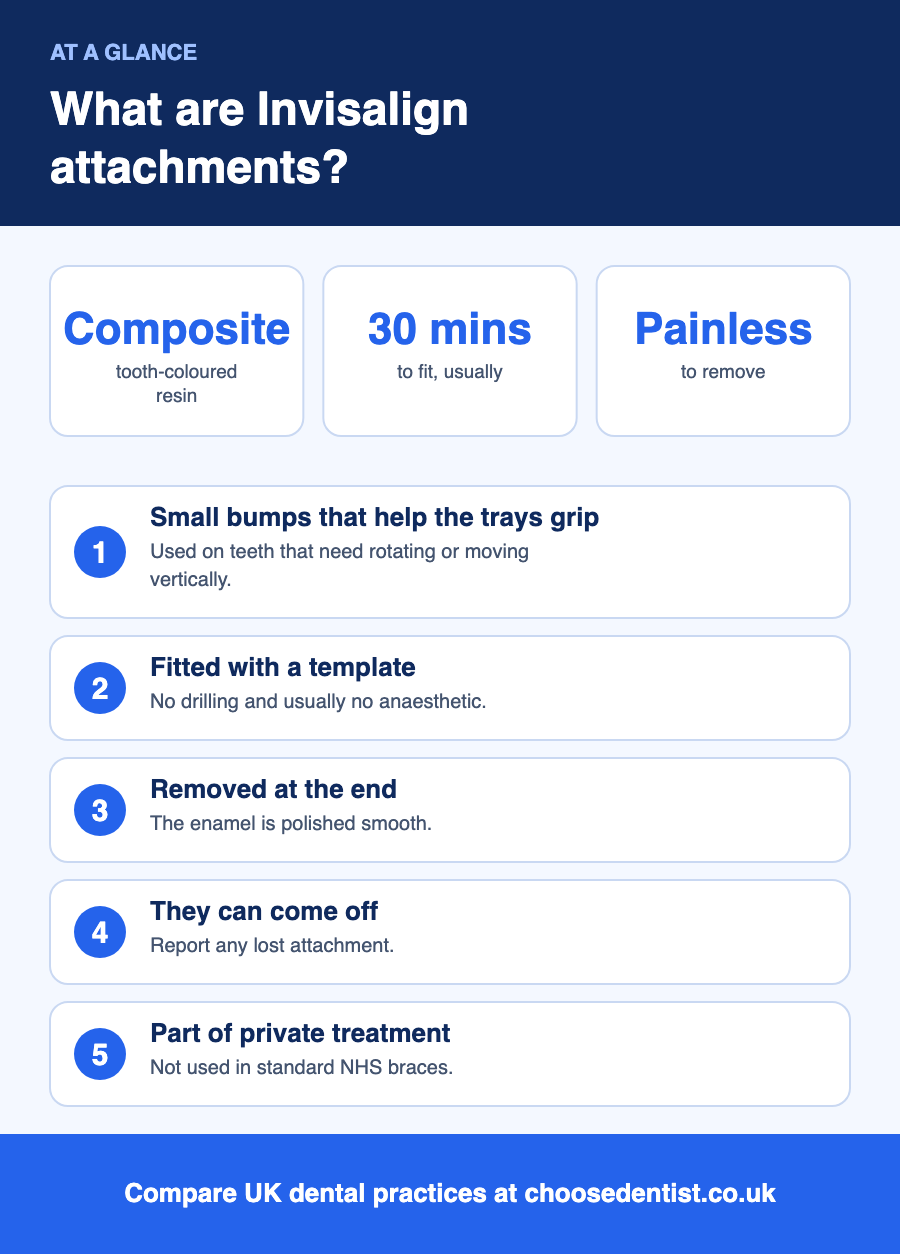
Attachments are small, tooth-coloured shapes of composite resin that are bonded to selected teeth during clear aligner treatment, giving the plastic trays something to push against. They look like tiny bumps, they are made of the same type of material as a white filling, and they are removed at the end of treatment without damaging the tooth. Many patients are surprised to learn about them, but they are a routine part of aligner treatment.
Their purpose is to help the aligners do things that a smooth plastic tray cannot manage on its own. Understanding what they are for, how they are fitted and how they affect daily life removes a good deal of the mystery.
Why attachments are needed
The Wikipedia article on clear aligners explains that plastic is less rigid than metal, so some movements need compensation through attachments. A smooth tooth is difficult for a tray to grip, especially when it has to be rotated or moved vertically, and an attachment gives the aligner a ledge to apply force against.
The article notes that attachments may be bonded to teeth needing rotation or extrusion, and that having more of them can reduce the aesthetic advantage of the system. Not every patient needs them, and simple cases may need few or none.
| Aid | What it does | Notes |
|---|---|---|
| Attachment | Gives the aligner a ledge to push against | Tooth-coloured composite; removed at the end |
| Interproximal reduction | Creates a little space between teeth | A very thin layer of enamel is polished |
| Button for elastics | Holds elastics between upper and lower teeth | Helps correct the bite |
| Precision cut in the aligner | Allows an elastic to be attached | Planned with the digital model |
How they are fitted
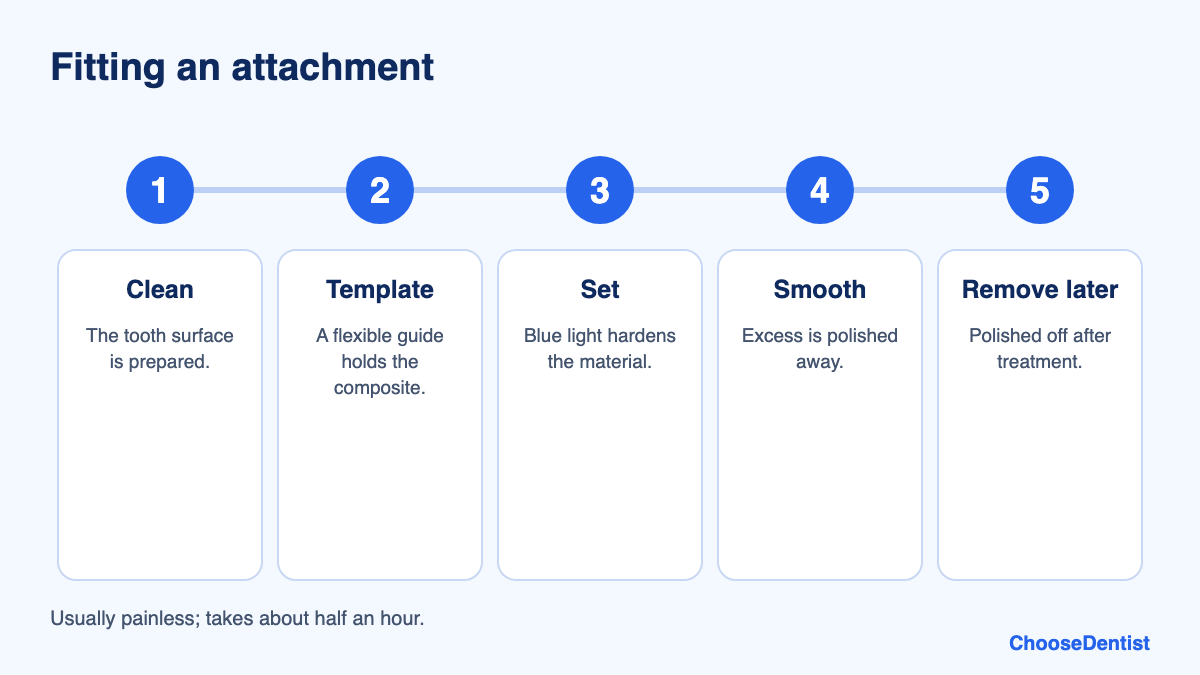
Fitting is quick and usually painless. The dentist cleans the surface of the tooth and applies a template, a flexible plastic guide that holds the composite in the correct shape and position. The composite is set with a blue light, the template is removed and any excess is smoothed. There is normally no drilling and no anaesthetic, and the whole process takes about half an hour.
The positions and shapes are planned in advance on the digital model, so each attachment is designed for the movement it will assist. Some are rectangular or wedge-shaped, others are rounded, and they are placed on the teeth that need the most guidance.
How they feel and look
Attachments are the same colour as the tooth and are less obvious than a bracket, though they can be seen up close. Some patients notice them with the tongue for the first few days, and the trays may feel tighter at first. Because they provide extra grip, the aligners can feel a little more snug when first fitted, and removing them may need a bit more care, with a fingertip at the back of the tray.
Attachments can attract stain a little more than the tooth surface, so brushing carefully around them and avoiding dark drinks with the trays out helps keep them looking natural.
Other aids used alongside attachments
Attachments are not the only technique. Interproximal reduction, in which a very thin layer of enamel is polished from the sides of teeth to create space, is sometimes used to allow crowded teeth to align, and the Wikipedia article mentions it as a way of achieving a better fit. Buttons bonded to teeth can hold elastics between the upper and lower arches to correct the bite, and precision cuts in the aligners serve a similar purpose.
These aids are decided as part of the treatment plan, and a patient should understand which are proposed and why.
Taking attachments off
At the end of treatment, the attachments are removed. The dentist polishes them away with fine instruments, leaving the tooth surface smooth, and then often finishes with a polish. The process is usually painless and quick. The enamel underneath is typically undamaged, although the surface may feel slightly different for a short time.
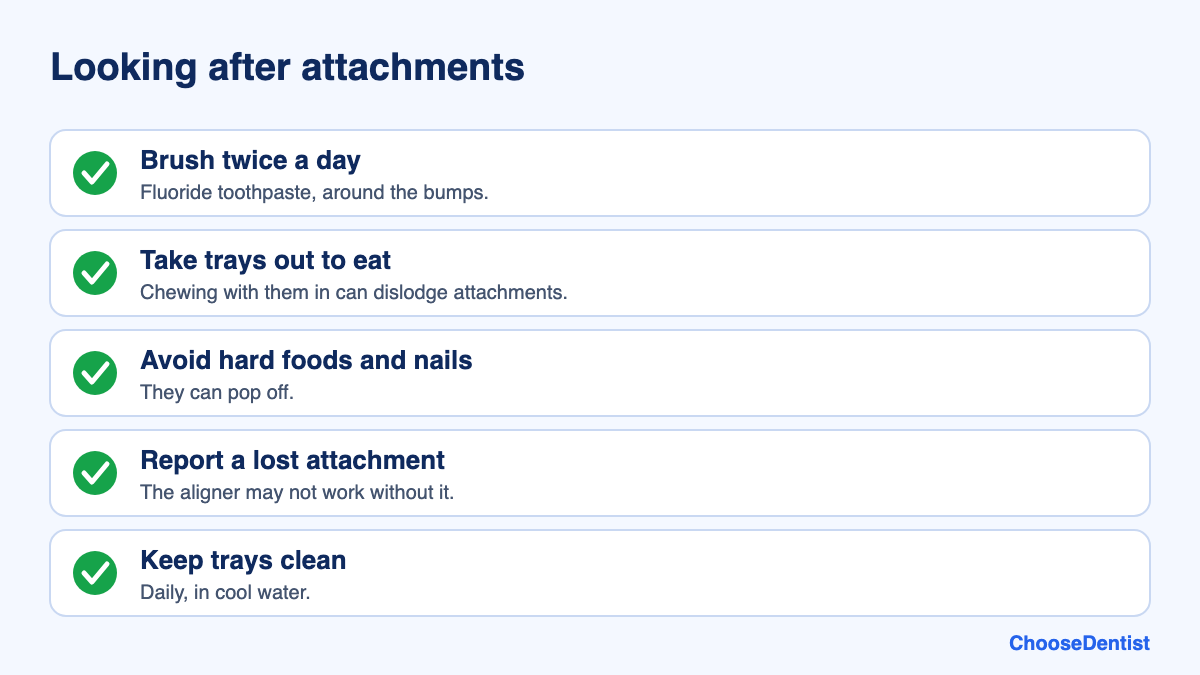
Attachments may come off during treatment if the bond fails, particularly if the patient chews on the trays or eats with them in. A lost attachment should be reported, since the aligners may not work properly without it, and the practice can usually replace it at a review.
Caring for attachments
Care is straightforward. Brushing twice a day with fluoride toothpaste, cleaning between the teeth, and taking the trays out to eat and drink anything but water protect both the teeth and the attachments. Patients should avoid biting hard foods and nails, which can dislodge them, and should keep the trays clean.
Are attachments noticeable?
Attachments are intended to blend in, but they are visible at close range, and the effect depends on where they are placed and how many there are. On the front teeth they are more noticeable than on the back ones. The colour is matched to the tooth, though it can change slightly over time, and some patients find that their appearance is less discreet than expected. This should be discussed at the start, because the number and position of attachments are part of the plan and can sometimes be adjusted.
Do attachments damage the teeth?
When they are fitted and removed properly, attachments should not harm the enamel. The composite is bonded to the surface and polished off afterwards, and the surface may be slightly rougher for a short time. Poor cleaning around attachments can allow plaque to collect, which is a greater risk than the attachment itself, and so careful brushing is important. Patients who notice a rough area or a persistent mark after removal can ask the dentist to polish it further.
Why some treatments need more than others
The number of attachments depends on the movements required. A simple case may need two or three, whereas a complex one may need many more, along with buttons for elastics. The plan shows where each will go, and patients can ask the clinician to explain what each is for. Understanding the logic helps to explain why some people need more visits and more time for fitting.
Questions to ask about attachments
At the planning stage, patients can ask how many attachments are expected, where they will be placed and whether they will be on visible teeth. It is also worth asking how long they will stay on, what happens if one comes off and whether replacements are covered in the price. Seeing the digital plan with the attachments marked helps to visualise the final appearance, and gives an opportunity to raise any concerns about how noticeable they will be.
NHS and private options across the UK
Attachments are part of private aligner treatment and do not usually apply to NHS orthodontics, which generally uses fixed braces for eligible patients under 18. The NHS explains on its page about braces that fixed metal braces are commonly used. Charging for NHS dentistry differs across the four nations. England has three bands and an urgent charge, Wales numbered bands and an urgent charge with a contract reform under way, Scotland free examinations and free treatment under 26 with a capped share of the cost for other adults, and Northern Ireland a percentage of the dentist’s fee up to a ceiling. Private aligner treatment typically costs from about £2,500 to £5,500, and the price normally includes attachments, though it is worth checking whether replacements are covered.
Asking the right questions
Patients can ask how many attachments are planned, where they will go, whether interproximal reduction is expected, how they will be removed and whether replacements are included. A clinician who explains these points at the start is usually well organised.
The ChooseDentist directory of practices offering clear aligners can be searched by postcode, with CQC and Google ratings displayed where available. Two practices can be compared side by side, and details of treatment should be confirmed directly with the practice.