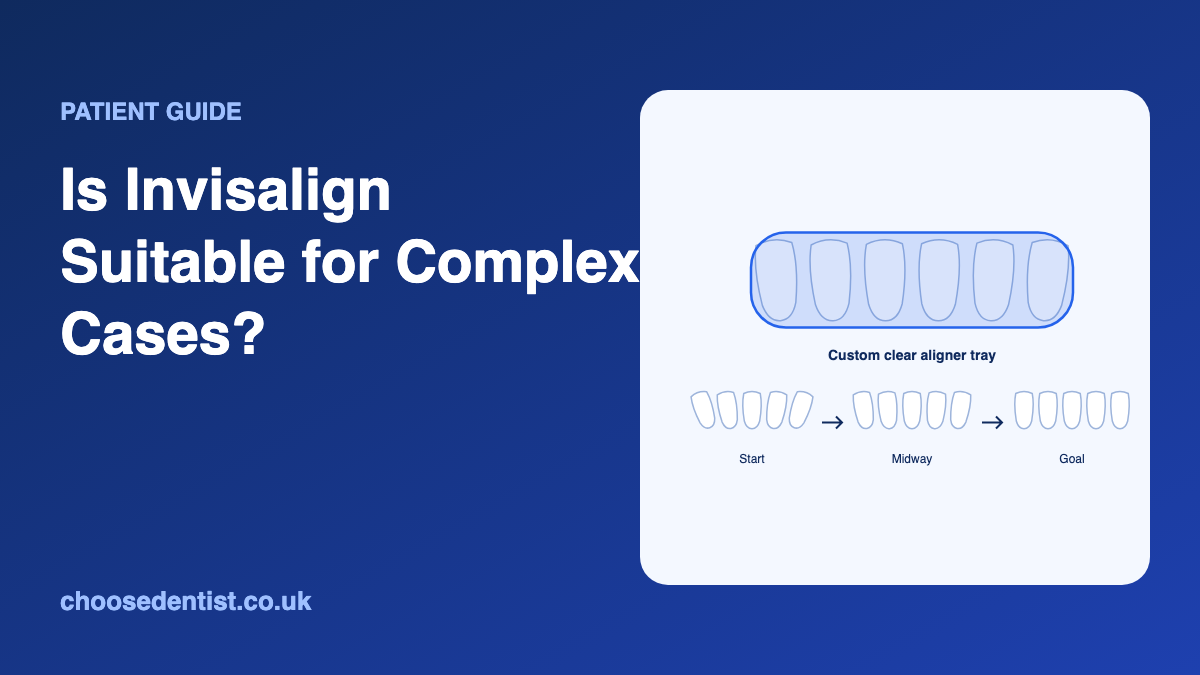
Clear aligners can treat a wider range of problems than they once could, and many complicated cases are now managed successfully, but there are limits, and some movements are still handled better by fixed braces. Whether clear aligners are suitable for a particular patient depends on the type of problem, the skill of the clinician and the willingness of the patient to wear the trays consistently.
The word complex covers many situations, from severe crowding and rotated teeth to a bite in which the jaws do not meet properly. Understanding which of these aligners handle well, and which they handle less well, makes it easier to have an informed discussion with an orthodontist.
What aligners do well
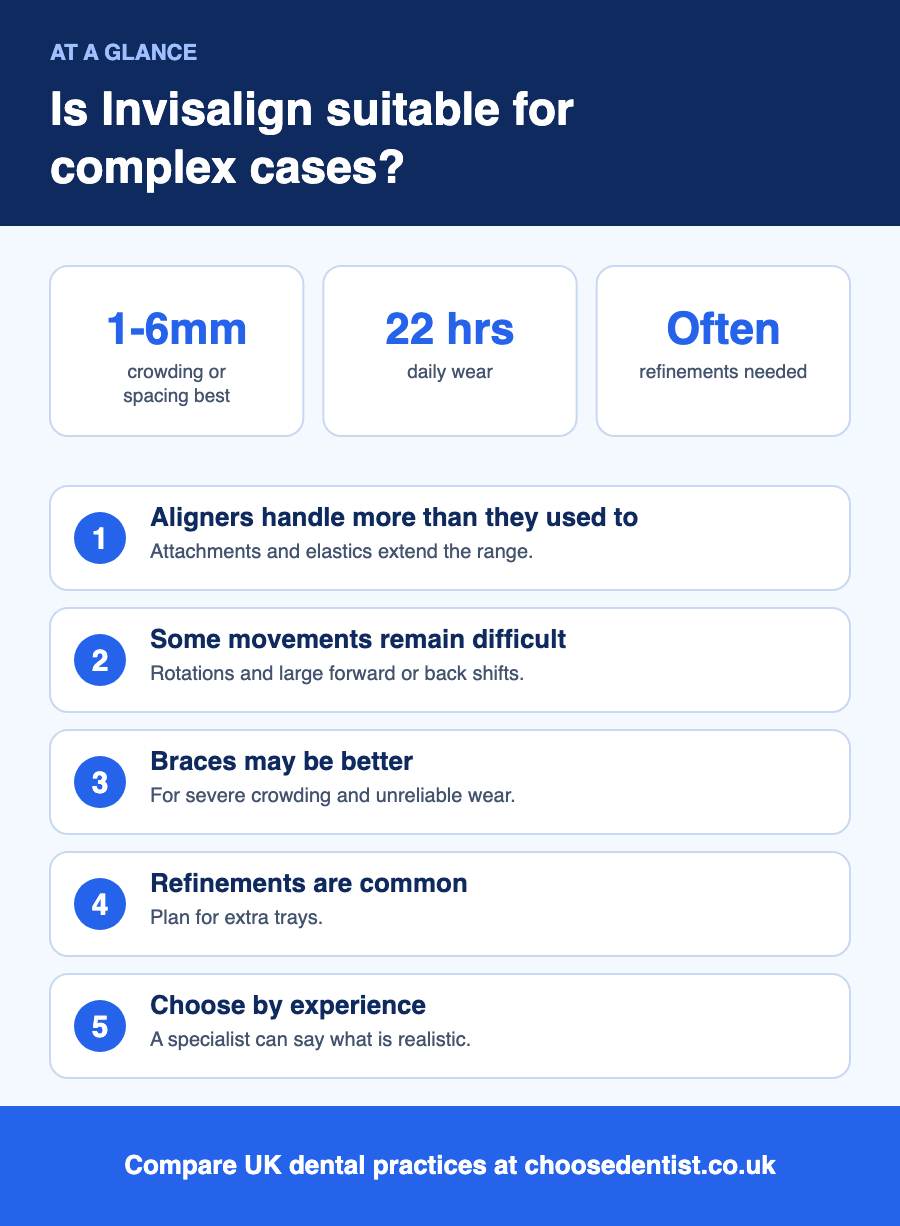
The Wikipedia article on clear aligners says that they are generally suggested for mild to moderate crowding of about one to six millimetres and mild to moderate spacing of a similar size, without discrepancies between the jaws, and for relapse after fixed treatment. They are also considered useful for moderate crowding of the front teeth. These are the situations in which the plastic trays can apply the required forces with predictable results.
Skilled clinicians use a variety of techniques to extend this range, including small tooth-coloured attachments bonded to the teeth, elastics between the upper and lower aligners and careful staging of the movements, and many report good outcomes in cases that would once have gone to braces.
| Problem | Aligners | Fixed braces |
|---|---|---|
| Mild to moderate crowding or spacing | Often well suited | Also effective |
| Relapse after earlier treatment | Often well suited | Effective |
| Severe crowding or large rotations | Possible but harder; may need attachments | Often preferred |
| Teeth too far forward or back | Less predictable | Often preferred |
| Jaw mismatch needing surgery | Not corrected alone | Not corrected alone |
Where aligners struggle
The same source says aligners are likely to be less effective than conventional braces for teeth that are too far forward or back, or that need to be rotated. Teeth with short or rounded crowns are harder to grip, and large vertical movements, such as pulling a tooth down into position or closing a deep bite, are demanding. Moving molars bodily over a long distance is another challenge.
Severe skeletal problems, where the jaws themselves are mismatched, are not corrected by any type of brace and may need surgery in combination with orthodontics. A patient with this kind of problem will be advised by an orthodontist or maxillofacial team, and aligners would only play a part in preparing the teeth.
The role of attachments and elastics
Attachments are small shapes of composite resin bonded to certain teeth to give the plastic something to push against, and the Wikipedia article explains that they are used on teeth needing rotation or extrusion, though more of them can reduce the aesthetic advantage. Interproximal reduction, which is the careful polishing of a very thin layer of enamel between teeth to create space, is sometimes used as well.
Elastics worn between the arches help to correct the bite and are common in more complicated cases. They have to be worn consistently, and they are often combined with a longer period of treatment.
When braces may be better
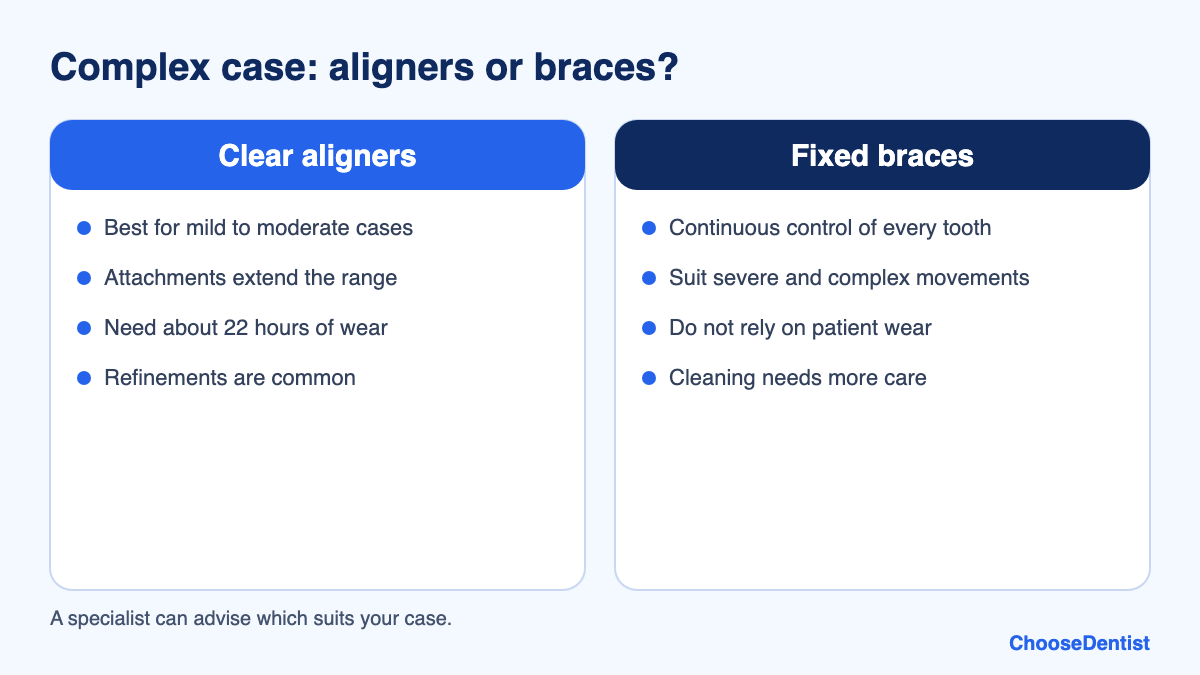
Fixed braces give the orthodontist continuous, precise control over every tooth, and they do not rely on the patient. They are often recommended for severe crowding, significant rotations, tooth movements that need a lot of force and cases where the patient is unlikely to wear removable trays reliably, such as some younger patients. The Wikipedia article notes that aligners are not generally recommended for complex cases, so an honest practitioner will say so when braces are the better route.
Some treatment plans combine both. A patient may start with a short period of limited braces to correct a particular movement and then complete with aligners, or the reverse.
Choosing a clinician for a complex case
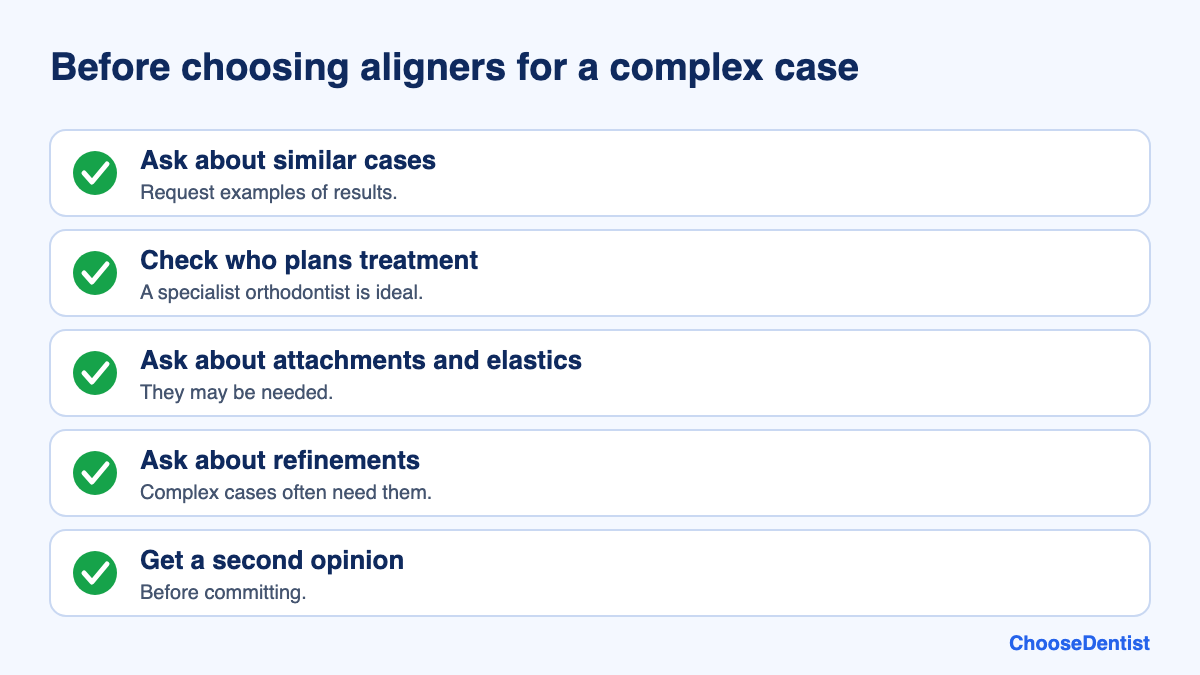
Experience matters more than the brand of aligner. Useful questions include how many cases like yours the clinician has treated, whether they are a specialist orthodontist, whether they can show results for similar problems and what the fallback is if aligners do not deliver the expected movement. Be wary of anyone who promises that aligners can fix everything, and of services that offer little or no face-to-face supervision.
Refinements and realism
Complex cases frequently need a set of refinement aligners to finish the job, since the first series rarely achieves every planned movement. The Wikipedia article notes that extra rounds may be needed because the first round often does not achieve full movement. A candid clinician will explain this at the start and will set out how long the whole process is likely to take, which is often longer than for simple cases.
Questions people often ask
Patients often wonder whether they have left it too late, or whether previous braces make aligners impossible. Neither is usually true: adults of any age can be treated if gums and bone are healthy, and aligners are frequently used to correct relapse after braces. People with missing teeth, crowns or bridges can often be treated too, although existing restorations limit what can be moved and may need to be replaced afterwards. A clinician can say what is feasible once the mouth has been examined.
The importance of a digital plan
Modern aligner systems create a three-dimensional simulation of how the teeth are expected to move. For a complex case, studying this plan carefully with the clinician is worthwhile. It shows the sequence of movements, the expected final position and the number of trays, and it allows the clinician to flag any stages where the movement is likely to be difficult. Patients should ask what the plan expects of each stage and how progress will be checked.
Time and commitment
Complicated treatment usually takes longer, often fifteen months to two years or more, and needs more discipline. Wearing the trays for around twenty-two hours a day and attending reviews are essential, and elastics, where used, have to be worn consistently. Patients who are honest with themselves about their ability to commit are more likely to be happy with the outcome, and a clinician may recommend braces to a patient who doubts they will manage.
What a second opinion can add
For a complicated problem, a second opinion from a specialist orthodontist is particularly useful. One clinician may be confident that aligners will work, while another may recommend braces or a combined approach, and hearing both views helps the patient to understand the trade-offs. A second consultation is a small cost compared with the price of treatment, and a clinician who is confident in their plan will not mind being compared.
NHS and private options across the UK
For complex problems that affect function, the NHS may provide orthodontic care, but it usually uses fixed appliances rather than aligners, and eligibility is mostly limited to children under 18 with a clinical need, as the NHS explains on its page about braces. Complex jaw problems may be treated through hospital orthodontic and surgical teams. Charging for NHS dentistry differs across the four nations. England has three bands and an urgent charge, Wales numbered bands and an urgent charge with a contract reform under way, Scotland free examinations and free treatment under 26 with a capped share of the cost for other adults, and Northern Ireland a percentage of the dentist’s fee up to a ceiling. Adults needing complex aligner treatment pay privately, and fees for comprehensive cases commonly run from about £3,000 to £5,500 or more.
Making a decision
A thorough assessment, with records and a three-dimensional preview of the planned movements, helps patients to see what is achievable. A second opinion is reasonable before committing, especially for a complicated case.
The ChooseDentist directory of practices offering clear aligners can be searched by postcode, with CQC and Google ratings shown where available. Two practices can be compared side by side, and the suitability of a case should be confirmed directly with the clinician.