
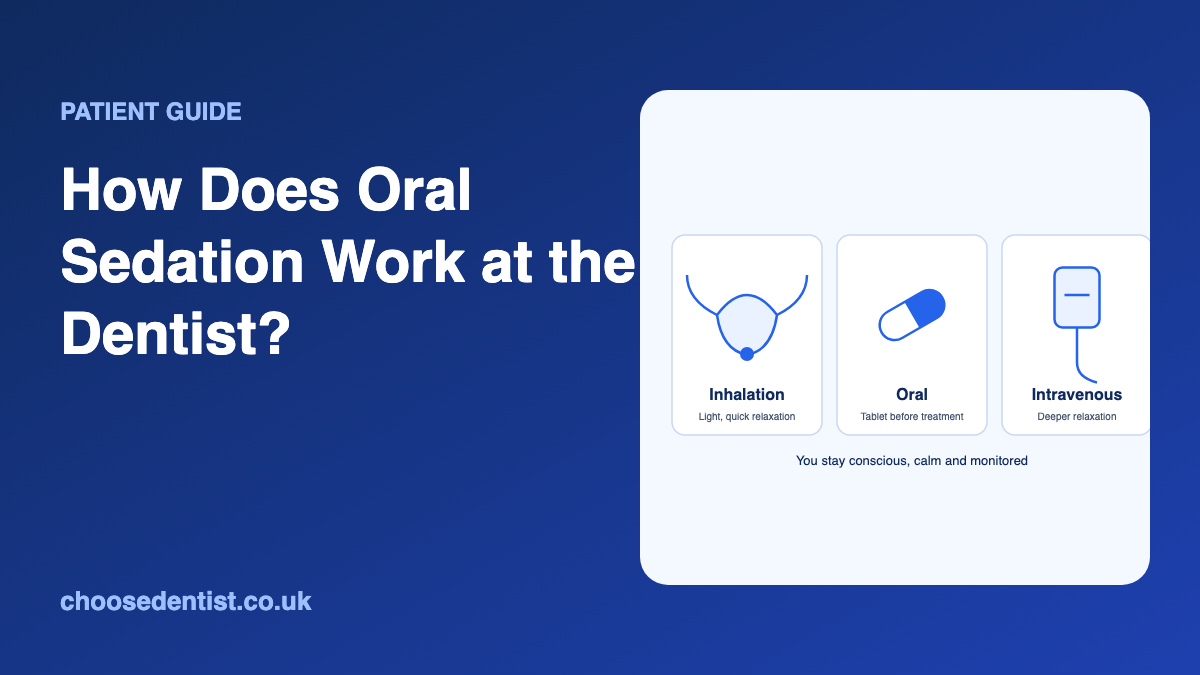
Oral sedation involves taking a sedative medicine, as a tablet or liquid, shortly before dental treatment so that the patient arrives and remains calm and relaxed. It takes effect more slowly than inhalation or intravenous sedation and the dose cannot be adjusted once it has been given, but it is simple to administer and avoids needles. Most people feel drowsy and at ease, and many remember little of the appointment.
It is one of the most commonly offered forms of dental sedation for people with moderate anxiety who dislike needles, and it is also used as a pre-medication for children. As with other methods, it needs a proper assessment, an escort and clear aftercare.
What is used
The Wikipedia article on sedation dentistry describes oral sedation as using midazolam or temazepam, usually as a syrup or a tablet, with an onset of around fifteen to twenty minutes. Both are benzodiazepines, a group of medicines that reduce anxiety and cause drowsiness. The article notes that the dose is fixed, unlike inhalation sedation, where it can be varied from moment to moment.
The dentist selects the medicine and the dose according to the patient’s weight, age, health and anxiety, and gives instructions on when to take it, which may be at home an hour before the appointment or in the surgery under supervision.
| Feature | Oral sedation | Notes |
|---|---|---|
| How it is given | Tablet or liquid before treatment | Midazolam or temazepam are commonly used |
| Onset | About 15 to 20 minutes | Dose is fixed once taken |
| Level | Relaxed and drowsy; may recall little | Local anaesthetic still needed |
| Escort | Needed | Responsible adult should stay for the day |
| Typical private cost | About £100 to £300 | Varies by practice |
What it feels like
The effect builds gradually, and patients usually feel calm, relaxed and sleepy. They remain awake and able to respond, but may be slow to answer and may have little memory of the treatment. Some people feel only a light sense of ease, whereas others become quite drowsy, depending on the dose and how they respond.
Local anaesthetic is still needed to numb the teeth, and the sedation helps patients to tolerate the injection and the procedure. The effects last for several hours, so patients need to rest afterwards.
How it compares with other types
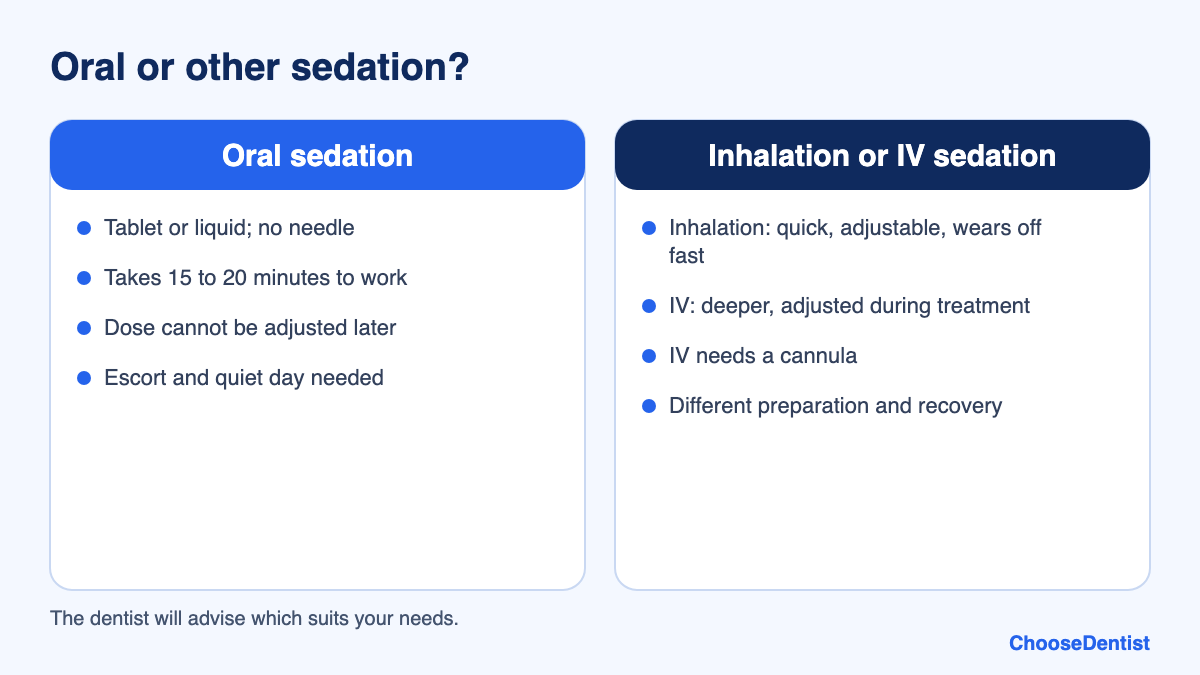
Oral sedation is less controllable than inhalation sedation, because the dose is committed once it is swallowed, and less predictable than intravenous sedation, in which the dentist adds small amounts until the desired effect is reached. Its advantage is simplicity, and it can be started at home to reduce anxiety on the journey, though dentists generally prefer patients to take it in the practice where possible.
It suits those with mild to moderate anxiety and short to moderate procedures. For severe phobia or longer treatment, intravenous sedation may be more effective.
Safety and side effects
Common side effects include drowsiness, nausea, dry mouth, headache and dizziness, according to the Wikipedia article, and less common effects include memory loss and, rarely, allergic reactions or effects on breathing. The medicine is processed by the liver and can interact with alcohol and with other sedating drugs, so the dentist asks about all medicines and about alcohol use.
The same article lists contraindications, including potential upper airway obstruction and severe illness affecting breathing or circulation. The staffing, monitoring and training standards for sedation are set out in the guidance from the Scottish Dental Clinical Effectiveness Programme.
Preparing and recovering
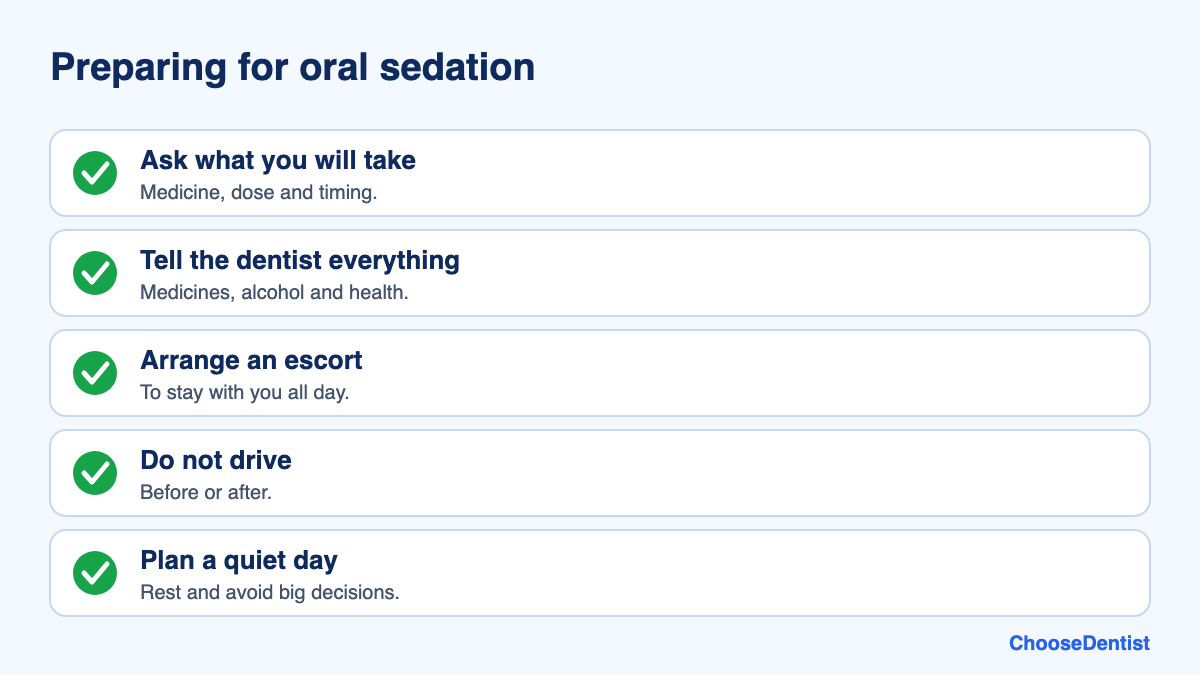
On the day, patients are generally asked to avoid alcohol, to follow any instructions about eating and to arrange for a responsible adult to accompany them. The medicine is taken at the specified time, and the patient should not drive to the appointment. Afterwards, they should rest, be supervised for the remainder of the day, avoid driving, machinery, alcohol and important decisions until the next day, and take things easy.
Because the effects can last many hours, those with caring responsibilities should arrange cover, and it is wise to plan a quiet evening.
Oral sedation for children
Syrups are used in children who cannot accept a mask or who need more than inhalation sedation, and the Wikipedia article notes that intranasal midazolam is common for paediatric use in the UK. Oral medicines are given under supervision, often in the surgery, because the response can vary and the child needs monitoring. Parents are given clear instructions on fasting and aftercare, and the child needs close supervision at home until the effects have worn off. Specialist teams usually provide it.
When it may not be suitable
Oral sedation is not for everyone. Patients with breathing problems, liver disease, certain mental-health conditions, a history of drug or alcohol misuse or who take other sedating medicines may need an alternative or a hospital setting. Pregnant patients are generally advised to avoid elective sedation. Because the dose is fixed, the dentist must judge it carefully, and patients who respond strongly to sedatives are better suited to a technique that can be adjusted.
What the next day is like
Most patients feel drowsy for the rest of the day and are back to normal by the next morning. A little grogginess, a mild headache or dry mouth are common and pass quickly. Patients should drink water, eat lightly and rest, and avoid driving until they feel completely alert. If any symptoms are unusual or worrying, they should contact the practice using the number provided.
Oral sedation for nervous adults who dislike needles
A significant number of people fear needles more than the dentist, and for them a tablet or a liquid is an attractive way of reducing anxiety. It can be started the evening before for patients who cannot sleep, or an hour before the appointment, as the dentist directs. The simplicity is the main attraction, but it needs to be balanced against the lack of control once the dose is taken, which is why the dentist begins with a conservative dose for a first appointment and adjusts it at later visits if needed.
What if it does not seem to work?
Responses vary. Some patients feel only a mild effect from the first dose, while others find it stronger than expected. The dentist will observe the patient and, if the level is inadequate, may postpone treatment or use a different method, and notes are kept for the next visit. Taking extra tablets at home without advice is dangerous and should never be done, because the doses are carefully calculated and interactions with alcohol or other medicines are serious.
NHS and private options across the UK
Oral sedation is offered by some NHS and private dentists. Sedation within the NHS is mainly provided through referral to community or hospital dental services for patients with severe anxiety, medical complexity or special needs, and availability in ordinary NHS practices varies, so it is worth asking the dentist and checking whether any extra charge applies. Charging for NHS dentistry differs across the four nations. England has three bands and an urgent charge, Wales numbered bands and an urgent charge with a contract reform under way, Scotland free examinations and free treatment under 26 with a capped share of the cost for other adults, and Northern Ireland a percentage of the dentist’s fee up to a ceiling. Private fees for oral sedation are usually lower than for intravenous sedation, often from about £100 to £300 per appointment, depending on the practice and the medicine.
Questions to ask
Patients can ask which medicine and dose are proposed and why, when to take it, whether it is suitable alongside their other medicines, who will supervise them and how long the effects will last. It is also worth asking whether the practice offers a trial of the sedation, and what the arrangements are for an escort.
Finding a practice
A practice with experience of treating anxious patients, a thorough pre-assessment and clear written instructions provides a good starting point.
The ChooseDentist directory of sedation practices can be searched by postcode, with CQC and Google ratings displayed where available. Two practices can be compared side by side, and the details of the sedation service and cost should be confirmed directly with the practice.
