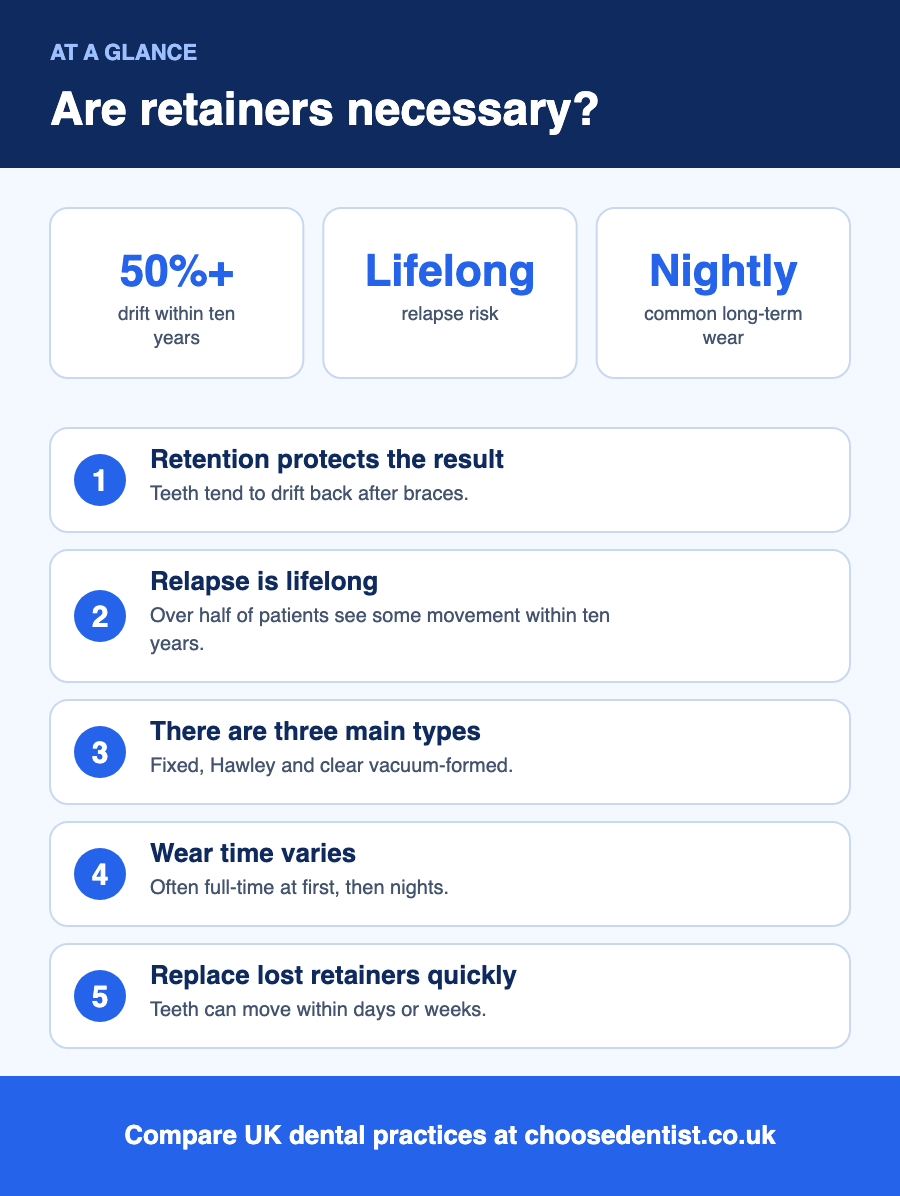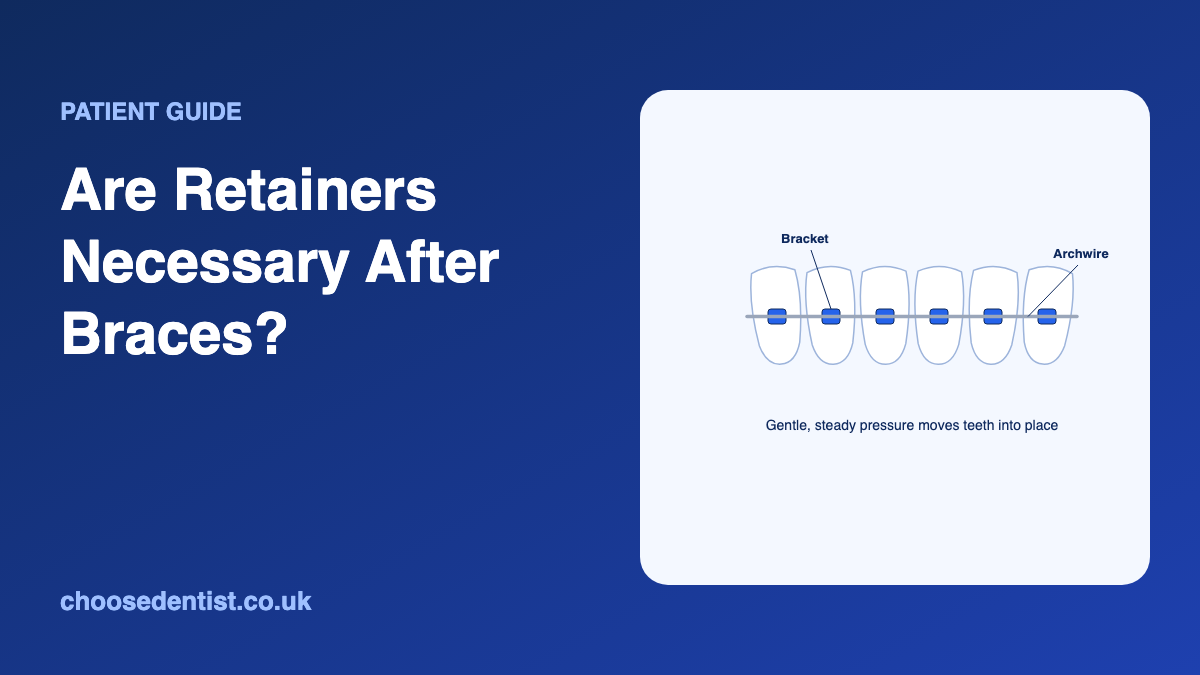
Yes. Retainers are the part of orthodontic treatment that keeps the result in place, and without them teeth tend to drift back towards their old positions. After braces are removed, the bone and gums around the teeth are still adapting, and the fibres that hold each tooth in position have a natural tendency to pull it back. A retainer holds the teeth steady while the tissues settle and, for most people, continues to protect the result for years afterwards.
The need for retainers is widely understood by orthodontists but often underestimated by patients, who sometimes assume that treatment ends the day the brace comes off. In practice, active treatment is only half the story, and retention is what makes the result last.
Why teeth move back
The Wikipedia article on orthodontic retainers describes relapse as a lifelong risk and gives several causes, including recoil of the gum fibres, pressure from the soft tissues of the lips, cheeks and tongue, the way the teeth bite together and continued growth. It states plainly that relapse can occur if retainers are not worn regularly after treatment.
The general article on orthodontics adds that more than half of patients see some drift back towards their original positions within ten years of treatment. That is not a failure of the braces: teeth are not set in concrete, and they respond to forces throughout life.
| Type | How it works | Points to consider |
|---|---|---|
| Fixed retainer | A thin wire bonded behind the front teeth | Invisible and always in place; needs careful cleaning |
| Hawley retainer | Wire and acrylic plate, removable | Durable and adjustable; may affect speech at first |
| Clear (vacuum-formed) retainer | Transparent plastic tray, often worn at night | Discreet; can break if you grind your teeth |
| Combination | A fixed lower retainer and a removable upper one | Common for long-term protection |
Types of retainer
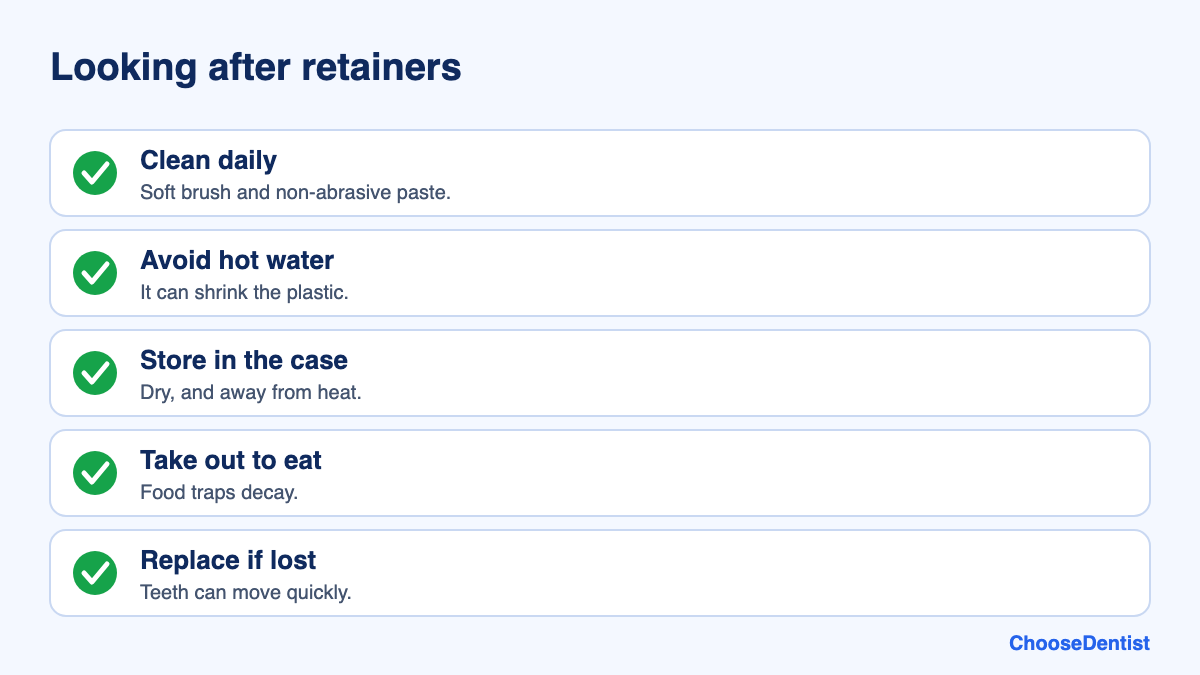
There are three main kinds. Fixed retainers consist of a thin wire bonded to the back of the teeth, most often the lower front teeth. The Wikipedia article notes that they suit cases with a higher chance of instability, such as severe rotations. They are invisible from the front and require no effort to wear, but they can make cleaning more difficult and occasionally come loose.
Removable retainers come in two forms. The Hawley retainer has a wire that runs around the front teeth and is attached to an acrylic plate on the palate, and the wire can be adjusted. Clear vacuum-formed retainers, sometimes called Essix retainers, are made of transparent plastic, are almost invisible and are commonly worn overnight. Each has advantages: Hawley retainers are durable and adjustable but may affect speech at first, while clear ones are discreet but can break in people who grind their teeth.
How long to wear them
Orthodontists give different advice, and it depends on the patient. The Wikipedia article says that the orthodontist may advise wearing a retainer for a set period or indefinitely, and that vacuum-formed retainers are most commonly worn overnight. A typical pattern is full-time wear for the first few months, then nights only, and then perhaps a few nights a week for the long term.
Many orthodontists now recommend long-term, night-time wear, together with a fixed retainer on the lower teeth in some cases, because the risk of relapse never entirely disappears. The practical question is not whether to wear a retainer but how little can safely be used, and the orthodontist is the best person to answer it.
Looking after retainers
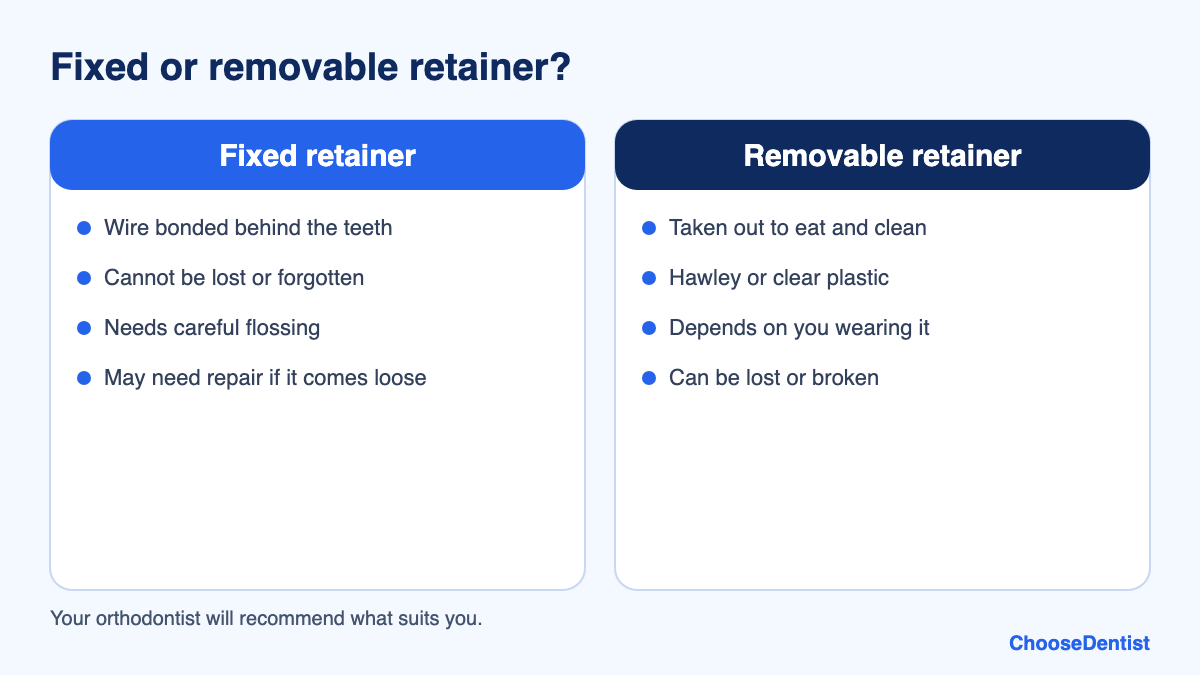
Removable retainers should be cleaned daily. The Wikipedia article advises cleaning them with a wet toothbrush and non-abrasive toothpaste before they are put in, storing them dry in their case and keeping them away from heat. It warns that hot water can cause shrinkage, so they should not be rinsed or soaked in it.
Retainers left in during meals can trap food and, according to the same source, may lead to decay and gum inflammation, so they are best removed to eat and drink anything other than water, then cleaned and replaced. Fixed retainers need careful flossing around the wire, and an interdental brush or a floss threader helps.
Replacing a lost or broken retainer
Retainers do get lost and broken, particularly removable ones left in a pocket or wrapped in a napkin. Replacing them promptly matters, because teeth can move within days or weeks, and a retainer that no longer fits may not be safe to force in. The Wikipedia article notes that clear retainers are easier to remake than other types if they break, which makes them cheaper to replace, though costs vary by practice.
Do all patients need them?
Practically everyone who has had orthodontic treatment is given a retainer, because it is not possible to predict who will relapse. Some people’s teeth appear very stable and others shift quickly, and there is no reliable test beforehand. Patients whose teeth were severely rotated or whose gaps were closed are at higher risk, which is why a bonded wire is often advised for them. Those who had mild crowding may do well with a removable retainer worn less often, but the orthodontist will set the schedule.
Retainers and speech or comfort
New retainers can feel strange. Hawley retainers cover part of the palate and may cause a lisp or extra saliva for a few days, while clear retainers can feel tight. Most people adapt within a week or two, and wearing the retainer as much as possible at the start, including while speaking, speeds the process.
The cost of retainers
Retainers are often included in the price of private treatment for the first set, but replacements are normally charged. As a rough guide, a removable retainer commonly costs from about £100 to £400, depending on the type and the practice, and a fixed retainer may cost a similar amount to fit and repair. Because retainers are lost and broken more often than people expect, some patients ask for a spare set when treatment ends. On the NHS the first set is usually part of the course, but the arrangements for replacements vary, so it is worth asking before the braces come off.
NHS and private options across the UK
For patients treated on the NHS, the NHS says that a retainer is worn after the braces come off to prevent teeth moving back, with the orthodontist setting how long it should be worn. The first set is normally supplied as part of the NHS course, although replacements may carry a charge, so it is worth asking at the outset. The NHS page on braces explains this.
Eligibility for NHS braces is limited mostly to children under 18 with a clinical need, and charges differ across the four nations. England uses three bands and an urgent charge, Wales numbered bands and an urgent charge with reform under way, Scotland free treatment under 26 and a capped share for other adults, and Northern Ireland a percentage of the dentist’s fee up to a ceiling. Private patients usually have retainers included in the quote for the first set, with replacements at the practice’s own rates, commonly from about £100 to £400 per retainer.
Planning for retention
Before braces go on, patients can ask what retainers they will need, how long they will be expected to wear them, what the first set and replacements cost and who to call if one breaks. Understanding the retention plan at the outset avoids disappointment later.
The ChooseDentist directory of orthodontic practices can be searched by postcode, with CQC and Google ratings displayed where they are available. Two practices can be compared side by side, and retainer policies and costs should be confirmed with the practice.