
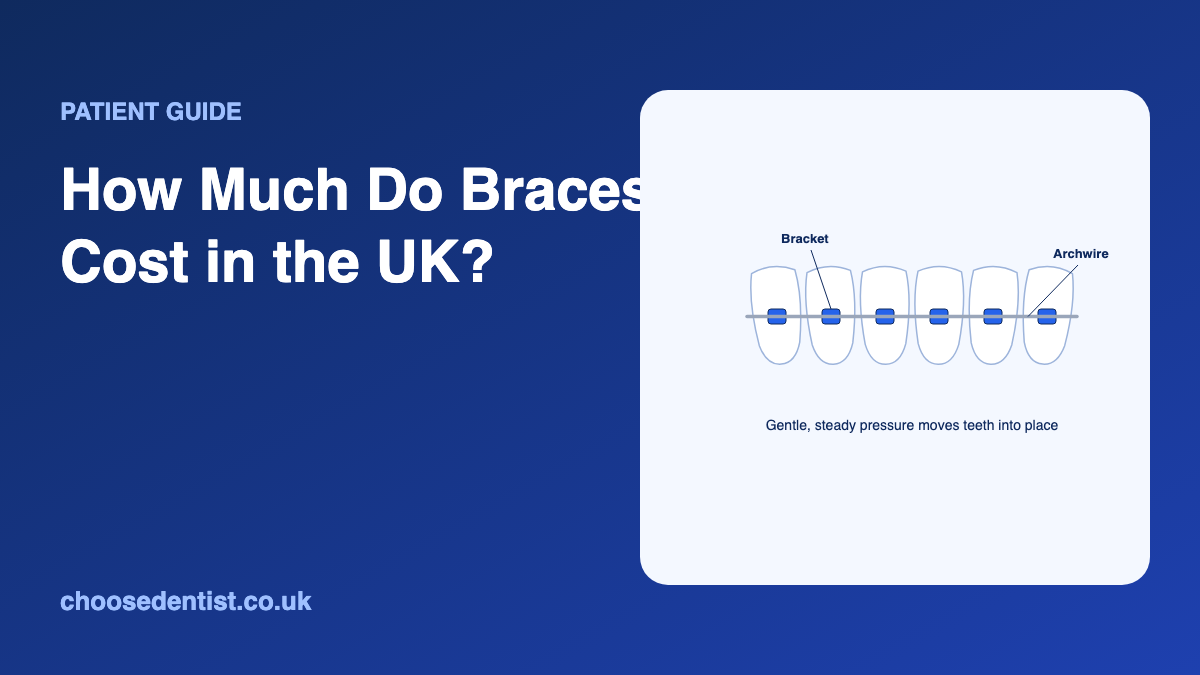
Private braces in the United Kingdom commonly cost from about £2,000 to £5,000 for a full course of treatment, although simpler cases can be cheaper and complex ones considerably more expensive. The wide range reflects the type of appliance, the length and difficulty of the treatment, the experience of the clinician and the part of the country, so a single figure rarely describes what any one patient will actually pay.
For some young people the cost is nothing at all, since braces are provided free on the NHS to those under 18 who have a clear clinical need. For most adults and for children who fall below the threshold, braces are a private expense, and understanding what drives the price makes it easier to compare practices fairly.
What affects the price
The first factor is the appliance. Traditional metal braces are generally the least expensive. The Wikipedia article on dental braces notes that titanium braces are lighter and about as strong as steel but cost more, and ceramic, gold-plated and lingual braces, which are fixed to the back of the teeth, sit higher on the scale because the components and the skill involved are greater. Clear aligners are priced separately and are covered in our guide to Invisalign and clear aligners.
The second factor is the complexity of the case. A mild correction may take months and few adjustments, whereas severe crowding, a significant bite problem or the need for extractions or additional appliances extends both time and cost. Treatment by a specialist orthodontist, who has completed several years of postgraduate training, may cost more than treatment by a general dentist who offers braces, though many patients feel the extra expertise is worth paying for in a difficult case.
| Type of treatment | Typical private cost | Notes |
|---|---|---|
| Traditional metal braces | About £2,000 to £3,500 | Usually the least expensive fixed option |
| Ceramic (clear) braces | About £2,500 to £4,500 | Less visible; may be a little more fragile |
| Lingual braces | About £3,500 to £6,000 or more | Fitted behind the teeth; more specialised |
| Retainers | Often £100 to £400 per set | Check whether the first set is included |
| Complex or two-phase treatment | Higher; priced per case | May involve extractions or extra appliances |
What a quote should include
A transparent quote sets out exactly what the fee covers. The consultation, records such as X-rays, photographs and scans, the appliance, the adjustment appointments across the whole course, the removal of the brace and the first set of retainers should all be listed. Some practices bundle everything into a single price, while others charge separately for retainers, broken brackets or missed appointments, which can add several hundred pounds.
The NHS describes adjustment visits as taking place every six to eight weeks, so a course of treatment involves a good many appointments, and it is worth asking whether any are charged separately. It is also reasonable to ask how long treatment is expected to last, because a course that runs over the planned time may or may not carry an additional fee.
Ways of paying
Spreading the cost is common. Many orthodontic practices offer a deposit followed by monthly instalments for the length of treatment, often interest-free, and some arrange finance through a third party. Because treatment lasts one to two years or longer, monthly payments are usually modest, though the total remains the same, or higher if interest is charged. Reading the terms and confirming what happens if treatment ends early is sensible.
Some patients use private dental plans, though most cover routine care and offer discounts on other work, and they rarely meet the whole cost of braces. A few employers provide dental cash plans, and it is worth checking.

Costs that are easy to overlook
Retainers are the most commonly overlooked. They are not optional, and the Wikipedia article on orthodontic retainers describes relapse as a lifelong risk, so patients should expect to wear them for years and to replace them if they are lost or broken. A quote that excludes retainers can look cheaper than one that includes them without being so.
Other possible extras include extractions that may be needed to create space, the cost of repairing broken brackets or wires outside normal hours, and treatment of any decay or gum problems that arise during treatment. Good oral hygiene during braces keeps these to a minimum, and regular check-ups with the general dentist should continue throughout.
Cost compared with outcome
A lower price is not always better value, and a higher one is not necessarily a sign of quality. The aim is a stable, healthy result, and that depends on proper planning, regular supervision and retention afterwards. When comparing, it helps to ask who will carry out each appointment, whether the clinician is a specialist, how emergencies are handled and what the plan is if progress is slower than expected.

Cost for children and teenagers
Parents of children who do not meet the NHS threshold face the same private fees as adults, although some practices offer family discounts or a reduced price for a second sibling. Timing affects cost as well. Treatment is often most efficient when the permanent teeth have come through, usually between the ages of eleven and fourteen, and starting at the right time can avoid a longer, more expensive second phase later. An orthodontist can advise whether to begin now or to wait and review.
Questions to ask before agreeing to a price
Useful questions include whether the quote is fixed or an estimate, what happens if treatment takes longer than planned, whether broken brackets and missed appointments are charged, how many retainers are included and what a replacement costs. Asking whether a deposit is refundable and whether the fee covers an emergency appointment out of hours gives a clearer idea of the real cost of the course.
Why prices differ between practices
Two practices in the same town can quote very different sums for apparently the same treatment. Overheads, the clinician’s training and experience, the technology used for scans and planning, the number of visits included and the profit margin all play a part. A specialist practice that treats only orthodontic patients may charge more than a general practice offering braces alongside routine care, but it may also have more experience of unusual cases. Neither is automatically the better choice, which is why comparing what is included matters more than the headline figure, and why a consultation with more than one practice is worthwhile.
NHS and private options across the UK
According to the NHS, braces are usually free for people under 18 who have a tooth problem, with a dentist referring the patient to an orthodontist who decides whether they are eligible, and adults will usually pay privately. The NHS page on braces also notes that there may be a long waiting list. In England, adults who are accepted for NHS orthodontics on clinical grounds fall into the highest charge band, which is rare.
The other nations restrict NHS orthodontics in a similar way, though charging differs. Wales has numbered bands and an urgent charge, with children under 18 exempt and a contract reform under way. Scotland offers free NHS treatment to people under 26, although access to orthodontics still depends on clinical need, and adults over 26 pay a capped share of the cost. Northern Ireland charges adults a percentage of the dentist’s fee up to a ceiling and concentrates orthodontic services on children with a recognised need. Anyone not eligible will pay privately in every nation.
Getting the best value
Comparing at least two practices, asking for itemised written quotes and checking reviews and inspection reports give a clearer picture than the headline price. It is also wise to be cautious about very low offers and about pressure to pay in full at the first visit.
The ChooseDentist directory of orthodontic practices allows visitors to search by postcode, see CQC and Google ratings where they are available and compare two practices side by side. Prices and what is included should be confirmed directly with the practice.
