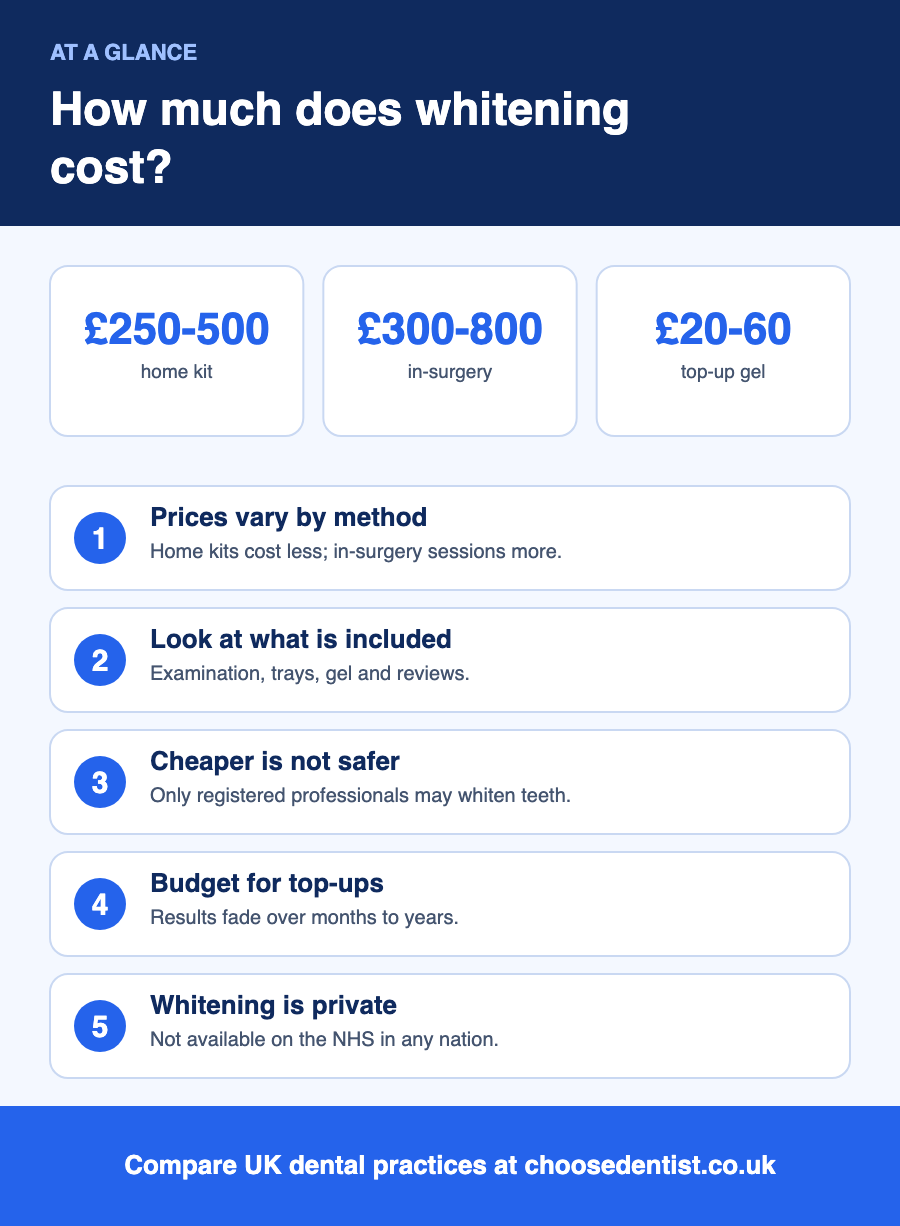
Professional teeth whitening in the United Kingdom commonly costs from about £250 to £500 for a custom home-tray kit and from about £300 to £800 for an in-surgery treatment, though prices vary by practice, method and region. Top-up gel to maintain the result is considerably cheaper, often £20 to £60 per syringe, which is why many people regard the initial outlay as the main cost.
Whitening is a cosmetic treatment, and it is a private service in all four nations. The price is therefore set by each practice, and the wide spread of quotes can be confusing. Understanding what the fee includes, and what a legitimate provider has to do before treatment, helps to explain why professional whitening costs more than products bought in a shop or from a beauty salon.
What affects the price
The method has the biggest influence. The NHS website describes two professional approaches: a home kit of whitening gel and custom-fitted trays worn for around two to six weeks, and a session at the surgery that takes about one to two hours. In-surgery treatments use stronger gels and are quicker, so they usually cost more, whereas home kits require impressions or a scan, a fitting visit and a supply of gel.
Other factors include the practice’s location, the brand of the system, the number of visits and whether a hygiene appointment is included. A preliminary examination and a clean are essential parts of safe whitening, and some practices bundle them while others charge separately.
| Option | Typical private cost | Notes |
|---|---|---|
| Home kit with custom trays | About £250 to £500 | Worn for about 2 to 6 weeks; trays are reusable |
| In-surgery whitening | About £300 to £800 | One to two hours; stronger gel used by the dentist |
| Top-up gel | About £20 to £60 | Used in the original trays |
| Replacement trays | About £50 to £150 | If they no longer fit |
| Hygiene visit before treatment | About £50 to £100 | Sometimes included in the price |
What the fee should include
A fair quotation specifies the examination, the whitening gel, the trays or the surgery session, any review appointment and the advice on sensitivity. It should say whether top-up gel is offered at a discount and whether trays can be reused. Asking for these details in writing helps to compare practices accurately.
The treatment should also involve a proper assessment. The NHS says that a dentist should first check that the teeth and gums are healthy, and treat any problems before whitening begins. A price that omits this check, or that is far lower than others, may reflect a service that cuts corners.
Why cheaper options are risky
Whitening is regulated in Great Britain. The General Dental Council states in its guidance on what the law says that tooth whitening is the practice of dentistry and may only be carried out by registered dental professionals, and that the High Court confirmed this in 2013. Products releasing more than 0.1 per cent hydrogen peroxide can be sold only to dental practitioners, which means a beauty salon offering stronger bleaching is breaking the law.
The NHS website warns that products from pharmacies, online sellers or beauty salons do not work as well and may harm the teeth and gums. A bargain price from a non-dental provider is therefore no bargain if the result is poor or the treatment causes injury.

Top-ups and maintenance
Whitening is not permanent, so maintenance is part of the real cost. Results fade at different rates, and many patients top up every six to twelve months using the original trays and a fresh syringe of gel. The NHS suggests that following a dentist’s advice may keep the effect for around three years, while the Wikipedia article on tooth whitening says re-treatment may be needed every six months to a year, more often for smokers and heavy consumers of tea, coffee and red wine.
Replacing worn trays after a few years, and the occasional hygiene visit to remove surface stain, are additional costs to bear in mind. Over several years, the total may be considerably more than the first quotation.
Ways of paying
Most practices take payment on the day for a home kit, and some offer instalment plans or fold whitening into a membership that includes routine care. Packages combining a hygiene visit, a check-up and whitening are common and can be good value for patients who need all three. Dental insurance seldom covers cosmetic treatment, so it is wise to check before assuming a contribution.

Is whitening good value?
Value depends on how long the result lasts and how much it matters to the patient. A home kit with reusable trays spreads its cost across several years of top-ups, whereas a single in-surgery session may need repeating within a year or two. Patients who smoke, drink a lot of tea or coffee or have porous enamel may find the effect fades faster, and the cost per year of brightness rises accordingly. Considering the lifestyle changes that protect the result, such as rinsing after dark drinks, is a way of getting more from the investment.
Questions to ask before paying
Useful questions include who will carry out the treatment and whether they are registered, what strength of gel is used, how many shades lighter the teeth are likely to become, what happens if sensitivity develops and what a top-up costs. It is reasonable to ask to see the starting shade recorded on a shade guide and photographs, since this lets the patient and dentist judge the result objectively. A practice that is happy to answer all of these points is a good sign.
Whitening alongside other treatments
Whitening is often combined with a hygiene visit, a check-up or other cosmetic treatment, and the order matters. Natural teeth should be whitened before bonding, veneers or crowns are made, because restorations do not change colour and must match the final shade. Planning the sequence at the outset avoids paying to replace work that no longer matches, and some practices offer package prices when several treatments are booked together.
Seasonal offers and loyalty schemes
Many practices run promotions around the summer and the party season, and patients who already attend regularly may be offered a preferential price. These can be genuine bargains, but they should be judged on what is included. A discounted price that skips the examination or the hygiene visit is not the same as a full service, and a long-term membership may only be worthwhile if the patient would use the other benefits. Asking what the offer covers, and for how long it applies, keeps the comparison honest.
NHS and private options across the UK
Whitening is not available on the NHS. The NHS says that it is a private treatment carried out at a dental surgery and that the chemicals should only be used or sold by dental professionals, as its page on teeth whitening explains. Charging for NHS dentistry differs across the four nations, but none covers whitening. England has three bands and an urgent charge, Wales numbered bands and an urgent charge with a contract reform under way, Scotland free examinations and free treatment under 26 with a capped share of the cost for other adults, and Northern Ireland a percentage of the dentist’s fee up to a ceiling. A dentist can carry out NHS care at the same visit, but the whitening is charged separately and privately.
Practices sometimes advertise introductory prices or seasonal offers. These can be genuine, but it is wise to ensure that the examination and the quality of the product are not compromised, and to confirm what the price includes.
Getting the best value
Value comes from a thorough examination, a safe and legal product, clear information and sensible aftercare, not just from a low price. Comparing two or three practices, asking about the gel’s strength and how sensitivity is managed, and reading reviews give a good picture.
The ChooseDentist directory of teeth whitening practices can be searched by postcode, with CQC and Google ratings displayed where available. Two practices can be compared side by side, and the price and method should be confirmed directly with the practice.