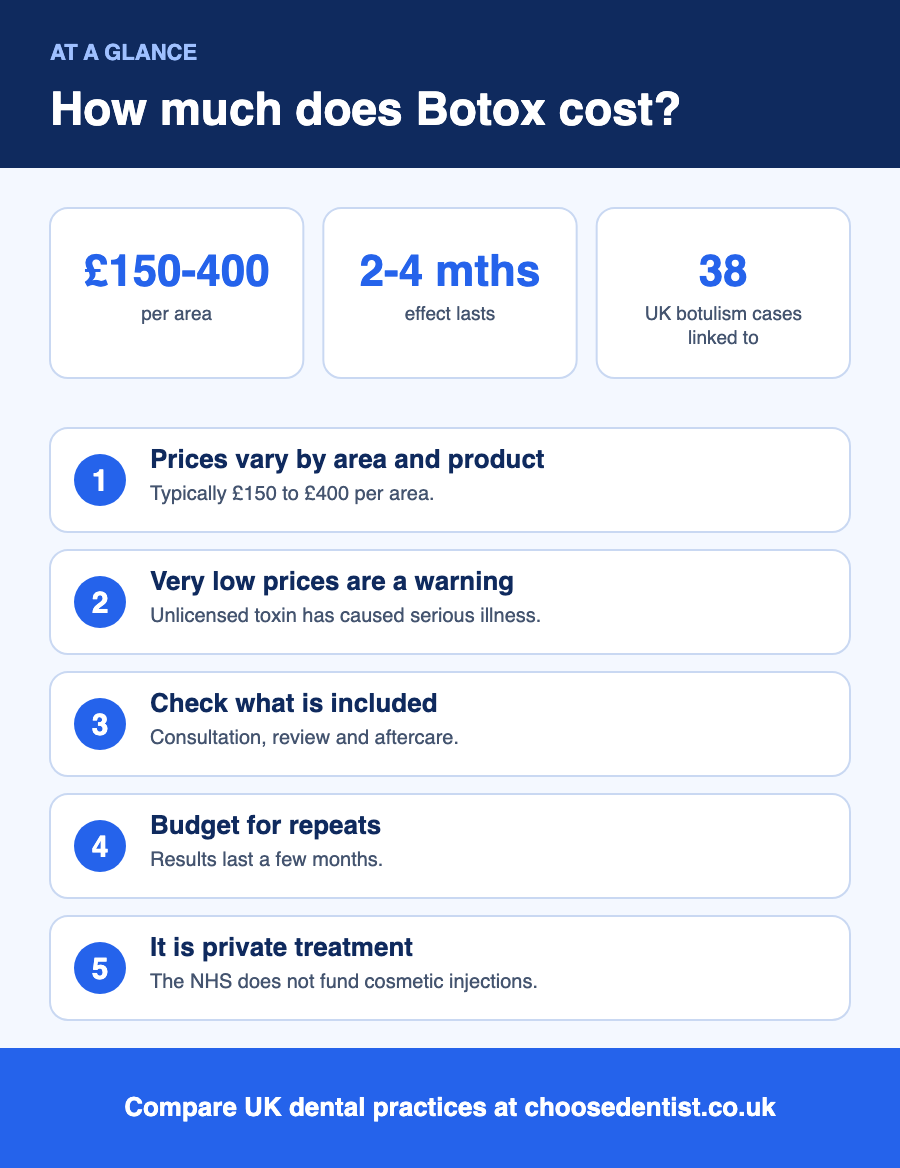
Anti-wrinkle injections of botulinum toxin, widely known as Botox, commonly cost from about £150 to £400 per area in the United Kingdom, with prices varying by practice, region, product and the number of areas treated. A single area such as the forehead or the frown lines is the cheapest, and treating three areas costs more, though many practices offer a package price for combinations. The treatment is private, and every practice sets its own fees.
The price needs careful interpretation, because the cheapest quote is not always the best, and in this area very low prices can signal real risk. The sections below explain what drives the cost, what a fair quote includes and how to avoid unsafe treatment when looking for facial aesthetics.
What affects the price
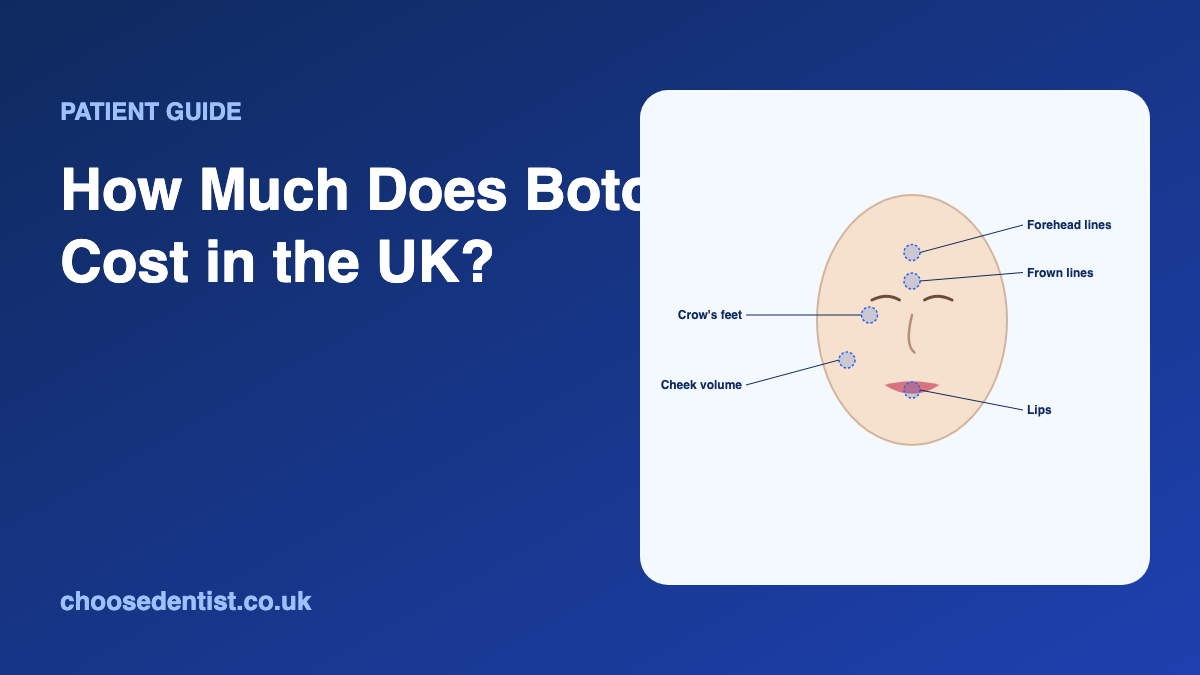
The number of areas treated is the main driver, with the forehead, frown lines and crow’s feet the most common. The dose required varies with muscle strength, which is one reason prices differ between patients, and some practices charge by the unit while others charge by the area. The product matters: the Government’s guidance for enforcement officers states that the brands licensed for cosmetic use in the UK are Azzalure, Bocouture and Botox, and prices differ slightly between them.
Other factors include the practitioner’s experience and qualifications, the location and overheads of the practice, and whether a consultation, a review appointment and aftercare are included. A thorough consultation with a qualified prescriber is a legal requirement for the toxin, and part of the cost is for that clinical time.
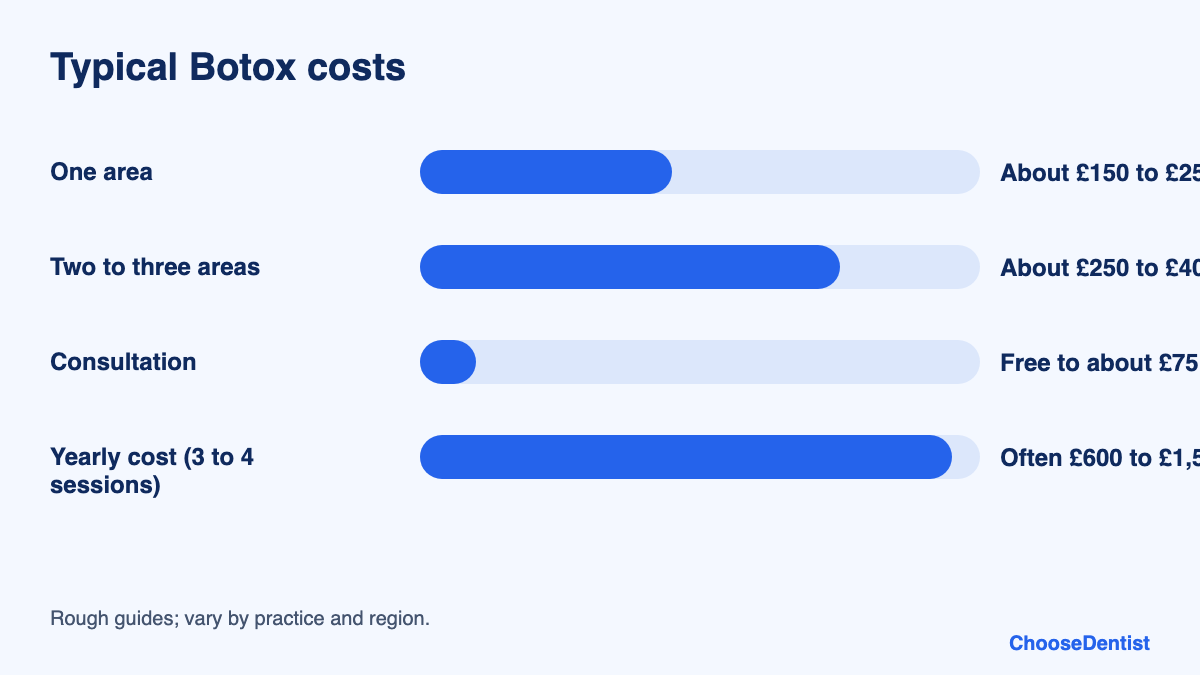
| Item | Typical private cost | Notes |
|---|---|---|
| One area (forehead or frown lines) | About £150 to £250 | Price per area or per unit |
| Two to three areas | About £250 to £400 | Often a package price |
| Consultation | Free to about £75 | Sometimes deducted from treatment |
| Review appointment | Often included | Usually 2 to 4 weeks after treatment |
| Repeat treatment | Every 3 to 4 months or so | Effect typically lasts 2 to 4 months |
Why very low prices are a warning
The Joint Council for Cosmetic Practitioners, a not-for-profit body that maintains a register of practitioners, advises on its page about unregulated botulinum toxin to be wary of prices far below standard clinic rates, noting that genuine products with full safety data are not cheap. It reports that the UK Health Security Agency linked 38 cases of iatrogenic botulism in England to unlicensed or counterfeit botulinum toxin injections in non-clinical settings.
A price that is dramatically lower than others may mean that the product is diluted, counterfeit or unlicensed, that the consultation is rushed or missing, or that the injector lacks proper training. The JCCP advises avoiding toxin bought through social media, auction sites or overseas pharmacies.
What a fair quote includes
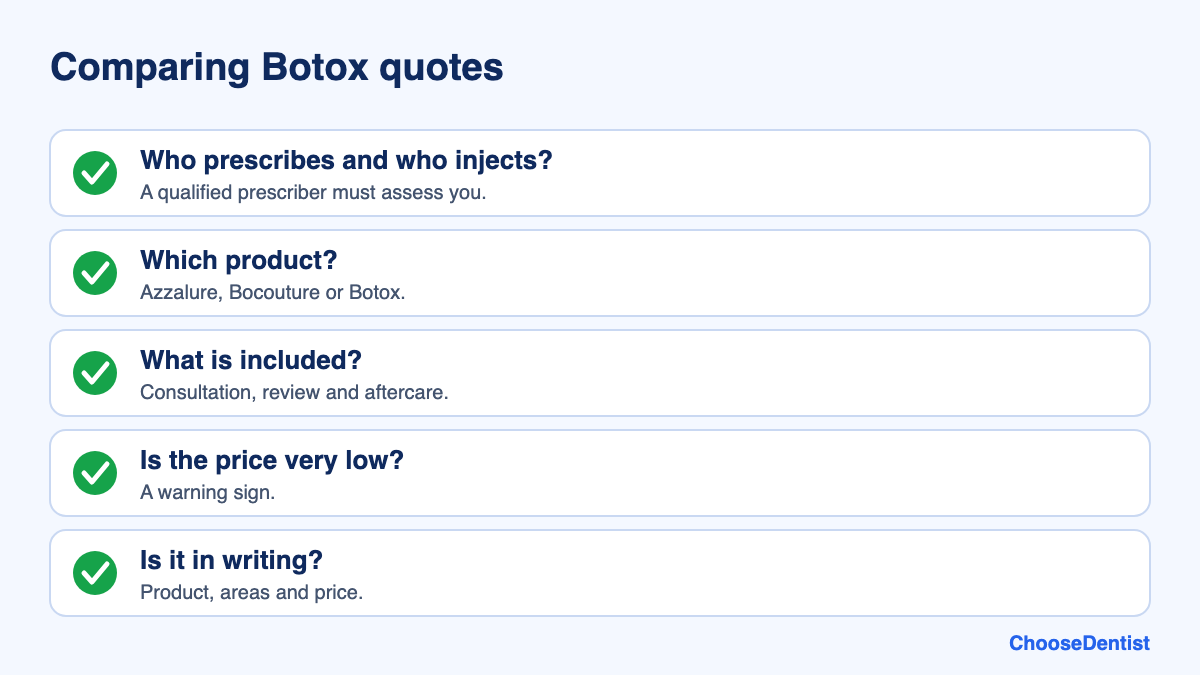
A quotation should state the product, the areas to be treated, the number of units or the price per area, and whether a consultation fee applies. It should say whether a review appointment is included, usually two to four weeks later, and what happens if an adjustment is needed. Asking for the quote in writing and for the product name, batch number and expiry date to be recorded at treatment adds a layer of safety, as the JCCP advises.
A reputable practice will explain that the first consultation involves a face-to-face assessment by a qualified prescriber, and that treatment may not go ahead if it is not suitable.
Cost over time
Botox is temporary. The Wikipedia article on botulinum toxin says that smoothing is usually visible three to five days after injection, that the effect on frown lines typically lasts two to four months and that muscles can be retreated to maintain the result. That means a patient who wishes to keep the effect will need treatment several times a year, and an annual cost of several hundred to over a thousand pounds is not unusual.
Some practices offer loyalty prices, packages for regular patients or membership schemes. It is worth asking, though the quality of care should come before the discount.
Paying for treatment
Most practices take payment on the day, and some offer instalment plans for larger packages. Because injectable treatments are elective, it is wise to avoid finance with high interest, and to be sceptical of offers that expire within hours, which are designed to pressure decisions. Dental insurance does not usually cover cosmetic procedures.
Units, areas and what you pay for
Some practices price per unit of toxin and others per area, and the two can be hard to compare. A forehead may need 10 to 20 units, frown lines 15 to 25 and crow’s feet 10 to 15 per side, depending on the muscles, and the cost per unit varies. Asking how many units will be used, what the price per unit is and whether the quoted area price covers extra units if the muscles are strong avoids surprises. A good practitioner will use as much as is needed for a natural result, and no more.
Consultation and follow-up charges
A consultation may be free, discounted against treatment or charged separately, and the clinical assessment is a legal requirement for the toxin whether or not the fee is itemised. A review appointment two to four weeks after treatment lets the practitioner check the result and, if needed, adjust it with a small top-up, which some practices include and others charge for. Asking about these costs in advance gives a clearer picture of the total.
Saving money safely
There are legitimate ways of keeping the cost down. Treating only the areas that bother you most, choosing a practice with a package or loyalty price, spacing treatments sensibly and avoiding unnecessary top-ups all help. What is not worth doing is cutting corners on safety, which can end up costing far more if something goes wrong, so a qualified prescriber, a licensed product and a clinical setting should be the baseline.
Botox at a dental practice
Many dental practices now offer anti-wrinkle treatment alongside dentistry, and dentists are registered prescribers who work within their competence and training. The prices are usually in line with other clinics, and the setting brings infection control, emergency equipment and regulated premises. Patients can ask the dentist what aesthetics training they have completed and how often they treat the area in question. Our guide to facial aesthetics at a dental practice explains what to check.
NHS and private options across the UK
Cosmetic facial aesthetics is private in every nation, and the NHS does not fund injections to improve appearance. Charging for ordinary NHS dentistry differs across the four nations, with England and Wales using numbered bands and an urgent charge, Scotland free examinations and a capped share of the cost for adults over 26, and Northern Ireland a percentage of the dentist’s fee up to a ceiling, but none of these covers cosmetic injectables. Practices are inspected by different bodies across the UK: the Care Quality Commission in England, Healthcare Inspectorate Wales, Healthcare Improvement Scotland and the Regulation and Quality Improvement Authority in Northern Ireland. Reading the inspection report for a practice is a helpful independent check.
Prices vary between regions, with London and the south-east at the higher end. Patients should compare at least two practices, looking at qualifications and safety as well as cost.
Getting good value
Value comes from a qualified prescriber, a licensed product, a proper consultation, careful technique and good aftercare. It is better to pay a fair price for safe treatment than to risk harm for a saving of a few pounds.
The ChooseDentist directory of facial aesthetics practices can be searched by postcode, with CQC and Google ratings displayed where available. Two practices can be compared side by side, and prices, products and prescribers should be confirmed directly with the practice.