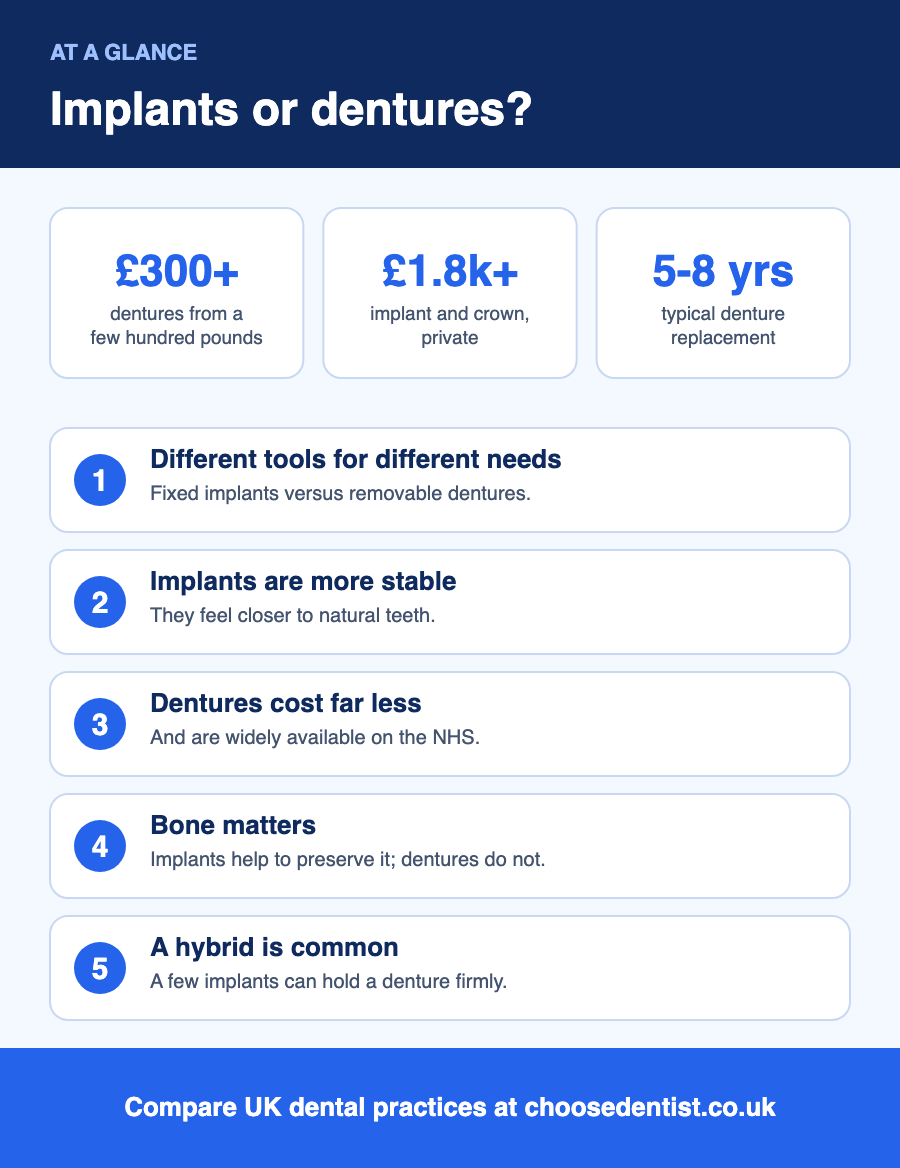
Dentures and dental implants both replace missing teeth, but they work in different ways and suit different people. Dentures sit on the gums and are removable, while implants are fixed into the jawbone and support teeth that stay in place. Neither is better in every case, and the right choice depends on the number of teeth missing, the health of the jaw, the budget and how much maintenance a person is willing to take on.
The decision is easier when the practical differences are laid out side by side. Stability, comfort, cost, lifespan and the effect on the jawbone all count, and so does availability: dentures are widely provided on the NHS, whereas implants almost never are.
How each option works
A denture is a custom-made appliance, usually of acrylic, that replaces some or all of the teeth. Complete dentures replace a whole arch and are held in place largely by suction and the muscles of the cheeks and tongue, while partial dentures fill gaps and may clip on to natural teeth. The Oral Health Foundation explains the main types in its guide to dentures, including acrylic, metal and flexible versions.
An implant is a titanium post placed in the jawbone, which fuses with the bone over a few months and carries a crown, a bridge or a denture. The NHS website describes implants as fixed into the jawbone to replace tooth roots, supporting crowns or some types of denture. A hybrid, in which a few implants hold a denture firmly in place, is a common compromise.
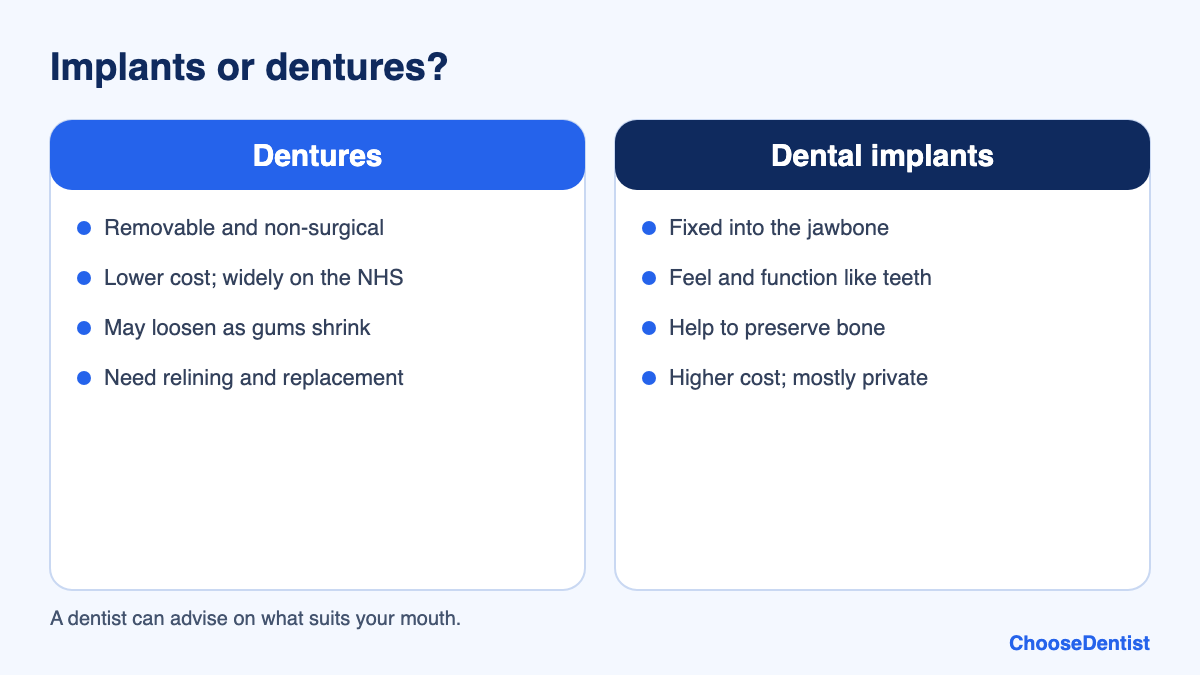
| Feature | Dentures | Dental implants |
|---|---|---|
| Fixed or removable | Removable | Fixed (or implant-retained denture) |
| Stability | Can move, especially lower dentures | Very stable |
| Surgery | None | Yes, under local anaesthetic |
| Typical private cost | From a few hundred pounds | From about £1,800 per implant and crown |
| NHS availability | Widely available, band 3 in England | Rare; mostly private |
| Effect on bone | Does not prevent bone shrinkage | Helps to maintain bone |
Comfort and function
Implants feel and function more like natural teeth. Because they are anchored in bone, they do not slip, and patients can usually bite and chew a wider range of foods with confidence. Dentures, particularly lower ones, can move during eating and speaking, since the tongue pushes against them and there is less surface for suction. The Wikipedia article on dentures notes that lower dentures are less retentive because of the tongue and greater bone resorption.
Dentures take time to get used to, and sore spots are common in the first weeks. They need adjusting as the gums change, and some wearers use adhesive for added security. Against that, they require no surgery, which makes them suitable for people who cannot or prefer not to have it.
Effect on the jawbone
When teeth are lost, the bone that held them gradually shrinks. The Wikipedia article says that edentulous ridges tend to resorb progressively over the years, especially in the lower jaw, and that implants can help to prevent bone loss. Over time, shrinkage changes the shape of the face and makes dentures fit less well, which is one reason why some people are advised to consider implants earlier rather than later.
Cost
Dentures are considerably less expensive, and on the NHS a standard denture is charged within the highest band in England rather than as a private fee. Private dentures range from a few hundred pounds for a basic acrylic denture to several thousand for premium designs. Implants are mostly private, with a single implant and crown commonly costing from around £1,800 to £3,000, so replacing several teeth or a full arch costs a good deal more.
Over a lifetime, the gap narrows. Implants are not replaced as often, but crowns can need replacement and maintenance is ongoing, while dentures need relining and eventual replacement every few years. The Oral Health Foundation says dentures often need replacing every five to eight years.
Lifespan and maintenance
Implants can last for decades in a healthy mouth, though the crown may need replacing after ten to fifteen years, and they need the same careful cleaning as natural teeth, with regular check-ups to guard against gum problems around the implant. Dentures last for years with proper care, but gums and bone change, so they loosen and wear and need adjustment.
Daily care differs. The NHS advises that dentures should be cleaned with soft soap or washing-up liquid, rinsed after meals and left out at night, while implants are brushed and cleaned between like teeth.
Who tends to suit which
Implants tend to suit people who are in good general health, have enough bone, are prepared to pay and want a fixed, natural-feeling result. Dentures suit those who prefer a non-surgical route, have limited budgets, are not suitable for implant surgery or need to replace many teeth at once at the lowest cost.
Appearance and speech
Implant-supported teeth look and feel like natural ones and do not affect speech, since nothing covers the palate or moves when talking. Dentures can alter speech in the early weeks, particularly sounds such as s and th, and an upper denture covers the roof of the mouth, which some people find affects taste and the feel of food. The Wikipedia article on dentures notes that replacing front teeth helps patients to enunciate certain sounds more easily, so well-made dentures can restore clear speech once the wearer has adapted.
Implant-retained dentures
For many people the best answer is a combination. Two to four implants in the lower jaw, or more in the upper, can be fitted with attachments that clip a denture firmly in place, which improves stability and chewing without the cost of a fixed full arch of teeth. The denture can still be removed for cleaning, which many patients prefer. This approach is generally private, but it is often the most cost-effective way of transforming a loose lower denture.
Short-term and long-term considerations
Dentures can usually be made within weeks and need no surgical recovery, so they suit someone who needs teeth quickly. Implants take months from start to finish, with healing time before the final crown. Over many years, however, the picture shifts: implants tend to preserve bone and need fewer replacements, while dentures need regular relining and renewal as the mouth changes. Some patients start with dentures and move on to implants later, and a dentist can plan the first stage so that it does not prejudice the second.
NHS and private options across the UK
Dentures are widely available on the NHS. The NHS says an NHS dentist may offer them if needed to treat a dental problem, and that in England they fall in charge band 3, while implants are mostly private and rarely available on the NHS. The pages on dentures and on dental treatments explain this.
Charging varies across the nations. England and Wales use numbered bands, with Wales undergoing contract reform. Scotland provides free examinations and free treatment under 26, and adults over 26 pay a capped share of the cost. Northern Ireland charges a percentage of the dentist’s fee up to a ceiling. In every nation, an implant-supported denture would normally be a private choice, even if a conventional denture is available on the NHS.
Making the decision
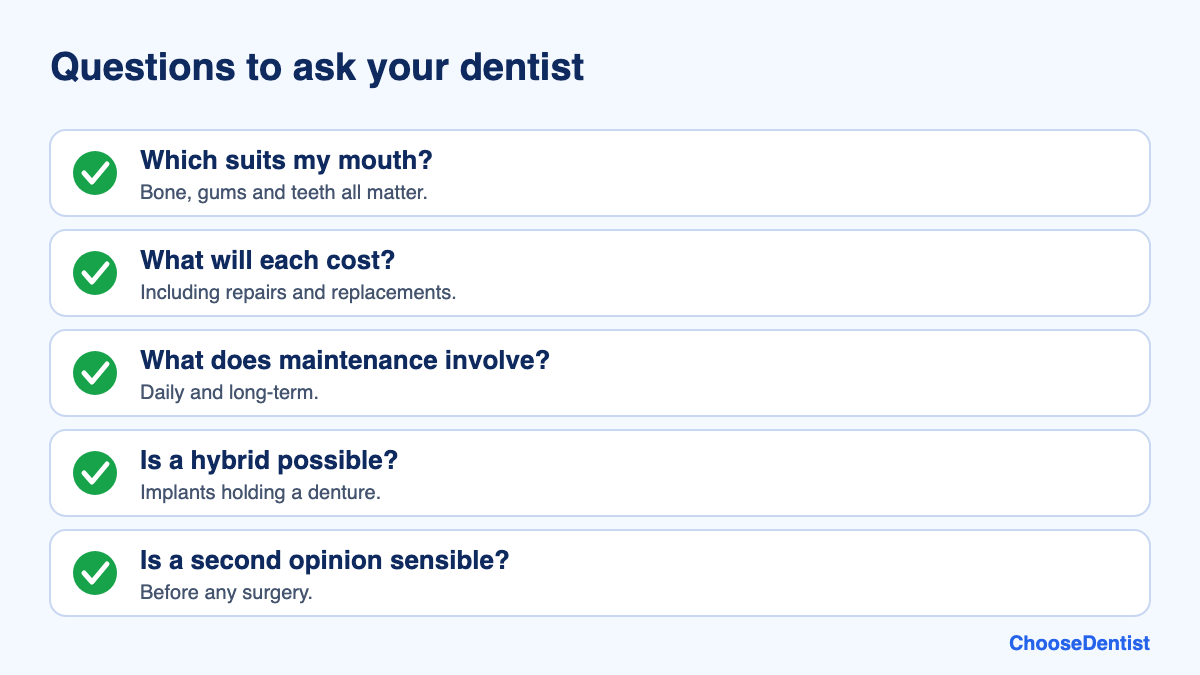
A sensible approach is to ask the dentist to explain both options in the context of the patient’s own mouth, with costs, timescales and a candid account of the downsides. Seeing models, photographs and a three-dimensional scan can help, and a second opinion is reasonable before committing to surgery.
The ChooseDentist directory of denture and implant practices lets visitors search by postcode, view CQC and Google ratings where they are available, and compare two practices side by side. Details of treatment and cost should be confirmed directly with the practice.