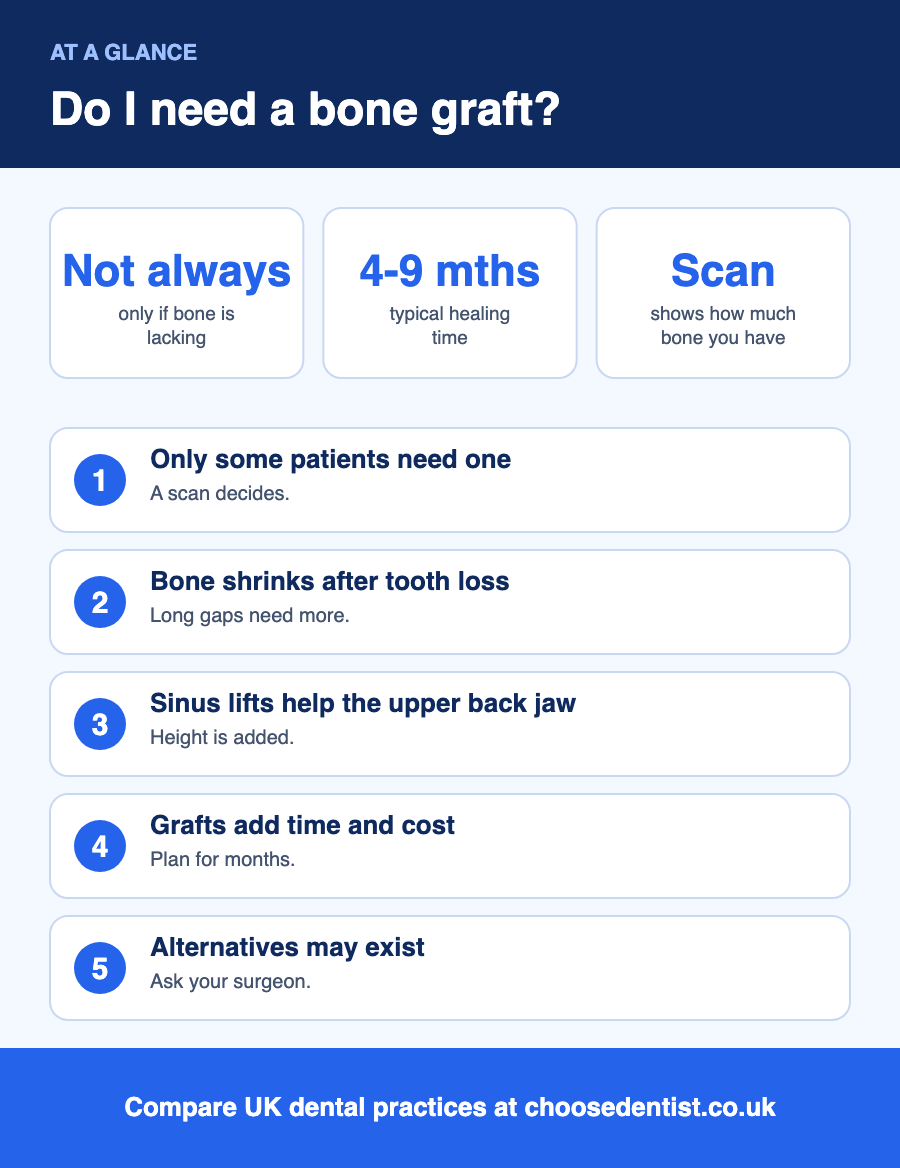
Not always. A bone graft is needed only when there is not enough healthy bone to hold an implant securely, and many people have enough and can go straight to implant placement. Whether you need one depends on how long the tooth has been missing, why it was lost, the position in the jaw and what a scan shows about the volume and quality of your bone.
Knowing why grafting is sometimes advised, what it involves and how it affects the timeline allows you to weigh a recommendation sensibly. This guide explains when a graft or a sinus lift is used in preparation for dental implants.
Why bone matters
The Wikipedia article on dental implants explains that an implant is stabilised by bone that grows onto the titanium surface. If the bone is too thin, too short or too soft, the implant may not be stable, and the chance of failure rises.
Bone also shrinks when it is no longer used. After a tooth is lost, the bone that supported it gradually resorbs, and the loss can be significant over several years. That is why a gap that has existed for a long time may need building up before an implant can be placed.
| Procedure | What it does | When it is used |
|---|---|---|
| Bone graft | Adds bone where it is thin or missing | Ridge too narrow or short |
| Sinus lift | Adds bone beneath the sinus | Upper back jaw with too little height |
| Socket preservation | Limits bone loss after an extraction | When an implant is planned later |
| No graft | Implant placed in existing bone | Enough healthy bone |
| Alternatives | Short, narrow or angled implants; bridge or denture | Where grafting is not wanted |
What a bone graft is
The Wikipedia article on bone grafting describes the surgical replacement of missing bone with material from the patient’s own body, a donor, animal sources or synthetic substitutes. In dentistry, the material is placed where the bone is deficient and, over months, the body replaces it with new bone of its own.
Common types include grafts using the patient’s own bone, bone from human donors, bone from animal sources, usually bovine, and synthetic materials. The dentist usually covers the graft with a membrane and closes the gum over it.
Sinus lifts
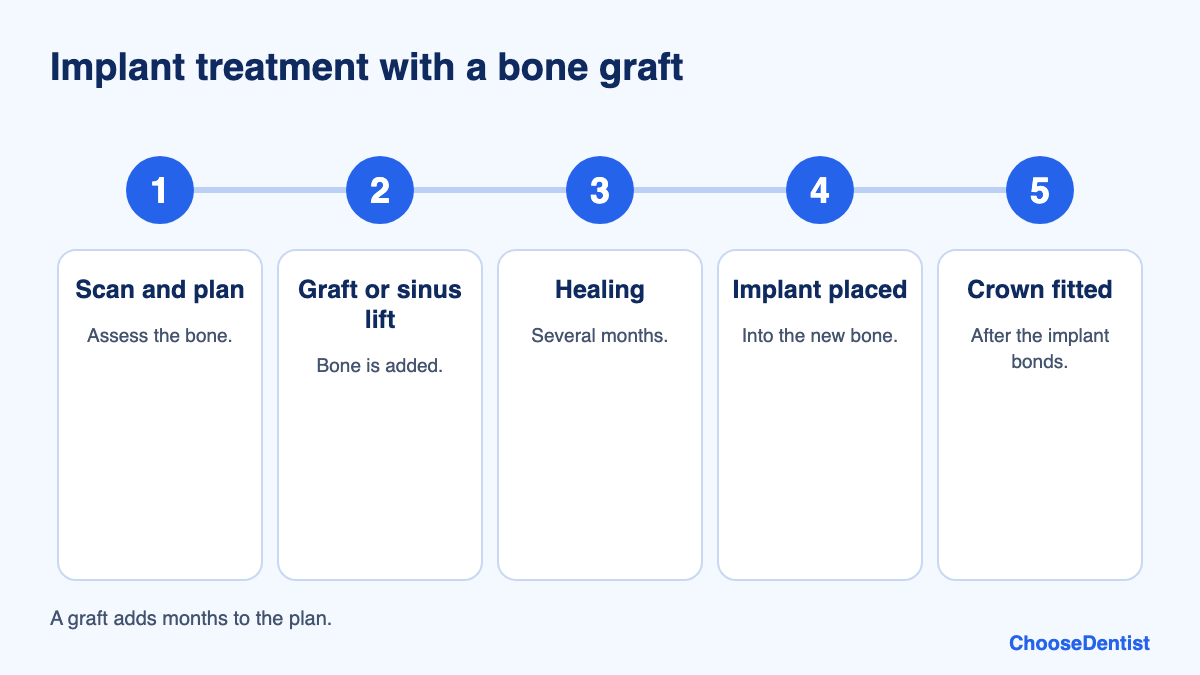
In the upper back jaw, the sinus cavity can sit close to the bone, leaving too little height. The Wikipedia article on the sinus lift describes a procedure in which the sinus membrane is lifted and bone graft material is placed in the space beneath it, so that an implant can be anchored. It may be done at the same time as the implant if there is enough bone to hold it, or as a separate stage with a wait of several months.
A scan shows how much height there is, and the surgeon will explain which approach is suitable.
Socket preservation
If a tooth has to be extracted and you plan an implant, the dentist may place graft material in the socket immediately to reduce bone loss. Alveolar ridge preservation describes techniques to limit the shrinkage that follows an extraction. This keeps the option of an implant open and may avoid a larger graft later.
If you know you are going to need an implant, raise it before the extraction.
How long it adds
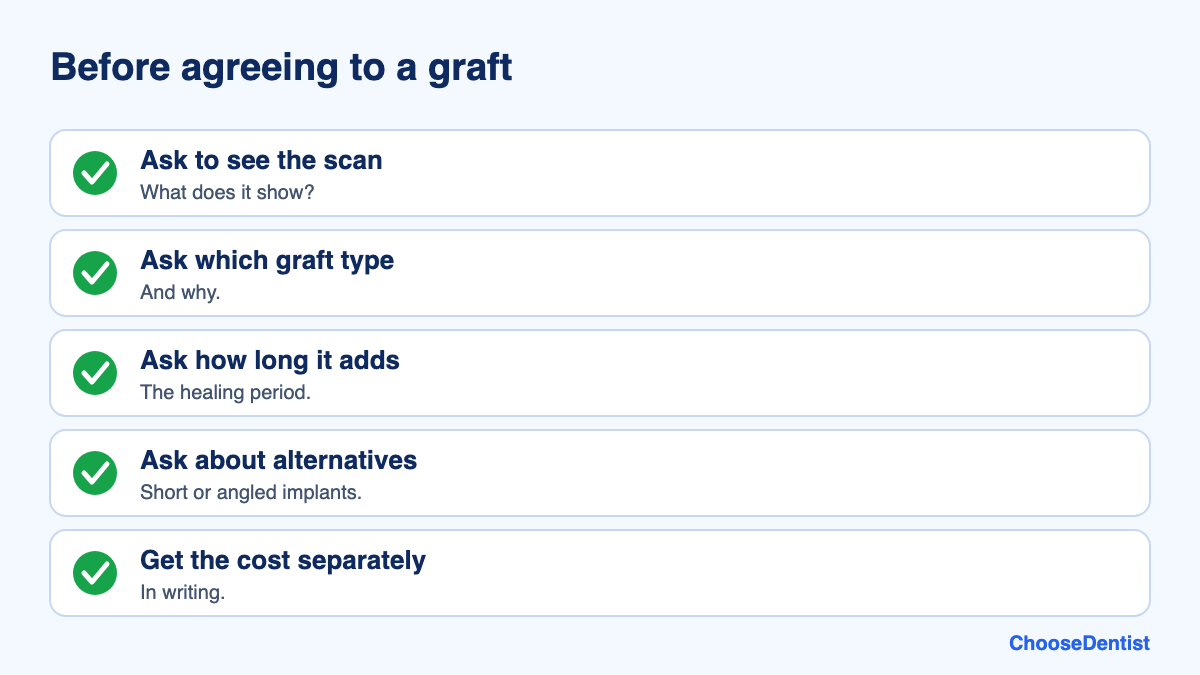
Grafts take time to mature. Depending on the type and size, the bone may need around four to nine months to integrate before an implant is placed, and some smaller grafts can be done at the same time as the implant. This is why treatment plans involving grafts take longer, and it is worth asking for a realistic timeline.
Alternatives
Alternatives to grafting include shorter or narrower implants, angled implants placed in the available bone, a different position, and for some patients a bridge or denture. Each has pros and cons, and a surgeon can say whether they are suitable. Our guide to dental implants versus dentures compares the broader options.
How the dentist decides
The decision rests on imaging. A standard X-ray gives a flat view, and many practices now use a three-dimensional cone beam scan that shows the height, width and density of the bone, and the position of nerves and sinuses. From this the surgeon can see whether an implant of the planned size can sit securely, or whether bone needs to be added first. If you are told that a graft is needed, ask to see the scan and have the reasoning explained.
Types of graft material
Patients are sometimes surprised by the choice of materials. Bone taken from your own body, often from the jaw or chin, has living cells and integrates well but requires a second surgical site. Donor human bone and animal-derived bone are processed so that they act as a scaffold into which your own bone grows. Synthetic materials do the same. Each has advantages, and some patients have religious or personal preferences about animal-derived materials, which the dentist should respect and discuss.
What to expect afterwards
After a graft, you may notice swelling and bruising for several days, with discomfort that is usually controlled with simple painkillers. You will be given instructions about rinsing, diet and avoiding pressure on the area, and you may be prescribed antibiotics. Small pieces of graft material can come away in the first days, which is not unusual, but anything more than that, or signs of infection, should be reported. A review appointment checks that the area is healing.
Planning ahead after an extraction
If an implant is a possibility in the future, mention it before any tooth is removed. Removing the tooth carefully, preserving the socket walls and placing graft material straight away can maintain the width and height of the bone, and may avoid a larger graft later. Waiting years after an extraction, by contrast, is a common reason for needing bone to be rebuilt. This is why dentists often ask patients about their plans for a gap at the time of an extraction.
Smoking and healing of grafts
Smoking is a particular concern with grafts, because the new bone depends on blood supply. Smokers have a higher rate of graft failure and infection, so surgeons often ask patients to stop before and after the operation. NHS stop-smoking services offer free support across the UK, and a dentist or pharmacist can point you in the right direction. Our guide to whether smokers can have dental implants covers the evidence.
Costs and the NHS
Grafting adds to the cost, and fees vary widely depending on the type and extent. The NHS says on its page about dental treatments that implants are usually only available privately and are expensive. NHS dental implants are rare and mostly private. NHS charging itself differs across the four nations: England has three bands and an urgent charge, Wales numbered bands with a contract reform under way, Scotland free examinations and free treatment under 26 with a capped share of the cost for other adults, and Northern Ireland a percentage of the dentist’s fee up to a ceiling per course. A written quote should show the graft separately.
Recovery
Recovery from a graft is similar to other oral surgery: swelling, mild pain and some bruising for several days, usually managed with painkillers and cold packs, soft food and careful cleaning. Smoking should be avoided, since it affects healing, and any signs of infection should be reported at once.
The ChooseDentist directory of dental implant practices can be searched by postcode, with CQC and Google ratings shown where available. Two practices can be compared side by side, and details of treatment and cost should be confirmed directly with the practice.