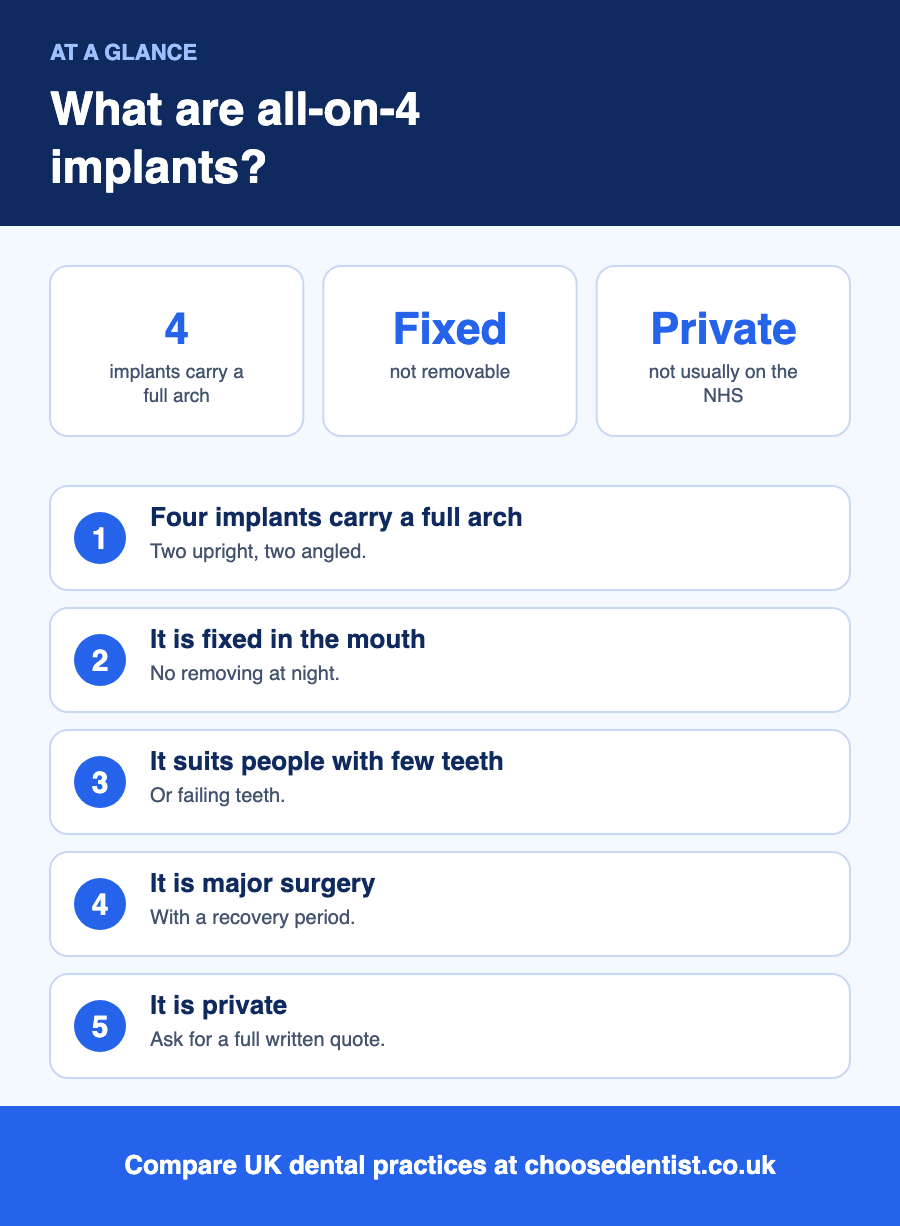
All-on-4 is a way of replacing a full arch of teeth, that is all the upper or all the lower teeth, with a fixed bridge supported by four dental implants, instead of one implant per missing tooth. The idea is that a small number of implants, placed at carefully planned angles, can carry a whole set of teeth, which reduces the number of implants and sometimes the need for bone grafting. It is a private treatment, and it is usually considered for people who have lost most or all of their teeth or whose remaining teeth cannot be saved.
Understanding what it involves, and how it differs from dentures and from implants placed tooth by tooth, helps patients to judge whether it is right for them. This guide explains the approach and its limits in relation to dental implants.
How it works
Instead of one post for each missing tooth, a full-arch bridge is attached to four implants. The two front implants are placed upright and the two back implants are angled, which allows longer implants to be anchored in the available bone and may avoid the sinus or nerve. The bridge, usually made of acrylic or a stronger material, replaces the whole arch and is fixed in place.
The Wikipedia article on dental implants describes implant-supported prostheses of this kind among the uses of implants, and notes that implants can support a single crown, a bridge or a denture.
| Feature | All-on-4 fixed bridge | Conventional denture |
|---|---|---|
| Support | Four implants in the jaw | Gums and suction |
| Fixed or removable | Fixed | Removable |
| Surgery | Yes | No |
| Typical time | A few months, with a temporary bridge | A few weeks |
| Cost | Many thousands of pounds, private | Lower; NHS dentures available |
| Cleaning | Under the bridge; hygiene visits | Remove and clean daily |
Who it suits
It is generally considered by people who have lost most or all of their teeth in one jaw, or who have teeth that are failing because of advanced gum disease or decay, and who want something fixed rather than a removable denture. It may suit people with reduced bone, because the angled implants can use the bone that is available.
It is not suitable for everyone. Uncontrolled gum disease, heavy smoking, poorly controlled diabetes and certain medical conditions raise the risk, and a scan is needed to confirm that the bone is adequate. Our guide to whether you are suitable for implants lists the main factors.

What happens
After assessment and planning, any remaining teeth that cannot be saved are removed, and the four implants are placed in one operation, usually under sedation or general anaesthetic. A temporary fixed bridge may be fitted on the same day or within a few days, which is why some practices describe it as teeth in a day. After a healing period of around three to six months, the permanent bridge is made and fitted.
The process is shorter than placing an implant for every tooth, but it is still a significant surgical procedure with a recovery period.
Advantages
Patients commonly choose it because it is fixed, so it does not slip or need removing at night, and it can feel more like natural teeth than a conventional denture. The Wikipedia article on dentures notes that lower dentures are less retentive because of the tongue and the loss of bone. A fixed bridge avoids that problem and may allow a wider range of foods.
Because fewer implants are used than for one implant per tooth, the cost is lower than a full set of individual implants, although it remains a substantial investment.
Risks and disadvantages
Risks include those of any implant treatment, such as infection, failure to bond and inflammation around the implants, as described in the Wikipedia article on peri-implantitis. Because a whole arch relies on four implants, the loss of one can affect the bridge, and a fracture of the acrylic can occur. Cleaning under the bridge needs attention, and regular hygiene visits are essential.
If the arrangement fails, revision can be complicated, so the experience of the surgical team matters.

The consultation and planning
Planning for a full-arch treatment is thorough. The dentist takes a detailed history, examines the mouth and gums, takes a three-dimensional scan to assess bone and may make models or digital scans for the bridge. You will be told which teeth need to be removed, how many implants are proposed, what the temporary and final teeth will look like and how long each stage will take. This is the time to ask for before-and-after photographs of similar cases, and to ask who will do the surgery and who will make the teeth.
Living with a fixed bridge
Once the bridge is fitted, most people adjust within a few weeks. Speech may feel different at first, and the tongue gets used to the new shape. Eating soft foods early on, then returning to a normal diet as advised, protects the healing implants. Cleaning is a daily task, using interdental brushes, a water flosser or superfloss to reach beneath the bridge, and hygiene visits are normally recommended every three to six months.
Maintenance and replacement
The acrylic teeth on a bridge wear and can chip, and they may need repair or replacement after some years, while the implants themselves are intended to last much longer. Some practices offer a stronger final bridge made of zirconia or titanium with acrylic. Ask what the long-term costs of maintenance are, how repairs are handled and what the warranty covers, because these running costs form part of the real price.
Costs and the NHS
Prices vary widely, and a full arch commonly costs many thousands of pounds. The NHS says on its page about dental treatments that implants are usually only available privately and are expensive. NHS dental implants are rare and mostly private. NHS charging itself differs across the four nations: England has three bands and an urgent charge, Wales numbered bands with a contract reform under way, Scotland free examinations and free treatment under 26 with a capped share of the cost for other adults, and Northern Ireland a percentage of the dentist’s fee up to a ceiling per course. It is sensible to ask for a written quote that covers the surgery, the temporary and final bridges, extractions, sedation, reviews and any warranty.
Questions to ask the surgical team
Because the treatment is complex, ask who will carry out the surgery and how many full-arch cases they have done, what happens if one implant fails, whether the final teeth are made in-house or by a laboratory and what warranty is offered. Ask what the clinic does about complications, how many review visits are included and what the fees will be for maintenance. Ask for the plan, with all costs, in writing, and compare it with other practices before agreeing.
Recovery in the first weeks
The first days after surgery involve swelling, bruising and some discomfort, usually controlled with painkillers, with a soft diet for several weeks. Rest, avoid strenuous exercise for a few days, keep the mouth clean as advised and attend your first review. Contact the practice if bleeding persists, if the temporary bridge breaks or loosens, or if you develop fever or increasing pain, because early attention matters.
Alternatives
Alternatives include a conventional complete denture, an implant-retained denture that clips onto two or more implants, and a bridge on more implants. Our guide to implants versus dentures explains the trade-offs.
The ChooseDentist directory of dental implant practices can be searched by postcode, with CQC and Google ratings shown where available. Two practices can be compared side by side, and details of treatment, warranty and cost should be confirmed directly with the practice.