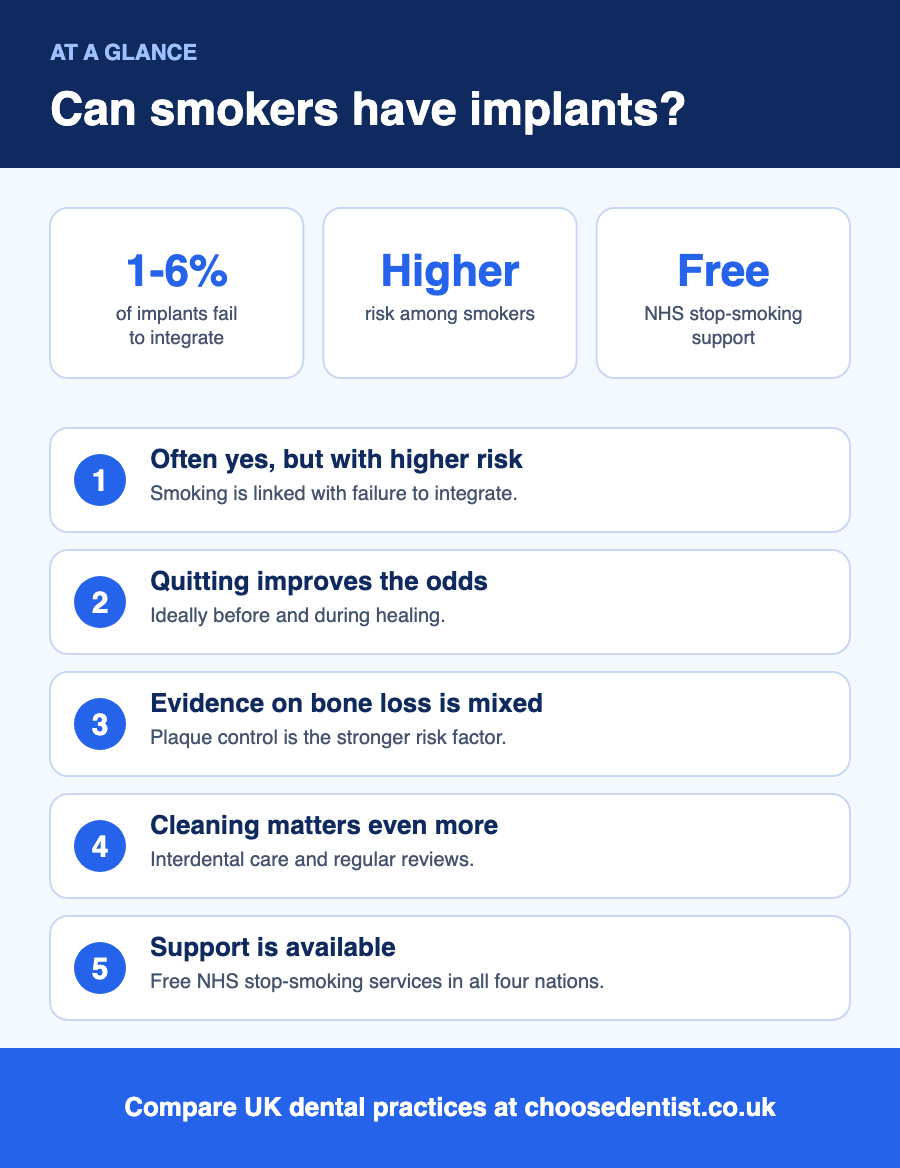
Smokers can have dental implants, but smoking raises the risk of complications, and many dentists will advise stopping before and after surgery. Tobacco affects the blood supply and the immune response in the mouth, which are exactly the things an implant relies on to heal and to stay healthy. The practical answer is that treatment is often possible, although the odds are better for those who can give up, even temporarily.
It is not an all-or-nothing matter, and the evidence is not quite as simple as it is sometimes made to sound. Understanding what is known, what is disputed and what a dentist is likely to recommend helps patients make a realistic decision about whether and when to go ahead.
How smoking affects healing
Smoking reduces blood flow to the gums and impairs the way tissues repair themselves, and it alters the bacteria that live in the mouth. After surgery, a titanium implant has to fuse with the bone, a process known as osseointegration, and this depends on good circulation and a calm healing environment. The Wikipedia article on dental implants lists smoking among the factors associated with failure of the implant to integrate, and notes that heavy smokers face a greater risk of peri-implantitis, the inflammatory disease that destroys the bone around an implant.
The same article reports that failure of integration happens in roughly one to six per cent of cases overall, so it is not common, but the risk is higher among those who smoke.
| Question | What is known | What it means in practice |
|---|---|---|
| Does smoking affect healing? | Linked with failure to integrate | Stopping before surgery improves the odds |
| Does smoking cause peri-implantitis? | Disputed; plaque control is the stronger factor | Meticulous cleaning and regular reviews |
| Can smokers still have implants? | Often yes, with informed consent | Dentists may delay treatment or review more often |
| Do nicotine products matter? | Nicotine narrows blood vessels | Discuss replacement therapy with the dentist |
What is disputed
The picture around long-term bone loss is less clear. The Wikipedia article on peri-implantitis says there is some debate as to whether smoking is a risk factor for peri-implantitis, even though smoking is clearly linked to gum disease around natural teeth, and it lists poor plaque control as the stronger and better-established cause. Researchers continue to investigate, and results differ between studies.
The sensible reading is that smoking is not proven to cause every failure, but it is consistently associated with worse outcomes, and the dental profession advises accordingly. The NHS lists smoking as a risk factor for gum disease and advises people who smoke to stop, which supports the same advice for the tissues around an implant.
What dentists usually advise
Advice varies, but a common approach is to ask patients to stop smoking for a period before surgery, often a few weeks, and to remain smoke-free during the early healing phase, which can last several months. Some clinicians are more flexible and will treat smokers provided they understand the risks and agree to attend more frequent reviews. Others prefer to delay treatment until the patient has quit.
Nicotine replacement products raise a question as well. Nicotine itself narrows blood vessels, so some dentists prefer patients to avoid it altogether during healing, whereas others consider replacement therapy a sensible step towards giving up. It is worth discussing openly.

Vaping and other forms of tobacco
The evidence on vaping and implants is limited, and dentists tend to take a cautious line because nicotine is still present and the effect on healing has not been fully studied. Cigars, pipes and chewing tobacco carry their own risks to the gums and bone. Patients should tell the dentist about all forms of nicotine they use, since the aim is to plan treatment honestly, not to judge.
Support to stop
Stopping smoking improves the outlook for an implant and for general and oral health. The NHS provides free support through local stop-smoking services, and a GP or pharmacist can advise on treatments. Many dental practices also offer advice, and a patient who is motivated by an implant may find that the prospect makes stopping easier. Even a reduction in the number of cigarettes helps.
Looking after an implant as a smoker
Patients who continue to smoke should be especially thorough with cleaning, since plaque control is the factor with the strongest evidence. Brushing twice a day, cleaning around the implant with interdental brushes and attending reviews and hygiene appointments frequently allow problems to be caught early. Any bleeding, swelling or taste change should be reported promptly.

Timing of treatment
Because the early healing period is the most sensitive, many clinicians plan implant surgery around a quit date. Stopping a few weeks before the operation allows the gums to recover some of their blood supply, and staying smoke-free until the implant has fully bonded, usually three to six months, gives the best chance of success. Patients who cannot manage this sometimes decide to delay treatment until they are ready, and the dentist can suggest interim options such as a temporary denture.
The risk of going ahead anyway
Some patients choose to proceed while still smoking. A dentist who agrees should explain the higher chance of complications, document that the risks were discussed and arrange more frequent reviews. It is also fair for a practice to point out that its warranty may not cover failures linked to smoking, so patients should read the terms before signing.
Questions to ask
Useful questions include whether the dentist treats smokers, what extra precautions they take, how much stopping would improve the odds, whether nicotine replacement is acceptable and what the warranty says about smoking.
Smoking and gum health in general
Smoking affects the whole mouth, not only implants. The NHS lists it as a risk factor for gum disease, and smokers are more likely to have receding gums, stained teeth and slower healing after any dental procedure. Stopping brings benefits well beyond the implant, from fresher breath to a lower risk of oral cancer, and dentists are used to supporting patients through the process. Treatment for smokers is therefore best seen as an opportunity to review habits, and many find that having an implant planned gives them a concrete reason to quit.
NHS and private options across the UK
Implants are usually a private treatment, so the discussion about smoking normally takes place in a private consultation. The NHS says that implants are mostly private and rarely available on the NHS, for example after mouth cancer or an accident. Stop-smoking support, however, is available through the NHS in all four nations, and NHS dentists give advice on smoking and gum health as part of routine care.
NHS dental charges for other treatment differ: England has three bands and an urgent charge, Wales a similar banded system with a contract reform under way, Scotland free examinations and free treatment under 26 with a capped share for other adults, and Northern Ireland a percentage of the dentist’s fee up to a ceiling. Private practices set their own fees, and some may charge for extra review appointments for higher-risk patients.
Making an informed choice
Patients who smoke should ask the dentist what the specific risks are for them, what would be done to reduce them, whether treatment should be delayed until they have quit and what the plan would be if a problem arose. An honest discussion at the outset is better than a surprise later.
The ChooseDentist directory of implant practices can be searched by postcode, with CQC and Google ratings shown where they are available. Two practices can be compared side by side, and the details of advice, aftercare and cost should be confirmed directly with the practice.