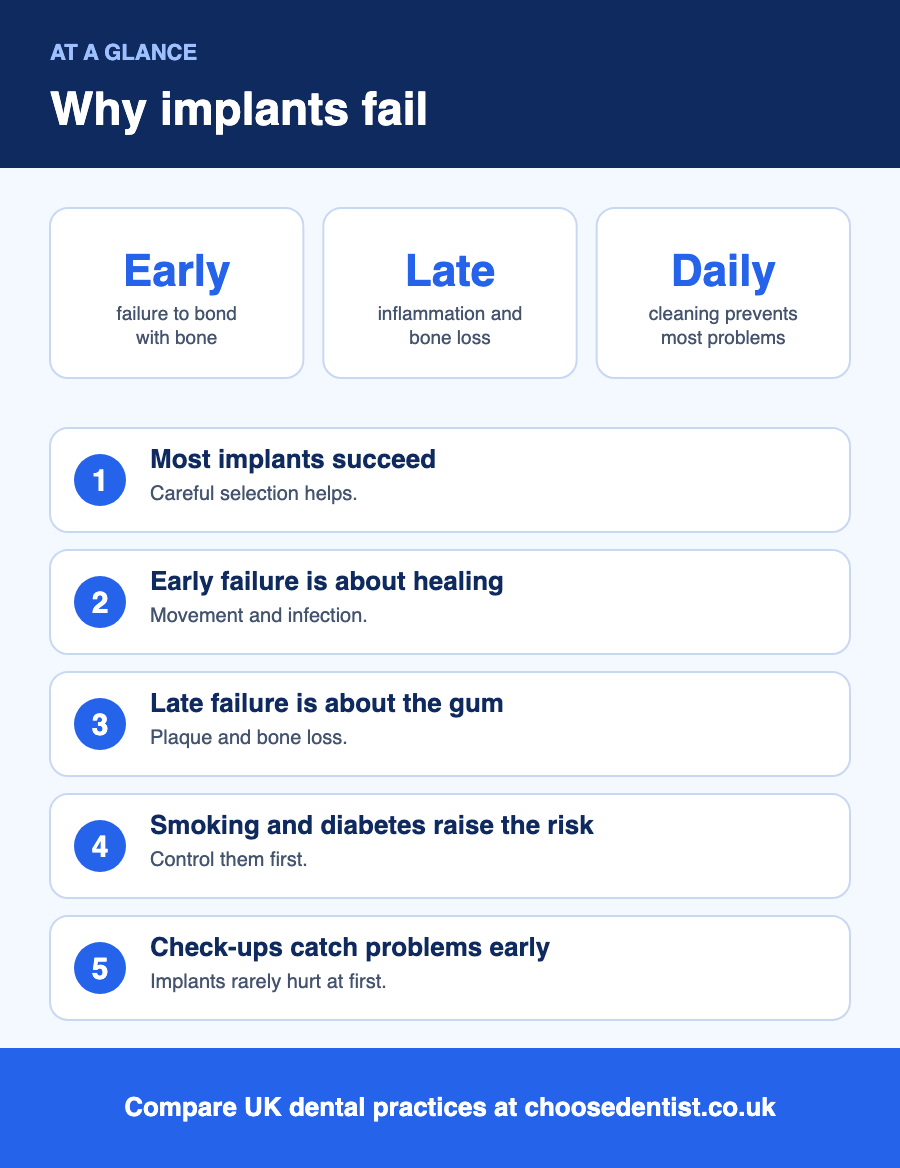
Most dental implants succeed, but a small proportion fail, and the reasons fall into two broad groups: failure to fuse with the bone in the first place, and loss of the bone and gum around an implant that has been in place for some time. Both can usually be anticipated by choosing a suitable patient and a careful clinician, and both are made less likely by good oral hygiene and regular reviews.
Understanding the causes helps patients to reduce their own risk and to spot problems early. This guide explains why dental implants fail, what the warning signs are and what can be done.
Early failure
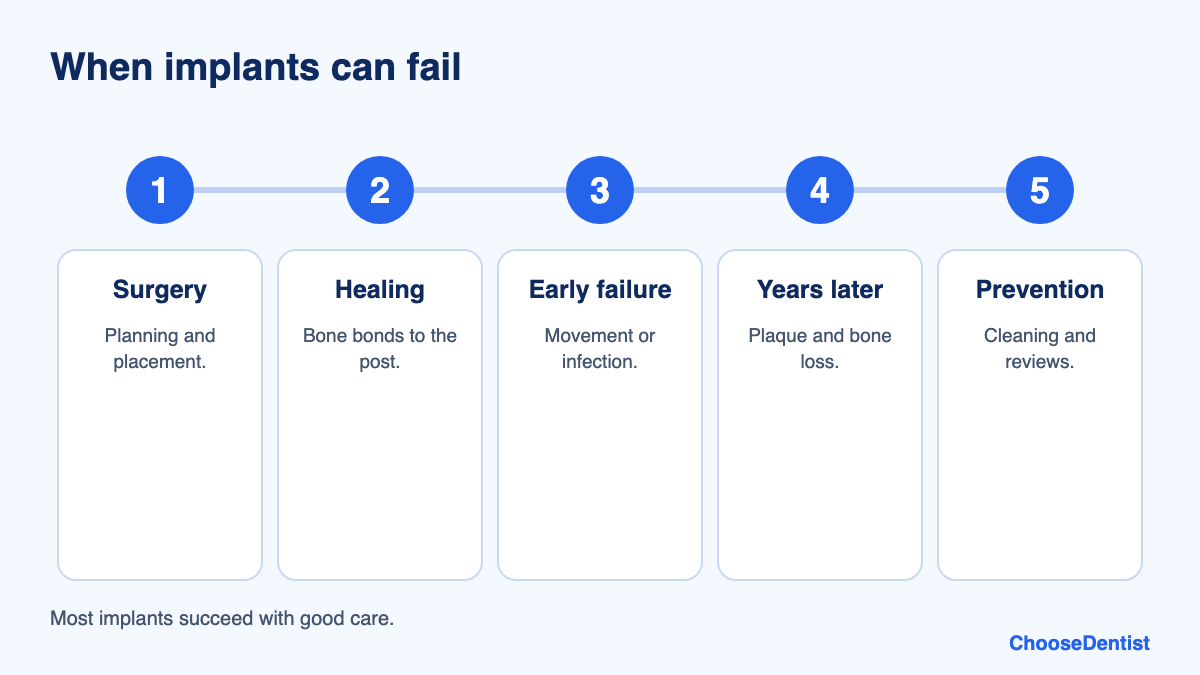
An implant relies on osseointegration, in which the bone grows onto the titanium surface and holds the post firmly. The Wikipedia article on dental implants explains that stability at the time of placement is the most important factor in success. If the implant moves during healing, becomes infected or is overloaded too soon, the bone may not bond and the implant becomes loose within the first weeks or months.
Contributing factors include poor bone quality, smoking, uncontrolled diabetes, infection at the surgical site, a poorly planned position and heavy biting forces during healing.
| Type of failure | Typical cause | Prevention |
|---|---|---|
| Early (first weeks to months) | Movement during healing, infection, poor bone, smoking | Careful planning; follow healing advice; stop smoking |
| Late: inflammation (mucositis) | Plaque around the implant | Daily cleaning; hygiene visits |
| Late: bone loss (peri-implantitis) | Untreated inflammation; gum disease history | Early treatment; regular reviews |
| Mechanical | Loose screw, fractured part, grinding | Night guard; check-ups |
Late failure
Later problems more often involve the tissues around the implant. The Wikipedia article on peri-implantitis describes an inflammatory condition affecting the soft and hard tissue around an implant, leading to progressive bone loss. It begins with inflammation of the gum, known as mucositis, which is reversible, and may progress to bone loss if the plaque is not controlled.
Other late causes include a fractured component, a loose screw, grinding and clenching that overload the implant and gum disease that was never fully treated. Our guide to what peri-implantitis is and how it is treated covers this in more depth.
Risk factors
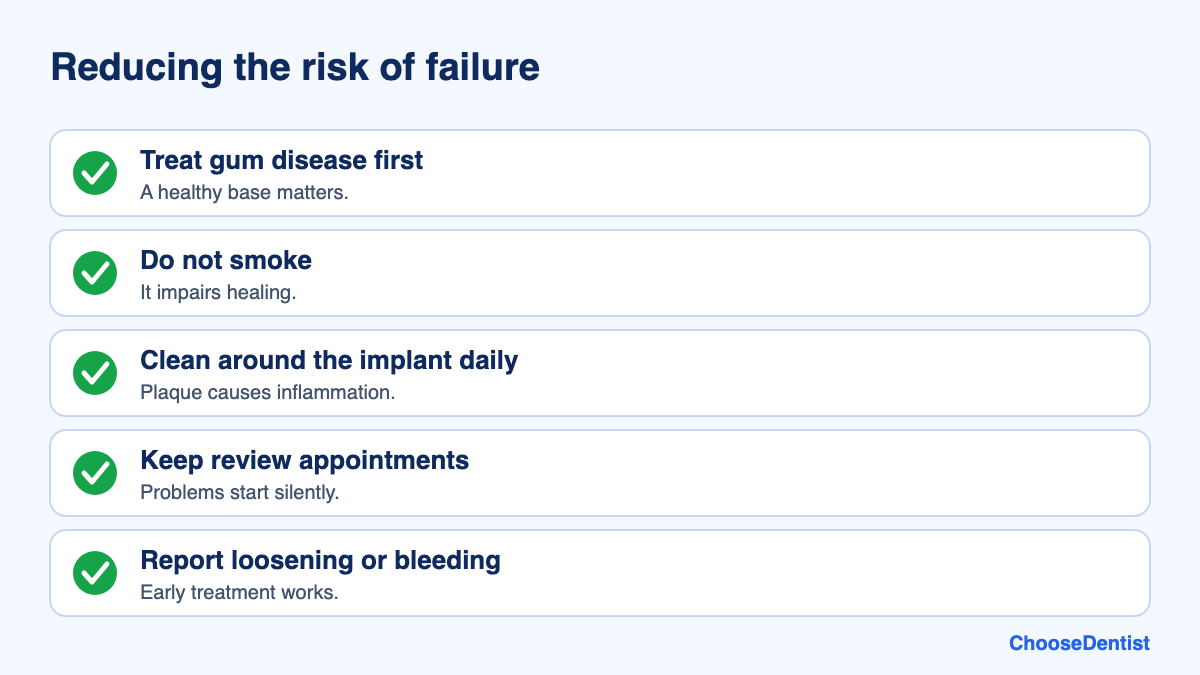
Smoking is among the best-known risk factors, because it reduces blood supply and impairs healing, and our guide on whether smokers can have dental implants explains the evidence. Poorly controlled diabetes, a history of gum disease, a dry mouth, poor oral hygiene and missed check-ups also raise the risk. Heavy grinding is another, which is why dentists sometimes recommend a night guard.
The skill of the clinician and the quality of planning matter as well. A scan to assess bone, careful positioning and a bite that does not overload the implant all reduce the chance of problems.
Warning signs
Contact the practice if an implant feels loose, if the gum around it is red, swollen or bleeds, if there is pus or a bad taste, if there is pain on biting or if the crown feels different. Early inflammation is much easier to treat than established bone loss, and implants rarely hurt until a problem is advanced, so regular check-ups matter even when everything feels fine.
Prevention
Prevention starts before surgery, with treatment of gum disease and decay, a frank discussion of smoking and health conditions and a full assessment of the bone. Afterwards, brush twice a day, clean between the teeth and around the implant daily, attend hygiene visits and check-ups at the interval advised and wear a night guard if you grind.
The Oral Health Foundation says in its guide to dental implants that implants can last many years with good care, but that there is no lifetime guarantee, which is consistent with the picture above.
How common is failure?
Published studies report that most implants survive for many years, and survival rates are high in healthy patients treated by experienced clinicians. The exact figures depend on the study, the population, the implant system and how success is defined, so it is hard to give a single number. What is consistent is that failure is more likely in smokers, in people with a history of gum disease, in poor bone and when oral hygiene is poor. A dentist should be willing to discuss realistic figures for your own situation, and not simply offer a blanket reassurance.
Gum disease before and after
A history of gum disease is one of the strongest predictors of problems around implants, because the same bacteria are involved. This is why dentists insist that gum disease is treated and controlled before surgery, and why people who have lost teeth to gum disease are asked to attend maintenance visits more often. Our guide to dental hygiene visits explains how often a hygienist is advised.
Overloading and grinding
Teeth that clench and grind put heavy forces on implants, and because an implant has no ligament to cushion it, those forces go straight to the bone. Over time, this can loosen screws, fracture components or contribute to bone loss. A night guard is often recommended, and the dentist will adjust the bite so that the implant does not bear more than its share.
Choosing the right practice
The experience of the clinician and the practice’s approach to planning and follow-up matter. Ask how many implants the clinician places, whether a scan is used to plan, what happens if the implant fails and whether a warranty is offered and under what conditions. A practice that welcomes these questions and puts the answers in writing is giving you a useful indication of its standards.
What happens if an implant fails
If an implant fails early, it is often removed, the area is allowed to heal and a new implant may be placed later, sometimes after a bone graft. If it fails late because of peri-implantitis, treatment may involve deep cleaning, antibiotics, surgery to clean the area or removal if the bone loss is severe. The dentist will advise on whether a replacement is suitable.
Ask the practice what its policy is, because many offer a warranty on the implant, usually with conditions such as attendance at reviews. Get it in writing.
Questions to ask about your own risk
Ask the dentist what they see as the main risks in your case, what has been done to reduce them and what you can do. Questions worth asking include whether gum disease or smoking is a concern, whether the bone is adequate, how the bite will be checked and how often you will be reviewed. A candid answer is more reassuring than a promise of a perfect result, and the same conversation is a good opportunity to confirm what the warranty covers.
After failure
Losing an implant is distressing and can feel like a failure of the whole plan, but it is not the end of the road. Once the area has healed and the cause is understood, many patients can have a replacement, sometimes with a graft, and others choose a bridge or denture. Understanding why it failed, whether through infection, smoking, overloading or poor bone, is the first step to deciding what to do next, and it is worth asking the dentist for an explanation.
NHS and private care
NHS dental implants are rare and mostly private. NHS charging itself differs across the four nations: England has three bands and an urgent charge, Wales numbered bands with a contract reform under way, Scotland free examinations and free treatment under 26 with a capped share of the cost for other adults, and Northern Ireland a percentage of the dentist’s fee up to a ceiling per course. Because implants are mostly private, any warranty, repair or replacement is a matter between you and the practice, which is another reason to ask about it at the outset.
The ChooseDentist directory of dental implant practices can be searched by postcode, with CQC and Google ratings shown where available. Two practices can be compared side by side, and details of guarantees and review arrangements should be confirmed directly with the practice.