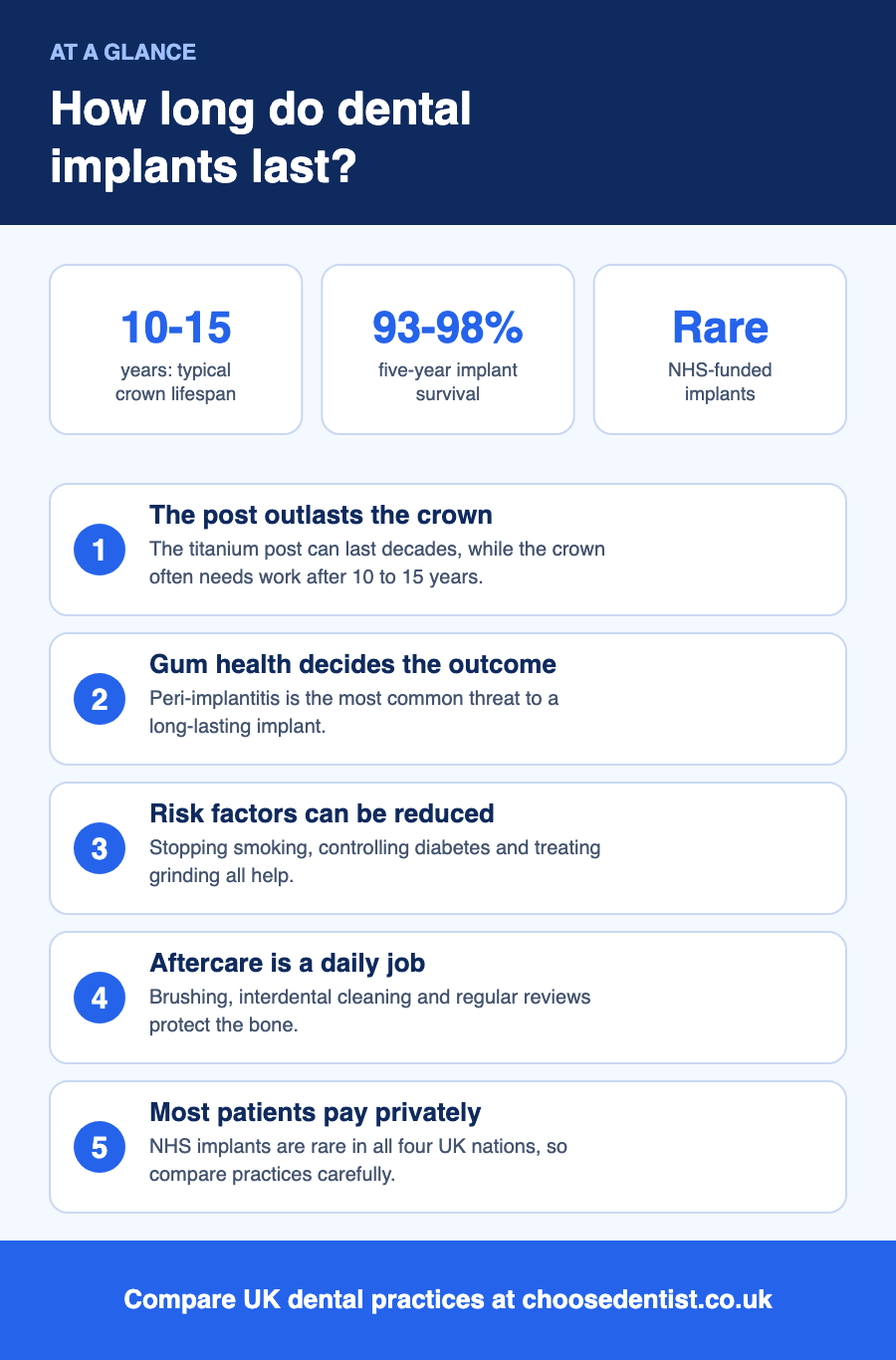
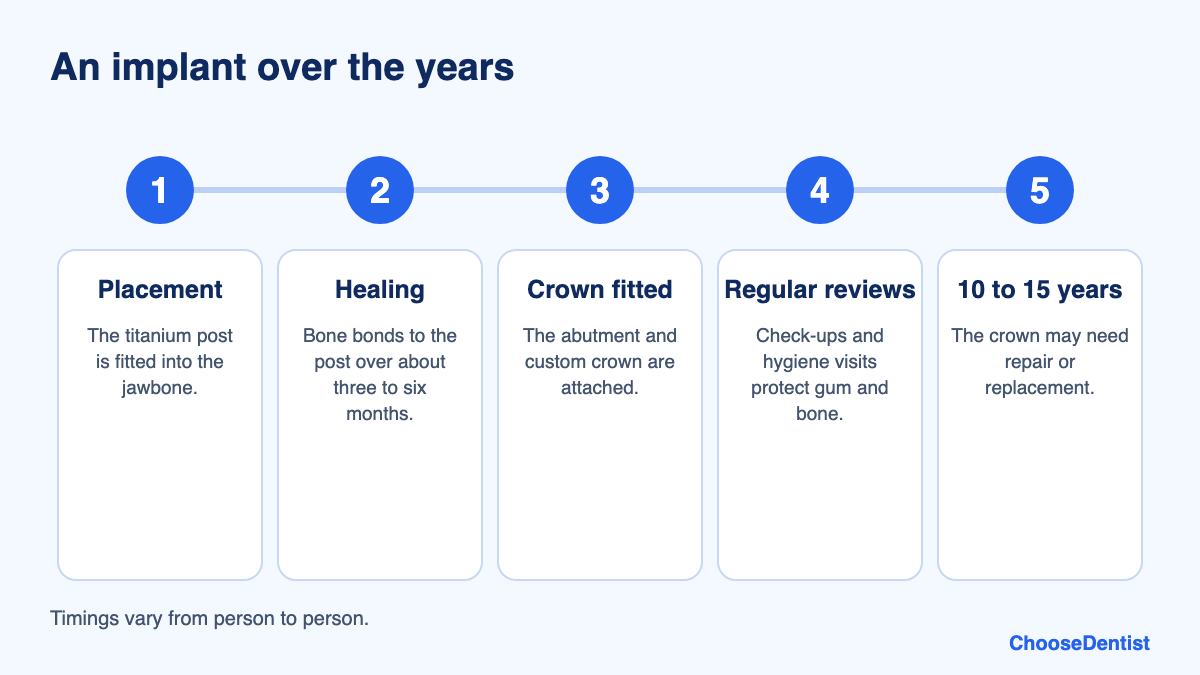
A well-placed dental implant is designed to outlast most other ways of replacing a tooth, and in a healthy mouth the titanium post can remain in the jaw for decades. The crown that sits on top is another matter. It takes the daily wear of chewing and is more likely to need attention after ten to fifteen years. Because the two parts age at different rates, a single figure for the lifespan of an implant seldom describes what actually happens.
Dentists tend to separate survival from success. An implant has survived if it is still in the mouth; it counts as a success only when the surrounding gum and bone are healthy and the crown works as it should. The gap between those two definitions goes a long way towards explaining why published statistics can look so different from one another.
New to implants? This short video shows how they work, step by step.
What the research suggests
The Wikipedia article on dental implants summarises the evidence in a fairly measured way. It reports survival rates of 93 to 98 per cent at five years in healthy tissue, with the prosthetic tooth itself lasting around ten to fifteen years. Longer studies that follow patients for sixteen to twenty years record a success rate of between 52 and 76 per cent, with complications of one kind or another in up to 48 per cent of cases. Those complications include loosened screws and chipped porcelain as well as problems with the bone, so they are best read as a reminder that implants need maintenance, not as proof that they fail.
The charity Oral Health Foundation takes a similar line in its guide to dental implants. It states that there is no lifetime guarantee, but that implants which are looked after properly often last a very long time. That is a sensible way to think about the figures: the implant is a long-term investment whose condition depends heavily on the person who owns it.
| Component | Typical lifespan | What tends to shorten it |
|---|---|---|
| Titanium implant post | Often two decades or more in a healthy mouth; no guarantee can be given | Gum disease around the implant, smoking, uncontrolled diabetes, heavy grinding |
| Abutment and screw | Long-lived, although the screw can loosen and need tightening | Excessive biting force, ill-fitting parts, poor bite balance |
| Porcelain or ceramic crown | Commonly 10 to 15 years | Grinding, chipping, wear and an uneven bite |
| Implant-supported denture clips | Replaced as they wear, often within a few years | Daily insertion and removal, grinding, poor cleaning |
Factors that shorten the life of an implant
By far the most common threat is infection of the tissues around the implant. Plaque builds up at the junction between gum and metal just as it does around a natural tooth, and the resulting inflammation is known as peri-implant mucositis. If it is left alone it can progress to peri-implantitis, in which the supporting bone is gradually lost and the implant becomes loose. The Wikipedia article gives a figure of about 9.7 per cent for peri-implantitis around single-crown implants in one analysis, and as high as 40 per cent in another, which shows how much the estimate depends on how the condition is defined and how long people are followed.
Smoking is closely linked to both failure to integrate and later bone loss, and poorly controlled diabetes raises the risk of peri-implantitis. Heavy grinding or clenching of the teeth places repeated force on the crown and its screw, which is why a dentist may suggest a protective night guard. Certain medicines, including bisphosphonates used for osteoporosis, have also been associated with a higher rate of implant failure, so a full medical history matters before treatment begins.
The quality of the original surgery counts too. Failure of the bone to bond with the implant occurs in roughly one to six per cent of cases, and the single most important factor is how firmly the post is held when it is first placed. Experience, planning and a proper three-dimensional scan all improve the odds.
Looking after an implant
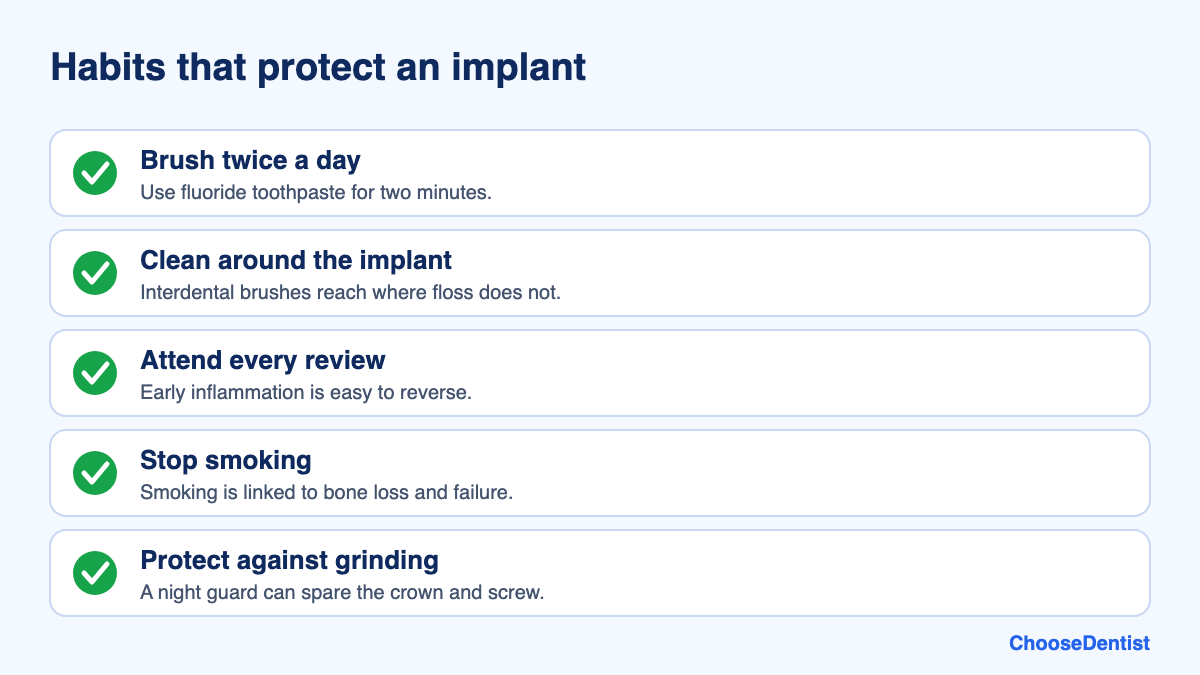
Day-to-day care is not complicated, although it does require consistency. The Oral Health Foundation advises cleaning an implant much as one would natural teeth: brushing for two minutes at night and once more during the day with fluoride toothpaste, and cleaning around the implant each day with interdental brushes. Floss is often less effective around the neck of an implant, so many clinicians recommend small interdental brushes or a water flosser instead.
Regular check-ups matter just as much as home care. A dentist or hygienist can measure the depth of the gum pockets around the implant, take an X-ray when needed, and catch early inflammation while it can still be reversed. How often these visits should take place varies. Some people are advised to attend every three to four months in the first year, others every six or twelve months once everything has settled.
Habits outside the bathroom have an effect as well. Stopping smoking, wearing a night guard if teeth are ground, and avoiding the use of the teeth to open packaging or crack hard objects all reduce the load on the crown and screw.
Warning signs deserve a prompt call to the practice: bleeding or swelling around the gum, a bad taste, a crown that feels loose or shifts when pressed, and tenderness when biting. Pain is not always present in early peri-implantitis, which is one reason routine reviews are worth keeping even when everything feels comfortable. Treatment at that stage is often a professional deep clean and better home care; leaving it makes the problem harder to reverse. Where an implant does fail, it can usually be removed and the site left to heal, after which a new implant may be placed, sometimes with a bone graft, depending on the cause.
NHS and private treatment across the UK
Implants are provided mainly as a private treatment. According to the NHS page on dental treatments, they are available on the NHS only in a small number of situations, for example for people who cannot wear dentures because of mouth cancer or an accident. In England, the standard NHS charge bands cover crowns, bridges and dentures at Band 3, but dental implants themselves are not part of the routine package, and any hospital-based provision is restricted to patients with a specific clinical need.
The position in the other nations is broadly the same, although the charging systems differ. Scotland charges NHS patients a percentage of the cost of treatment up to a maximum for each course, with free check-ups for everyone and free treatment for those under 26. Northern Ireland also applies a percentage charge with an upper limit, while Wales uses three numbered bands alongside a separate urgent charge and is in the process of reforming its dental contract. Whichever nation a person lives in, an implant for a missing tooth in a healthy mouth is something most patients will fund themselves.
Private fees are set by each practice. As a rough guide, a single implant with a crown commonly costs from about £1,800 to £3,000 or more, depending on the region, the materials and whether a bone graft is required. A written treatment plan should list the scan, surgery, abutment, crown and follow-up visits separately, and it should explain what the warranty covers and what the patient must do to keep it valid. Several practices offer monthly payment plans, which can spread the cost without changing the clinical plan.
Choosing where to have an implant placed
Since the long-term outcome depends so much on planning and aftercare, the choice of practice deserves as much thought as the choice of implant. Useful questions include how many implants the clinician places each year, what happens if a complication arises, and whether follow-up reviews are included. Reading the inspection information published by the Care Quality Commission for practices in England, and its equivalents in the other nations, gives an independent view of how a practice is run.
The ChooseDentist directory of implant practices lets visitors search by postcode, view CQC ratings and Google ratings where they are available, and compare two practices side by side before booking a consultation. It is a convenient starting point for building a shortlist, although the details of any treatment and its price should always be confirmed with the practice itself.