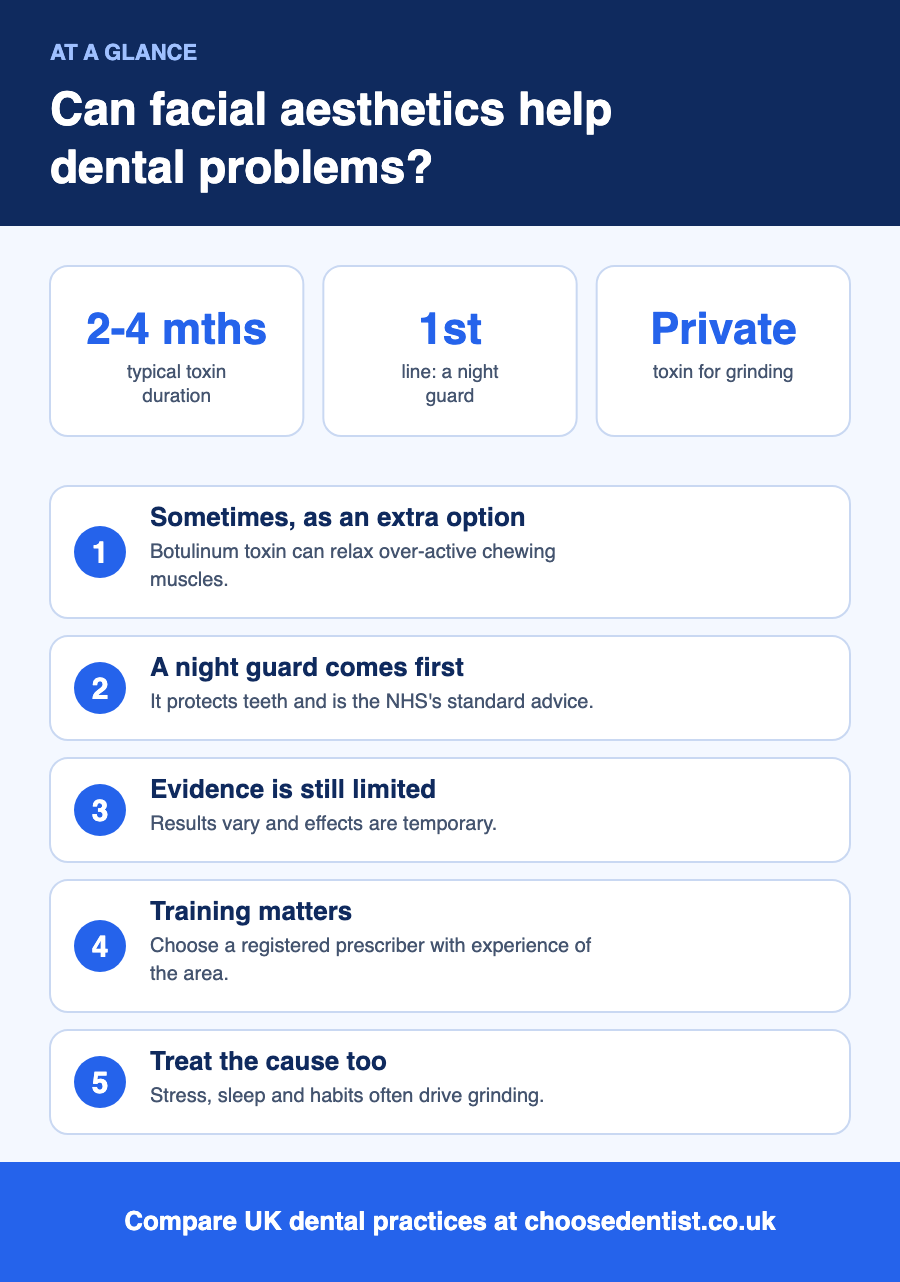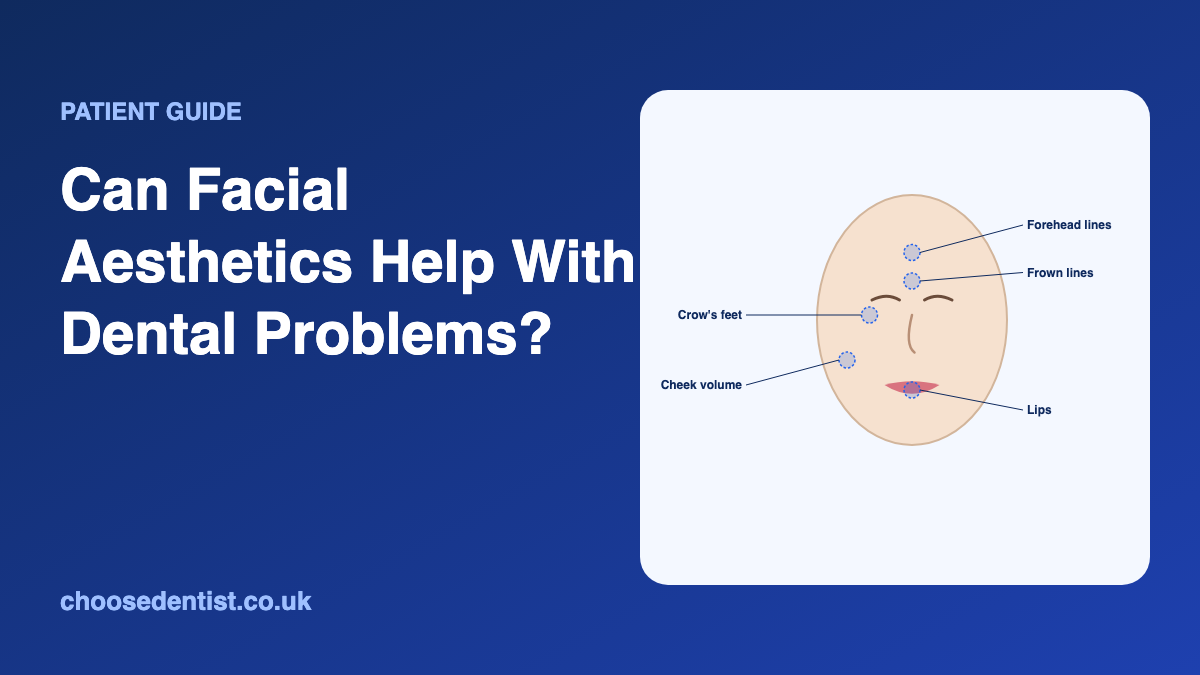
In some cases, yes. Botulinum toxin, the active ingredient in anti-wrinkle injections, relaxes muscles, and dentists have used it as part of the management of jaw clenching, teeth grinding and related muscle pain. It is not a first-line treatment, and it does not replace the standard measures, but it is one of the options that a dentist may discuss when a patient has strong chewing muscles and symptoms that other approaches have not controlled. This is one of the areas where facial aesthetics overlaps with ordinary dental care.
The overlap is limited, and it comes with caveats. The evidence base is smaller than for cosmetic uses, treatment is off-label in many cases, and the effects are temporary. It should be considered only after a proper assessment and a discussion of the alternatives.
Teeth grinding and jaw clenching
The NHS describes teeth grinding, or bruxism, as something that can happen awake or asleep, with stress and anxiety the commonest causes and other links including sleep problems such as snoring and sleep apnoea, some medicines, smoking and heavy alcohol or caffeine use. Possible signs include jaw pain, worn or broken teeth, headaches, earache and disturbed sleep, and the NHS notes that jaw pain can lead to temporomandibular disorder, or TMD.
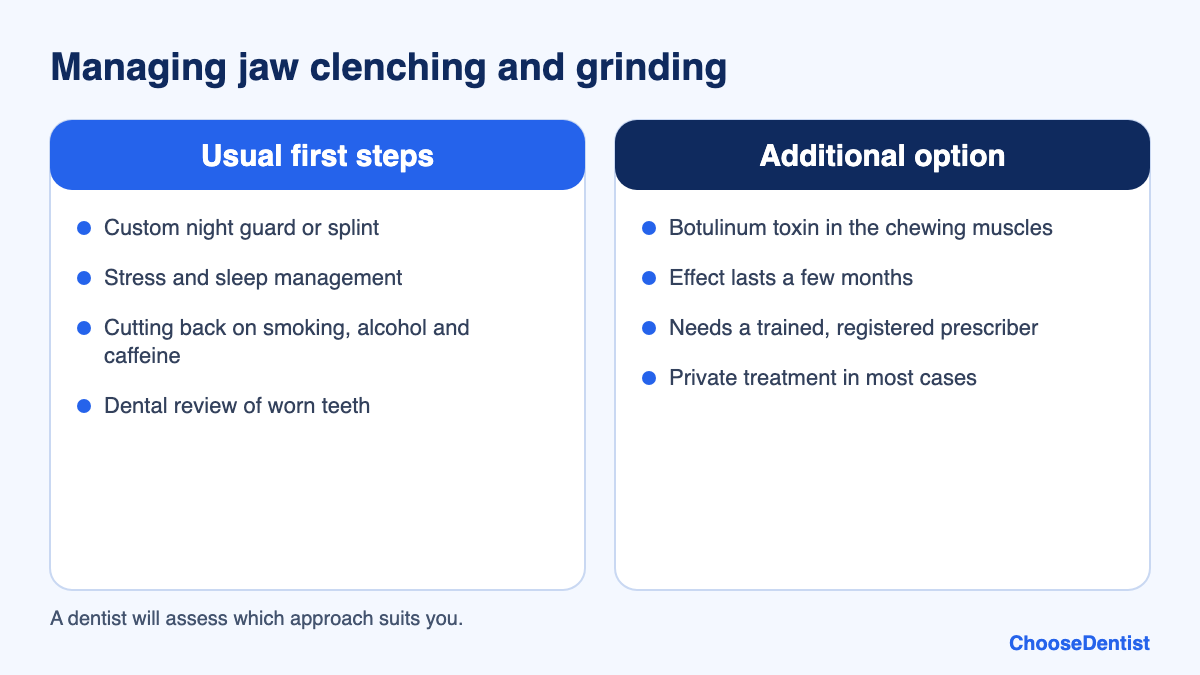
The first line of treatment, according to the NHS page on teeth grinding, is a mouth guard or splint worn at night and made to fit the teeth to protect them from damage, together with advice and support for stress from a GP and help with smoking and alcohol. It points out that treatment is not always needed. The page does not mention botulinum toxin, which gives a fair indication of where it sits: it is an additional option, not a standard NHS recommendation.
| Approach | What it involves | Notes |
|---|---|---|
| Night guard or splint | A custom-made guard worn at night | The usual first treatment; protects the teeth |
| Stress and lifestyle measures | Advice on stress, sleep, smoking, alcohol and caffeine | Often addresses the cause |
| Botulinum toxin | Small doses injected into the chewing muscles | An additional option; effect lasts months; private treatment |
| Specialist assessment | Referral for persistent pain or TMD | Considered when other measures have not helped |
How botulinum toxin is used
The Wikipedia article on botulinum toxin notes that the toxin is used to relax jaw muscles that are clenched, and that bruxism is among the indications. It also mentions that injecting the masseter, the main chewing muscle, can reduce chewing power for solid foods, and that high repeated doses can cause muscle atrophy, which recovers after a break from treatment.
In practice, a small dose is injected into the masseter on each side, and sometimes into the temporalis muscle at the temple. The effect begins after several days and typically lasts for a few months, so treatment is repeated if it is helpful. Some patients notice a slimmer jawline as the muscle reduces in bulk, which is a cosmetic side effect that some welcome and others do not.
What the evidence shows
Research on botulinum toxin for bruxism and jaw pain exists but is less extensive and less consistent than for its established medical uses, and results vary between studies. Some patients report fewer headaches, less jaw tension and reduced wear on their teeth, while others notice little difference. Because of this, many clinicians reserve it for patients with significant, persistent symptoms who have not responded to a night guard and other measures, and they present it as a trial. It does not cure the underlying cause.
Risks include weakness of the chewing muscles, difficulty with firm foods, an altered smile if nearby muscles are affected, and the general risks of injectables, such as bruising and, rarely, spread of the toxin. The treatment should be given by a practitioner with specific training in this application, who understands the anatomy of the area.
Other ways facial aesthetics overlaps with dentistry
Beyond bruxism, there are a few other points of contact. Dermal fillers can be used to support the lips and soften lines around the mouth, which some patients want alongside cosmetic dental treatment so that the final look is balanced. Following extensive restorative or orthodontic work, a change in the position of the teeth and the support of the lips can alter the appearance of the lower face, and a dentist may discuss whether aesthetic treatment has a role.
These are cosmetic choices. A good practitioner will make clear what is clinical and what is cosmetic, and will not suggest that fillers are needed to complete a dental treatment unless there is a genuine reason.
Safety and who should provide it
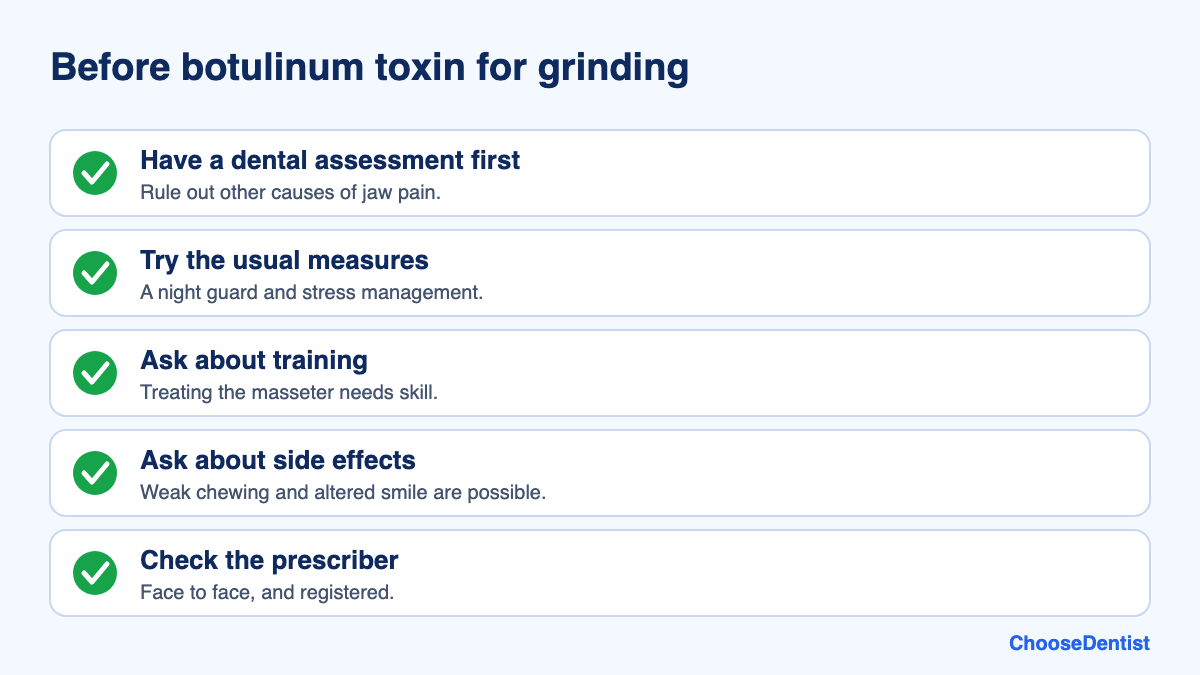
The same safeguards apply as for cosmetic work. Botulinum toxin is a prescription-only medicine, and the Joint Council for Cosmetic Practitioners advises on its page about unregulated treatments that patients should insist on a face-to-face consultation with a qualified prescriber, check the practitioner’s registration and avoid unlicensed products. A dentist is a registered prescriber and, working within their competence and with suitable training, can prescribe and administer the toxin for appropriate indications.
Patients should ask what training the dentist has in treating the masseter, how the dose will be decided, what the risks are and what the plan is if the result is not as hoped.
NHS and private options across the UK
For teeth grinding, the NHS offers advice and a night guard, and dental care of this kind is charged under each nation’s ordinary system: England and Wales use numbered bands and an urgent charge, Scotland provides free examinations and charges adults over 26 a share of the cost up to a maximum, and Northern Ireland charges a percentage of the dentist’s fee up to a ceiling. Botulinum toxin for bruxism is generally provided privately in dental practice, and fees depend on the area treated and the dose, commonly from about £150 to £400 per treatment, though this varies.
A night guard may be provided either on the NHS or privately, and private ones are often more durable. It is reasonable to ask the dentist which type is suitable.
Looking after the jaw at home
Simple habits can reduce clenching and strain. Applying a warm flannel to the side of the face eases tight muscles, and consciously keeping the teeth apart and the lips closed during the day, with the tongue resting gently on the roof of the mouth, helps those who clench while awake. Cutting back on chewing gum and on very hard or chewy foods rests the muscles, while relaxation techniques, regular exercise and a calmer bedtime routine tackle the stress that so often lies behind grinding. These measures cost little and carry no risk, and they are worth trying alongside any dental treatment.
Questions to ask at a consultation
A dentist considering botulinum toxin for jaw symptoms should be able to explain why it is suggested, what other measures have been tried, what dose is planned and how long the effect is expected to last. Patients can ask about the chances of weak chewing, whether the face shape may change, how many sessions are likely and what the total cost will be. Asking for the treatment plan in writing, and for a review appointment a few weeks after the injections, helps to judge whether it is worth continuing.
First steps for jaw symptoms
Anyone with jaw pain, clicking, headaches or worn teeth should see a dentist for an assessment before considering injections. The NHS advises seeing a dentist for tooth damage or sensitivity from grinding, for pain in the jaw, face or ear and when a partner notices grinding during sleep. Often a night guard, stress management and attention to sleep are enough.
The ChooseDentist directory of facial aesthetics practices can be searched by postcode, with CQC and Google ratings displayed where available. Two practices can be compared side by side, and details of the treatments offered and their price should be confirmed directly with the practice.