
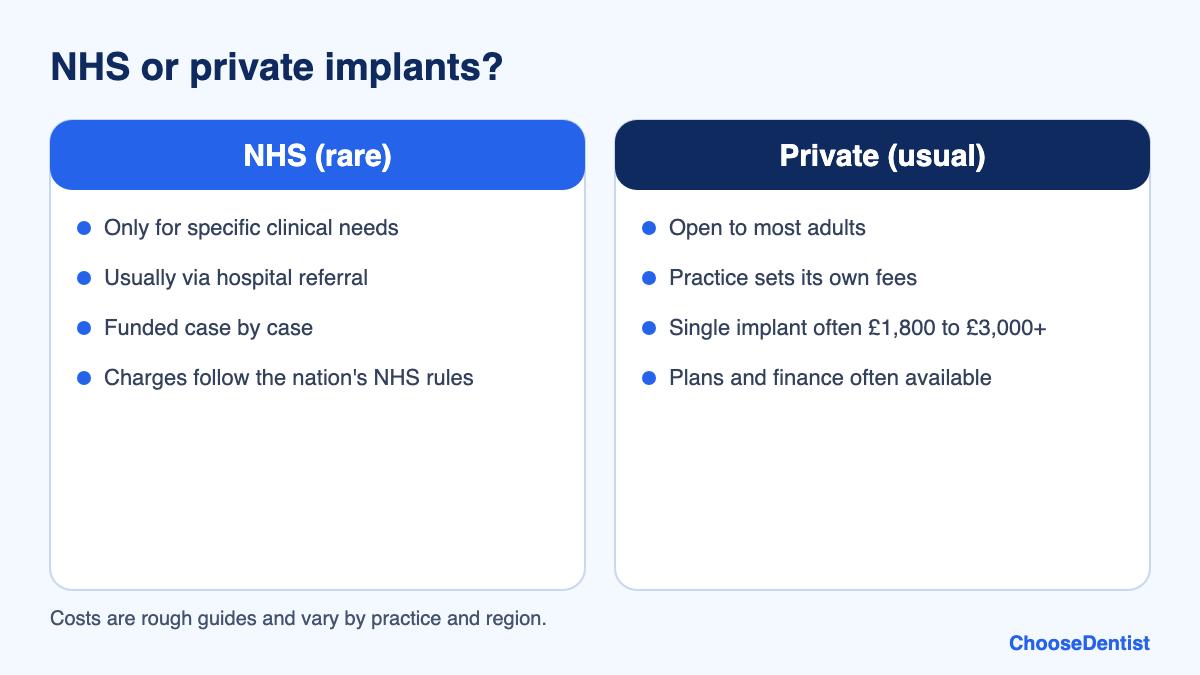
For most adults in the United Kingdom, dental implants are not something the NHS provides. The standard NHS offer in all four nations covers treatment that is clinically necessary to keep the mouth healthy, and a missing tooth can nearly always be replaced in other ways, such as a bridge or a denture, that fall within that remit. Implants are therefore treated as an elective, mainly private option, with a small number of exceptions that are worth understanding.
The picture is complicated slightly by the fact that health is a devolved matter. England, Scotland, Wales and Northern Ireland each run their own dental charging arrangements, and although none of them funds routine implants, the way patients pay for the NHS treatment they do receive varies a good deal from one nation to the next.
When the NHS does provide implants
The NHS website states that implants are usually private and expensive, and that they are rarely offered on the NHS. Where they are, it is typically for people who cannot wear dentures because of a specific clinical reason, such as mouth cancer or an accident. Such cases are generally dealt with through hospital dental services or specialist referral rather than through a high street NHS dentist, and a referral from a dentist or consultant is normally needed.
Other situations that can qualify include some congenital conditions, where teeth have never formed, and extensive damage after radiotherapy or surgery to the head and neck. Eligibility is judged case by case against local commissioning policies, which is why one health board or integrated care board may fund treatment that another does not. A patient who thinks they may fit one of these categories should ask their dentist or hospital team about a referral instead of expecting a routine appointment to lead there.
| Nation | How NHS dental charges work | Routine implants |
|---|---|---|
| England | Three numbered bands plus an urgent charge; one charge per course of treatment | Not part of the routine bands; rare hospital-based cases |
| Scotland | Free examinations for all and free treatment under 26; others pay a share up to a maximum | Not routinely funded; limited specialist cases |
| Wales | Three bands plus an urgent charge; contract reform under way | Not routinely funded; limited specialist cases |
| Northern Ireland | Percentage of the dentist's fee up to a ceiling per course | Not routinely funded; limited specialist cases |
How NHS dental charges work in each nation
In England, the NHS website lists three charge bands and an urgent band, and a patient pays one charge for a complete course of treatment, which is determined by the most expensive band involved. Crowns, bridges and dentures fall in the highest band, and implants do not appear on the list. The details are explained on the NHS page on how much NHS dental treatment costs. Children, pregnant women, those who have had a baby in the last year and people receiving certain benefits are exempt.
Scotland takes a different approach. According to NHS Inform, NHS dental examinations are free for everyone and treatment is free for people under 26, while other adults pay a share of the cost up to a maximum for each course of treatment. Northern Ireland, according to nidirect, generally charges 80 per cent of the dentist’s fee up to a ceiling per course of treatment, with free care for certain groups including some benefit recipients. Wales has three bands and an urgent charge, and the Welsh Government has announced that charges rose in April 2024 while a new contract is being introduced.
How a referral for NHS implants works
A patient who believes they qualify does not usually apply directly. The route begins with the dentist, who assesses the mouth, records why dentures or a bridge would be unsuitable and, where appropriate, refers the patient to a hospital dental department or restorative service. The specialist team then decides whether the case meets the local criteria. Waiting times can be long, and some areas have very few places, so it helps to ask early and to keep a copy of any letters or reports from a cancer or maxillofacial team, since they support the application.
A refusal is not necessarily final. Patients can ask for the reasons in writing and, in most areas, can request a review or a second opinion through their local health board or integrated care board.
What private implant treatment involves
Where implants are not available on the NHS, the practice sets its own fees. A single implant with a crown commonly costs from about £1,800 to £3,000 or more, with extra charges for a bone graft, sedation or a three-dimensional scan, and the cost of replacing several teeth rises accordingly. These figures are rough guides only; they vary by region and by the materials used.
Because there is no standard price list, comparing quotes properly depends on knowing what each includes. A good written plan separates the consultation and scans, the surgery, the abutment, the crown and any follow-up reviews, and it sets out the warranty terms and any conditions attached to them, such as attending regular hygiene visits. It should also state which parts of the plan, if any, are NHS treatment, because a practice that offers both must say clearly which is which. Many practices also offer finance or monthly payment plans, and a few run membership schemes that include routine care alongside discounts on private work.
Mixed NHS and private care
Many practices provide both kinds of care, and it is common to find an NHS dentist who also offers private implants. The NHS page on dental services states that a patient should be told which treatments are NHS and which are private, together with the cost, and that a written treatment plan should be provided for anything beyond a basic course. Confusion arises mainly when the two are blended without explanation, so it is wise to ask for the implant element to be priced and signed for separately from any NHS fillings or check-ups.
It is also worth remembering that NHS and private charges cannot be swapped between each other. Paying privately for an implant does not remove the right to NHS care for other clinically necessary treatment, and an NHS band charge does not contribute towards a private fee.
Alternatives the NHS does fund
Where an implant is not available, NHS dentistry in all four nations offers other ways of replacing missing teeth. A bridge uses neighbouring teeth to support a replacement, and dentures can replace one tooth, several or a full arch. Both sit in the top charge band in England and in the equivalent categories elsewhere. Neither is as stable or as long-lasting as an implant, and a bridge involves reshaping the neighbouring teeth, but they are available to patients who meet the usual NHS conditions and they cost considerably less.

Some people choose a hybrid route, using NHS care for routine check-ups, fillings and gum treatment while paying privately for an implant. This is perfectly acceptable, although the dentist should keep the two parts of the treatment separate and explain the charges for each in writing.
Finding a practice that offers implants
Since the decision is largely a private one, the choice of practice carries more weight than it would for routine NHS care. It is sensible to compare the experience of the clinician, the aftercare arrangements and the clarity of the quote, and to check the inspection information published by the Care Quality Commission in England and by the regulators in the other nations.
The ChooseDentist directory of implant practices allows visitors to search by postcode, to see which practices list implants among their services, and to compare two of them side by side, including their CQC and Google ratings where available. Prices and availability should still be confirmed directly with the practice.
