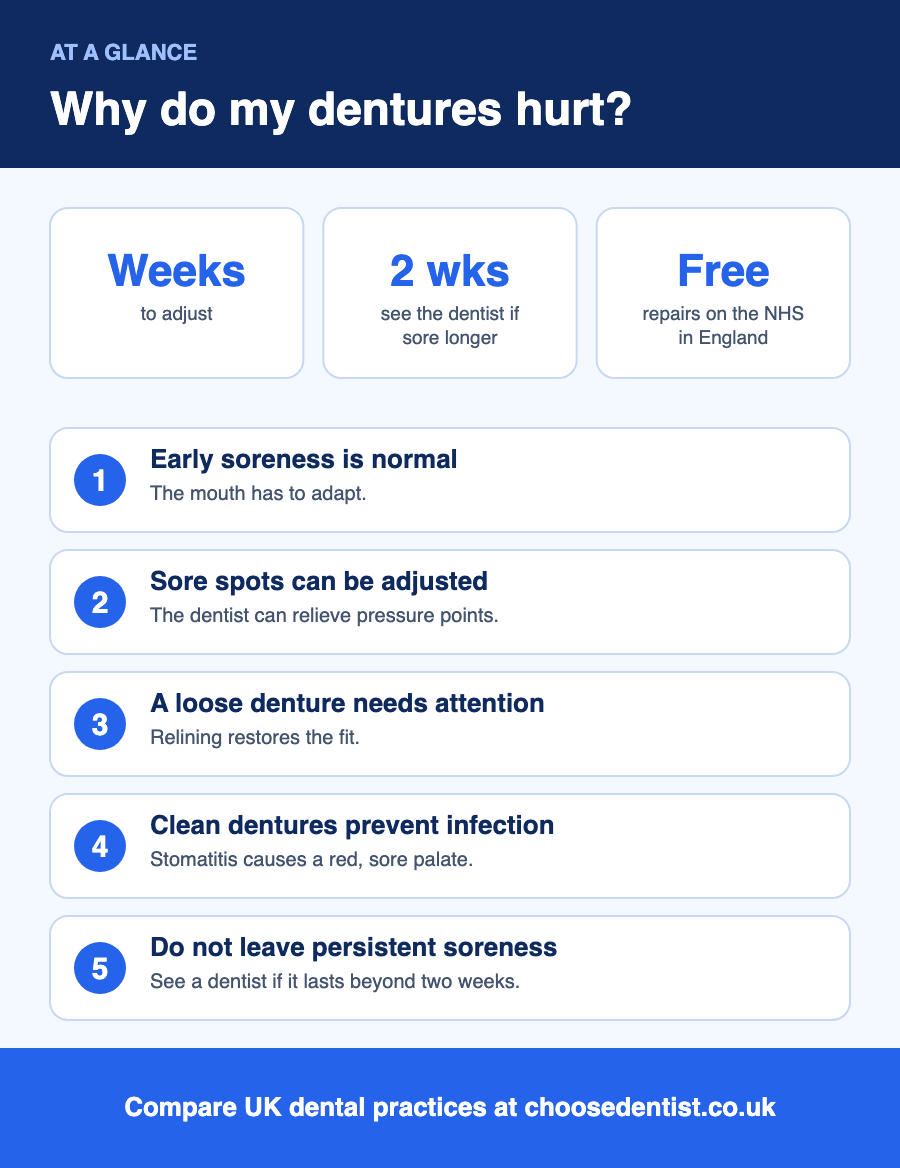
Dentures commonly hurt at first, because the gums and mouth have to adapt to a new appliance, and sore spots are among the most frequent problems in the early weeks. Pain that continues, or that appears after the dentures have been comfortable for a while, usually has an identifiable cause such as a poor fit, a high spot, a cracked denture or an infection, and it can almost always be put right.
The Wikipedia article on dentures says that complete dentures are painful at first and can take some time to get used to. That is a normal part of adjusting, but discomfort should improve, not worsen, and any persistent pain is a reason to see the dentist.
Normal discomfort while adapting
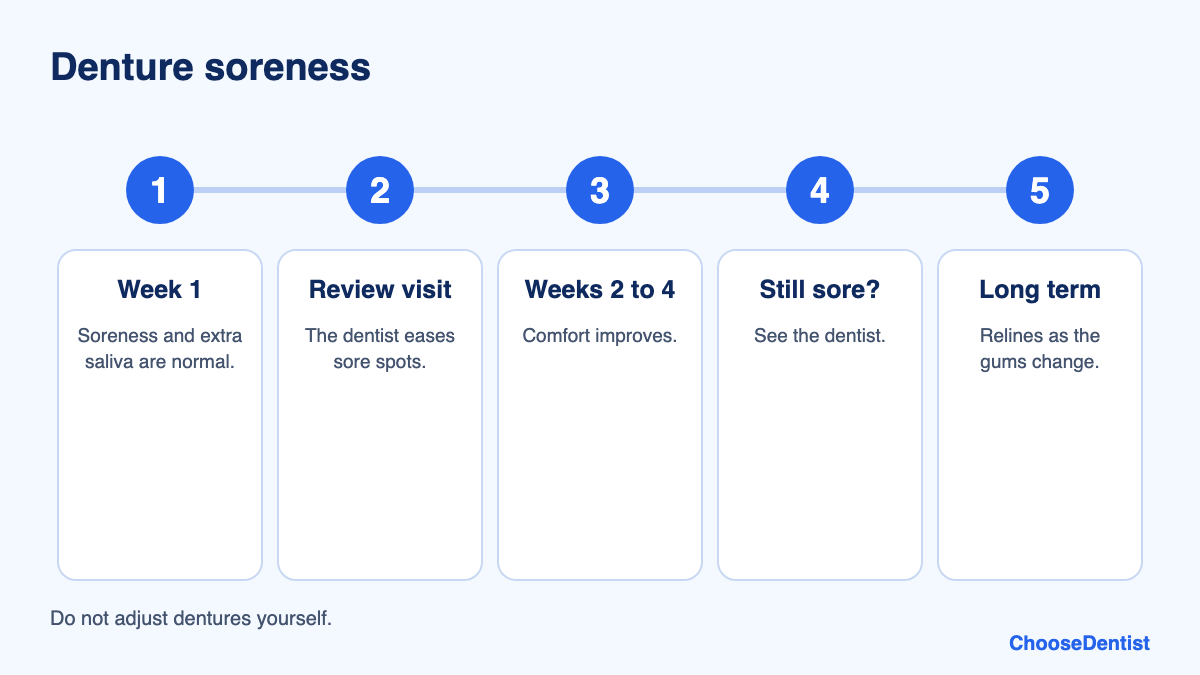
New dentures press on gums that are not accustomed to them, and the cheeks, lips and tongue have to learn new movements. The NHS says that adjusting can take a few weeks and suggests practising putting the dentures in and taking them out and starting with softer foods. During this time, mild soreness, extra saliva, a feeling of fullness and a slightly altered speech are normal.
Most patients are given a review appointment within a few days to a week to ease any sore spots, and several adjustments may be needed as the gums settle. Attending these visits makes a significant difference.
| Cause | Typical sign | What helps |
|---|---|---|
| Normal adjustment | Mild soreness and extra saliva in the first weeks | Soft foods, review appointment, patience |
| Pressure spot or high bite | Localised red or ulcerated area; pain on biting | Dentist adjusts the denture |
| Loose denture after gum shrinkage | Rubbing and food trapping | Reline or replacement |
| Denture stomatitis | Red, sore palate under the denture | Cleaning, leaving it out at night, antifungal treatment |
| Cracked or broken denture | Sharp edge or sudden pain | Professional repair |
Common causes of soreness
A pressure spot, where the denture presses too hard on one area of gum, is the commonest cause, and it shows as a localised red or ulcerated patch. A denture that is too high, so that it touches before the other teeth, can cause pain when biting. Over time, as the gums and jawbone shrink, a once-comfortable denture becomes loose and rubs, and food can become trapped underneath, causing further irritation.
The NHS notes that poorly fitting or uncleaned dentures can cause a sore mouth, infections and further problems with eating and speaking. Infection with yeast, known as denture stomatitis, causes a red, sore palate under an upper denture, and the Wikipedia article describes it as a common complication.
Other causes
Pain may not come from the denture alone. A remaining natural tooth with decay or gum disease, a clasp that presses on a tooth, a cracked or broken denture with a sharp edge or a mouth ulcer unrelated to the denture can all cause discomfort. Dry mouth from medicines reduces the natural cushioning of saliva, and nutritional deficiencies can contribute to sore tissue. A dentist can distinguish between these.
What helps at home
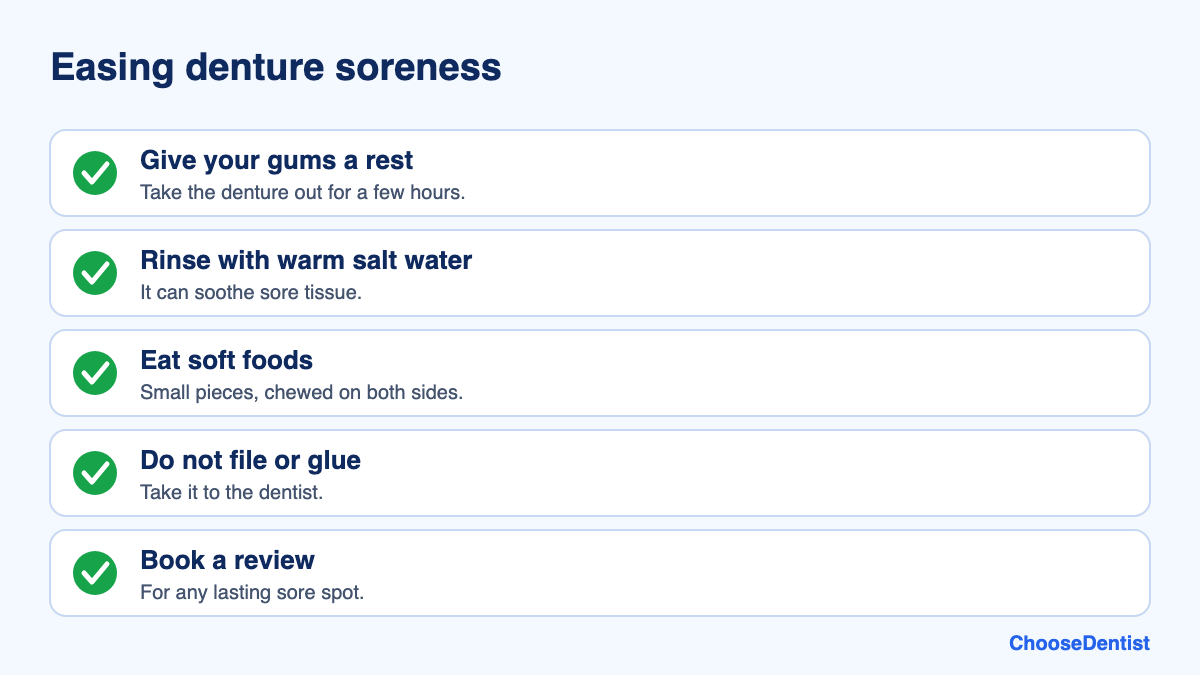
Taking the dentures out for a few hours gives the gums a rest, and keeping them clean prevents infection. A warm salt-water rinse, half a teaspoon in a glass of water, may soothe sore tissue, and over-the-counter oral gels can ease discomfort. Eating soft foods, cutting food into small pieces and chewing on both sides at once reduces the load.
What should not be done is trying to adjust or file the denture oneself, or using glue to mend it, since this can make the fit worse and harm the mouth. The denture is best taken to the dentist, and wearing it for several hours beforehand helps to show where the sore spot is.
When to see the dentist
An appointment is advisable if soreness lasts more than a week or two, if there is a persistent ulcer, if the denture is loose, if the gum is red, swollen or has white patches, or if the pain is severe. The NHS advises regular dental check-ups for denture wearers, because the mouth continues to change and problems can develop under a denture without being noticed.
Any sore area that does not heal within about two weeks should be examined, as persistent ulcers can occasionally signal a more serious problem and need checking.
What the dentist can do
Adjustments are often quick. The dentist marks the pressure spot, relieves it with a small adjustment and checks the bite. A reline adds a fresh layer to the inner surface to restore the fit, and a repair mends cracks. Antifungal treatment is prescribed for stomatitis, with advice to clean the denture and leave it out at night. If the denture is beyond repair, a new one is made, perhaps with a different design.
Lower and upper dentures
Lower dentures are more often uncomfortable than upper ones, because they have a smaller area to rest on and the tongue pushes against them, which makes them move. The Wikipedia article notes that lower dentures are less retentive because of the tongue and greater bone resorption. Sore spots tend to appear along the ridge, and eating can be difficult. Upper dentures can cause a gagging sensation or soreness in the roof of the mouth. Each has its own remedies, and where a lower denture stays loose, an implant-retained option may be worth discussing.
Bone and gum changes over time
After teeth are lost, the bone that held them gradually shrinks, which alters the shape of the gum ridge and loosens the denture. This is a slow process but it continues for years, so a denture that fitted well can become uncomfortable. Weight loss and illness can also change the shape of the mouth. Regular reviews and relines, usually every few years, keep the fit comfortable, and a denture that rocks or slips is a signal that something needs adjusting.
Pain from eating
Pain when chewing is often caused by uneven pressure, food trapped under the denture or a denture that moves. Cutting food into small pieces, chewing on both sides and avoiding very hard or sticky foods help in the short term. If pain persists, the dentist can check the bite, look for pressure spots and consider a reline. Patients who avoid foods because of discomfort risk a poorer diet, which affects general health, so it is worth seeking help.
NHS and private options across the UK
Adjustments to NHS dentures are generally part of the course of care, and the NHS says that repairing dentures is always free, though replacing them is charged. Charging for NHS dentistry differs across the four nations. England has three bands and an urgent charge, with dentures in the highest band, Wales numbered bands and an urgent charge with a contract reform under way, Scotland free examinations and free treatment under 26 with a capped share of the cost for other adults, and Northern Ireland a percentage of the dentist’s fee up to a ceiling per course. Private dentures usually come with a period of free adjustments, and patients should ask how long this lasts and what a reline or repair costs afterwards.
Practices differ in how quickly they can fit an adjustment appointment, and a denture wearer in pain should say so when booking, since it may be possible to be seen sooner.
Avoiding problems
Good habits help to prevent pain: keeping the denture clean, leaving it out at night, attending check-ups, having it relined when it loosens and replacing it when it wears. Patients should also look after the gums and any remaining teeth. A well-fitting, well-maintained denture should be comfortable.
The ChooseDentist directory of denture practices can be searched by postcode, with CQC and Google ratings displayed where available. Two practices can be compared side by side, and aftercare and costs should be confirmed directly with the practice.