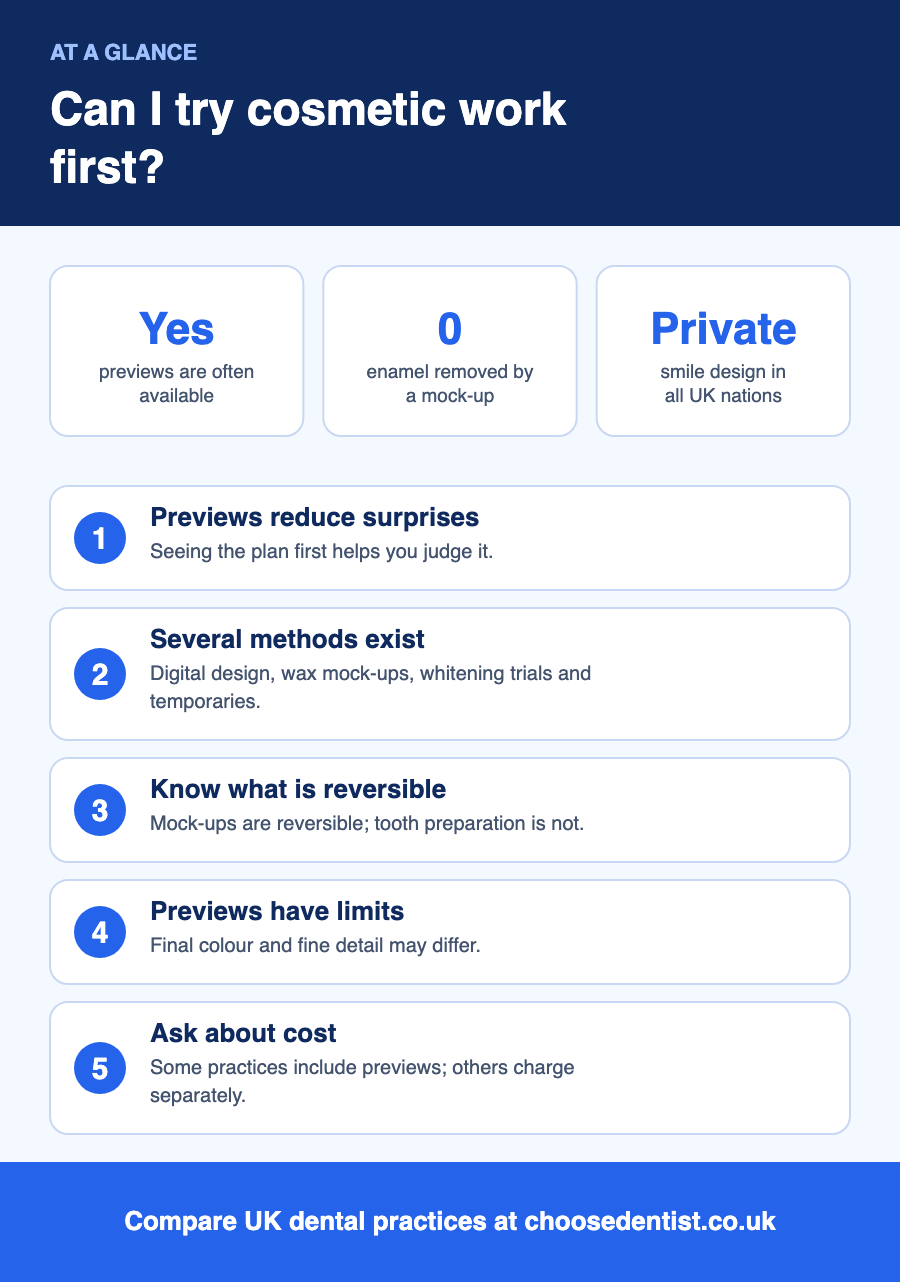
In many cases, yes. A good cosmetic dentist can show a patient how a smile might look before any irreversible work is done, using wax models, temporary materials, photographs or digital software. These previews are not a perfect guarantee of the final result, but they give a far clearer idea than a conversation or a gallery of other people’s photographs, and they are one of the best ways of avoiding disappointment with cosmetic dentistry.
Which method is available depends on the treatment and the practice. Whitening can be sampled in a measured way, bonding can be mocked up directly on the teeth and veneers are commonly previewed with a trial version, whereas some other procedures can only be previewed in a limited way. It is worth asking early on what the practice offers.
Why a preview is worth having
Cosmetic work is judged by the patient, not by the dentist, and the two may see a smile quite differently. A preview turns an abstract wish into something concrete. Patients can comment on the length, the shape and the colour of the teeth, and the dentist can adjust the plan accordingly. It also helps the dentist to understand what the patient actually wants, which is not always what is first described.
The Wikipedia article on cosmetic dentistry notes that for veneers, dentists often make diagnostic mock-ups first to guide the preparation. The same step helps the patient, who has a chance to see and approve the proposed shape before any enamel is removed.
| Preview method | Does it touch the teeth? | What it shows |
|---|---|---|
| Digital smile design | No | The overall direction of change on a photograph or scan |
| Wax-up and removable mock-up | No | Shape and length of the proposed teeth, worn in the mouth |
| Whitening trial with home trays | No | How light your teeth could become |
| Trial bonding layer | Usually minimal | Shape and size of a proposed repair |
| Temporary veneers | Yes, enamel is prepared | Shape, bite and appearance for a few weeks |
Common ways of previewing a smile
The simplest method is a photographic or digital design. The dentist takes photographs and sometimes a three-dimensional scan, and software is used to adjust the shape and position of the teeth on the image. This shows the broad direction of travel, though it does not account for the thickness of the materials or how the lips will move in real life, so it should be read as an indication.
A wax-up is a physical model. A dental technician builds up the proposed teeth in wax on a cast of the patient’s own mouth, and the dentist then takes an impression of it. A soft material is placed over the real teeth using that impression, producing a temporary mock-up that can be worn for a few minutes or a few days. This is usually the most convincing preview, since the patient can see themselves in a mirror and speak and smile with it in place.
For composite bonding, some dentists apply a trial layer of material without etching the tooth, so that it can be removed afterwards, though this depends on the dentist’s approach.
Reversible and irreversible stages
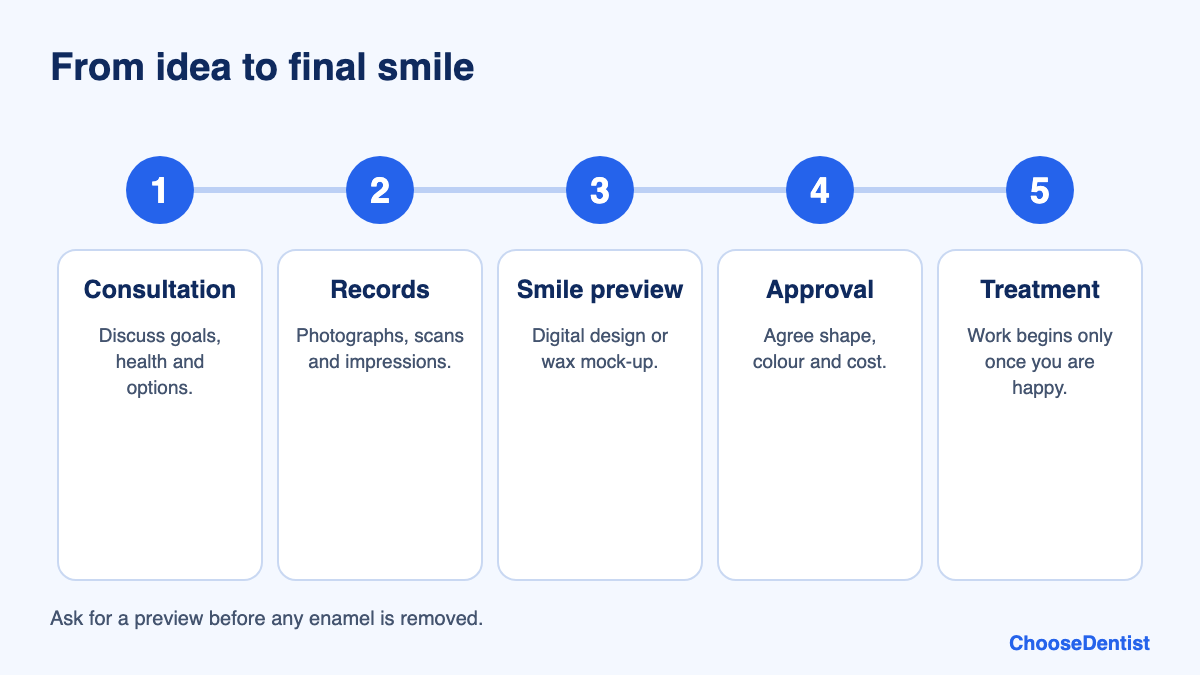
It is helpful to distinguish between stages that can be reversed and those that cannot. A digital preview, a wax-up and a removable mock-up leave the teeth untouched. So does a whitening trial, which can be carried out over a couple of weeks with a take-home kit, allowing the patient to judge the result before moving on to other work. Temporary veneers fitted after tooth preparation, in contrast, mean that enamel has already been removed. They are useful for testing the shape and the bite over a few weeks, but they are a stage in the treatment and not an alternative to it.
This is why the order of events matters. The Wikipedia article stresses that enamel removed during reshaping is irreplaceable, so a patient should be comfortable with the plan before this point. A dentist who goes straight to preparation without offering a preview is not necessarily acting badly, but it is reasonable to ask for one.
Realistic limits
A trial cannot reproduce everything. Colour in a temporary material can differ from the final porcelain, and a model made in a laboratory will not respond to the shifting light in a photograph or a social setting. Expectations should be modest about fine details, such as how the edges of a veneer catch the light or how the new teeth feel to the tongue.
Where a patient has doubts after seeing the preview, a pause is a better answer than going ahead. Practices that are comfortable with this tend to be those that give patients time and do not push decisions.
It also helps to remember that a smile has to suit a face, and a preview on a flat photograph cannot show how the teeth will look from the side or in motion. Asking to see a mock-up in natural daylight, and taking a few photographs of it from different angles, gives a fairer impression than judging it under the bright light of the surgery. Friends or family can be invited to give an opinion, although the final decision should stay with the patient.
What to bring to a consultation
A little preparation makes the appointment more productive. Photographs of smiles the patient admires, and of their own smile from some years ago, give the dentist a better idea of what is wanted. A list of current medicines and medical conditions is useful, as are details of any previous dental work and any problems with it. Writing down questions in advance helps, particularly about cost, timescales and what would happen if the result was not as hoped.
Common worries about previews
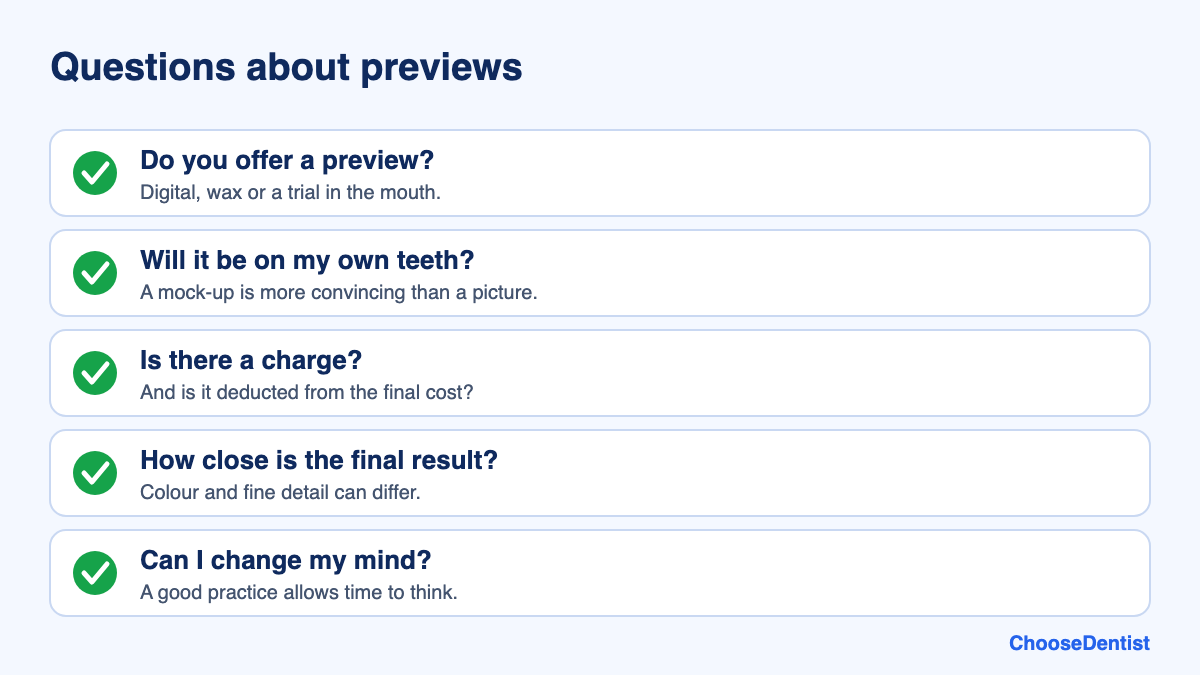
Some patients fear that a mock-up will look artificial, but this is exactly what the preview is meant to reveal, and the shape and colour can be adjusted until they look right. Others worry that seeing a preview creates pressure to go ahead. A reputable practice will not apply that pressure, and patients are free to take photographs, think about it and return, or to seek a second opinion with another dentist. A final concern is cost, and here it is sensible to ask beforehand whether the preview is free, discounted against treatment or charged separately.
NHS and private options across the UK
Previews of this kind are part of private cosmetic dentistry. The NHS covers clinically necessary treatment and, according to its website, cosmetic work will usually need to be paid for privately, so a smile design consultation, a mock-up or a set of temporary veneers would normally be included in a private fee or charged for separately. The same position applies in England, Scotland, Wales and Northern Ireland, though the way each nation charges for NHS dental care differs, with England and Wales using bands, Scotland providing free examinations and a capped percentage charge for most adults over 26, and Northern Ireland charging a percentage of the fee up to a maximum.
Some practices include a smile design appointment in the cost of treatment, some offer it as a stand-alone paid consultation and others give it free of charge. Asking whether the cost of a preview is deducted from the final bill is sensible, and so is asking what happens if the patient decides not to proceed.
Questions to ask at a consultation
Useful questions include whether a preview is offered, what form it takes, whether it will be on the actual teeth, what it costs, how closely it represents the final result and what the alternatives are if the patient is not happy. It also helps to ask to see the dentist’s own before-and-after photographs, preferably of cases that are close to the patient’s own.
The ChooseDentist directory of cosmetic dentistry practices can be searched by postcode, with CQC and Google ratings shown where available, and two practices can be compared side by side before booking a consultation. The details of any preview, treatment and price should be confirmed with the practice.