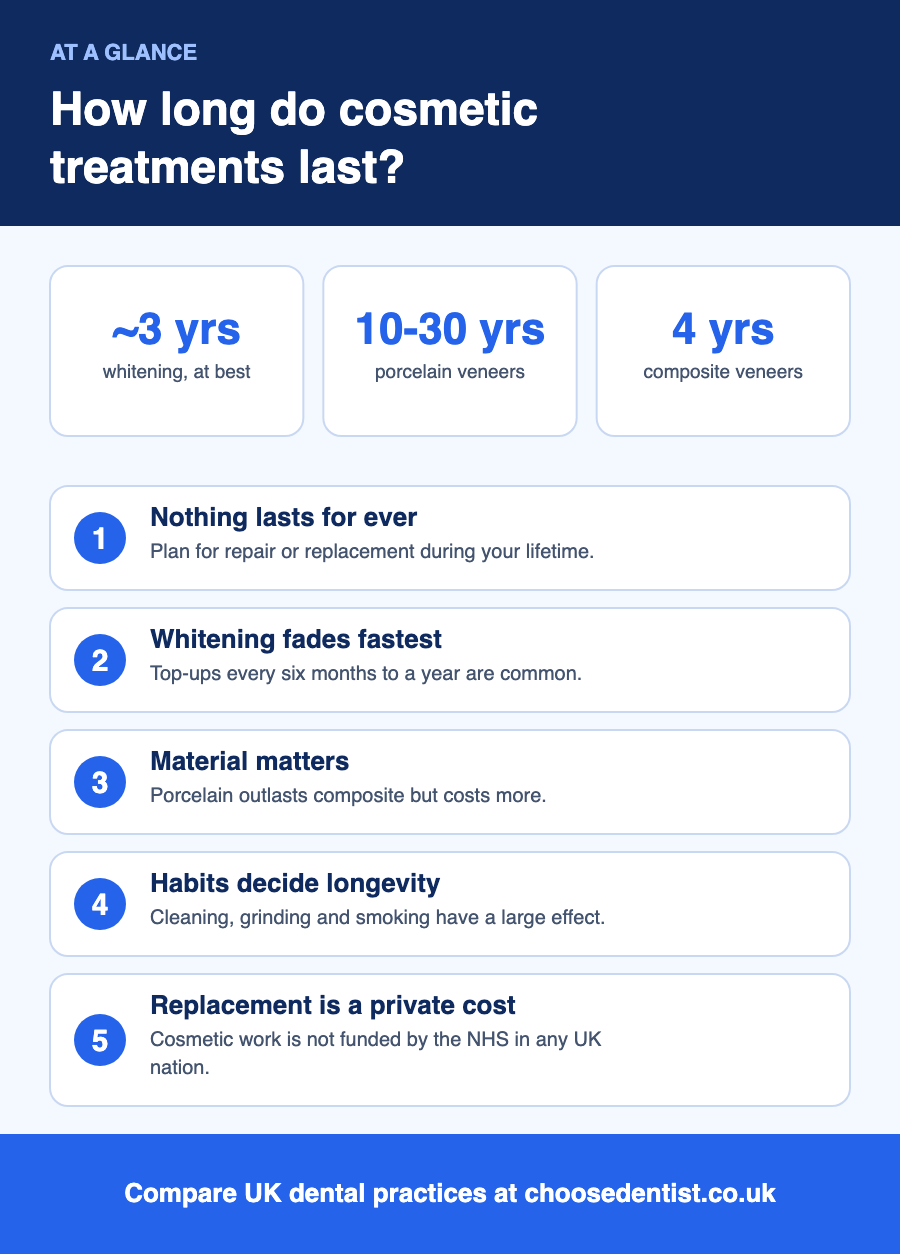
Cosmetic dental treatments last anywhere from a few months to several decades, depending on the procedure, the materials and the way the mouth is looked after. Whitening fades in months or a few years, bonding typically needs attention after several years, and porcelain restorations can last a decade or considerably longer. Nothing in the mouth is permanent, though, and anyone considering cosmetic dentistry should expect some form of maintenance or replacement during their lifetime.
Published figures are patchy, and clinical experience varies, so the numbers below are best read as ranges and not guarantees. They also depend heavily on habits that the patient controls, such as cleaning, diet, smoking and whether the teeth are ground at night.
Whitening
Whitening is the shortest-lived of the common treatments. The NHS website states that results are not permanent and that, following a dentist’s advice, the effect may be kept for around three years. Other sources describe a shorter period. The Wikipedia article on tooth whitening notes that a good deal of the initial change after an intensive in-surgery treatment comes from the temporary dehydration of the tooth, so a proportion of it is lost within the first week, and that re-treatment is commonly needed every six months to a year, more often in smokers and heavy tea, coffee and red wine drinkers.
The two accounts are not as contradictory as they appear. Most patients settle at a shade a little lighter than where they began, and top-up sessions with home trays, which can be reused, extend the effect. Lifestyle largely determines how fast the shade drifts back.
| Treatment | Typical lifespan | What shortens it |
|---|---|---|
| Teeth whitening | From several months to around three years | Smoking, tea, coffee and red wine |
| Composite bonding | Often around 5 to 10 years | Chipping, staining and grinding |
| Composite veneers | Roughly 4 years | Wear and staining |
| Porcelain veneers | Commonly 10 to 30 years | Grinding, trauma and gum recession |
| Crowns and bridges | Around 10 years or more | Decay at the margins and heavy biting forces |
| Dental implants | Post often decades; crown 10 to 15 years | Gum disease around the implant |
Composite bonding and reshaping
Bonding uses tooth-coloured resin, applied directly to the tooth and sculpted in the mouth. It is conservative and often reversible, but the material is softer than porcelain and more vulnerable to staining and chipping. A well-made bonded repair commonly lasts several years, and many need polishing, repair or replacement somewhere in the range of five to ten years, with biting habits, grinding and diet making a considerable difference. Bonding on the biting edges of front teeth tends to wear the fastest.
Reshaping, or enameloplasty, is different in kind. The Wikipedia article on cosmetic dentistry notes that it removes enamel, which cannot be replaced, so while the change itself is permanent, the new shape is as durable as the tooth.

Veneers
For veneers the picture depends on the material. The Wikipedia article on dental veneers says that composite veneers last approximately four years and that veneers in general, made with modern bonding agents, typically last between ten and thirty years. Porcelain is the longer-lived and more stain-resistant material, though it cannot be altered once made and is prone to chipping on a heavily loaded bite. Replacement is a normal expectation, not a sign that something went wrong, and since the original preparation removed tooth structure, a replacement veneer or a crown is usually needed instead of a return to the natural tooth.
The Oral Health Foundation says in its guide to veneers that they can last many years if looked after properly, that they can chip, crack or come loose, and that small chips may be repaired while sometimes a new veneer is needed.
Crowns, bridges and implants
Crowns and bridges are more robust. The Wikipedia article on cosmetic dentistry puts the average life of a bridge at nearly ten years, similar to a crown, though many last far longer with good cleaning and regular check-ups. Implants are generally the longest lasting of the options for replacing teeth, with the titanium post often serving for decades while the crown on top may need replacing after ten to fifteen years.
Straightening is a different matter again. Once the teeth are in a new position, retainers are needed to hold them there, and the Wikipedia article on orthodontics reports that more than half of patients see some drift within ten years. The result lasts for as long as the retainer is worn.
Habits that extend the life of treatment
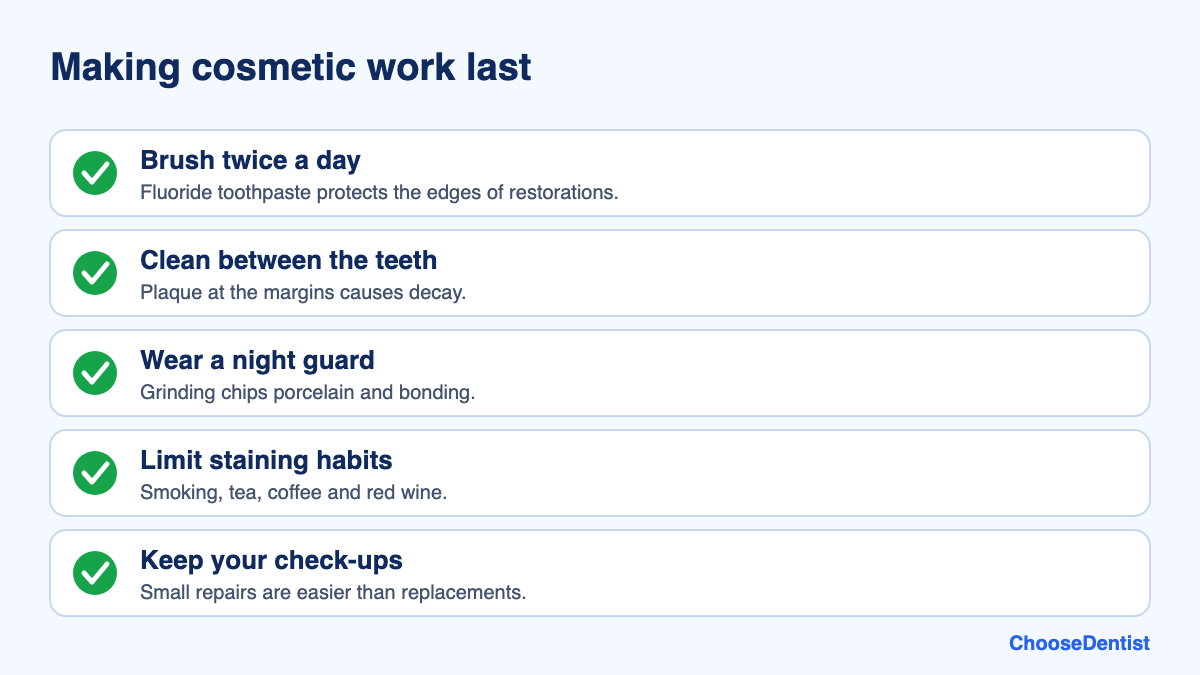
Day-to-day care has more influence on longevity than almost anything a dentist can do. Brushing twice daily with fluoride toothpaste and cleaning between the teeth keeps the margins of restorations free of plaque, where decay usually begins. A night guard protects against grinding, which is a frequent cause of chipped porcelain and bonding. Avoiding the use of the teeth as tools, and cutting back on staining foods and drinks and on smoking, keeps the appearance fresher for longer.
Regular check-ups and hygiene visits allow minor wear to be repaired before it becomes a larger problem, and many dentists recommend polishing bonded surfaces periodically.
Repair or replace?
When a restoration shows its age, the dentist will weigh up whether it can be mended. A small chip in bonding can often be polished or topped up in a single short visit, and a stained composite can sometimes be refreshed. Porcelain that has cracked usually cannot be repaired for long, and replacement is likely, though a minor chip may be smoothed. The decision depends on the position of the tooth, the bite and the condition of the tooth underneath, which is why regular check-ups are so valuable: they allow problems to be spotted while a simple repair is still enough.
Thinking about lifetime cost
A treatment that costs more at the outset can be better value if it lasts longer, though that is not always the case. Porcelain veneers, for example, are priced higher than composite ones but often last considerably longer, and a patient who expects to replace composite repeatedly may spend as much over time. Planning for maintenance, including hygiene visits, a night guard where needed and the likely cost of replacement in ten or fifteen years, gives a more honest picture than the quote for the first stage alone. It is reasonable to ask a practice to explain this.
NHS and private options across the UK
Purely cosmetic work is a private matter in all four nations, and so the replacement cycle is a recurring private cost. The NHS says that treatments done only to improve appearance, such as whitening, will normally need to be paid for privately, and veneers are generally private unless there is a clinical need. Where a clinical problem exists, the NHS funds treatment such as a crown or bridge in line with local charging rules: England uses numbered bands and an urgent charge, Wales has a similar structure under reform, Scotland provides free examinations and charges a percentage with a cap for most adults over 26, and Northern Ireland charges a percentage of the fee up to a ceiling.
Private prices vary by practice and region. As rough guides, composite bonding commonly costs around £150 to £400 per tooth, composite veneers a similar amount, and porcelain veneers from about £600 to £1,200 or more per tooth. Asking what the practice’s policy is on repairs, replacements and guarantees gives a clearer picture of the real cost over time.
Choosing a practice with maintenance in mind
A treatment’s lifespan depends partly on the quality of the work and the materials used, so it is worth asking about both, as well as what the practice offers if a restoration fails early. Written guarantees often carry conditions, such as attending hygiene visits regularly.
The ChooseDentist directory of cosmetic dentistry practices allows visitors to search by postcode, see CQC and Google ratings where they are available, and compare two practices side by side. Costs, guarantees and appointment availability should be confirmed directly with the practice.