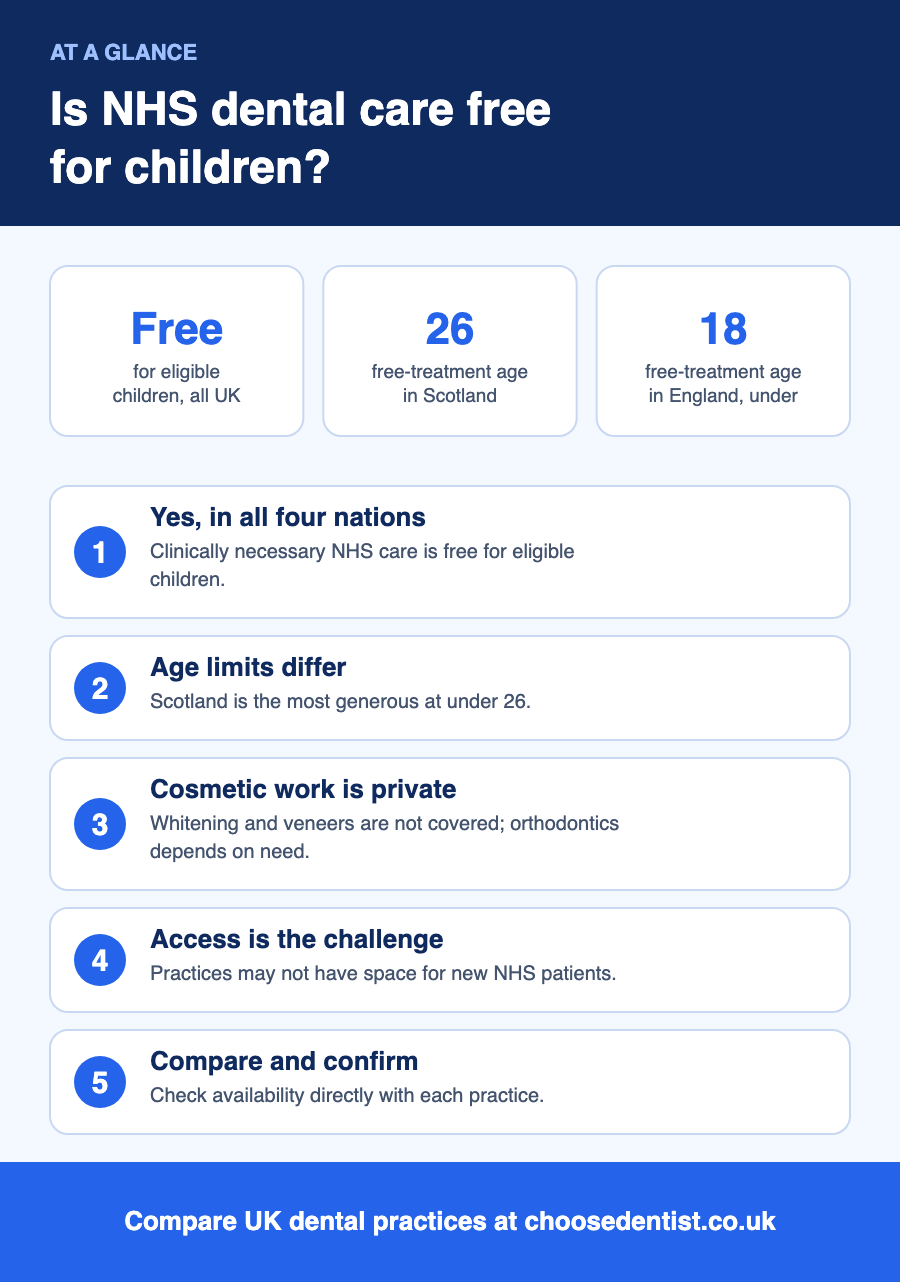
Yes. NHS dental care for children is free in all four nations of the United Kingdom, though the age at which entitlement ends differs from one nation to the next. A children’s dentist providing NHS care cannot charge for check-ups, fillings, extractions and other clinically necessary treatment for a child who is eligible, and the same applies to treatment that is needed urgently.
Free care does not always mean easy access, however. The main practical difficulty for many families is finding an NHS practice that has room for new patients, and there are also some things that remain private, such as cosmetic procedures and some types of orthodontic work. The sections below explain what free actually covers, where the age limits sit in each nation and what to do if a practice asks for payment.
What is covered for children
The NHS website states simply that NHS dental care for children is free. In practice this includes routine examinations, X-rays where they are clinically needed, fluoride varnish, fissure sealants to protect the back teeth, fillings, root canal treatment, extractions and treatment of dental injuries and infections. Emergency care is also provided without charge for eligible children.
What the NHS provides is determined by clinical need. Treatment that is purely cosmetic, such as whitening or veneers, is not part of the NHS offer. Orthodontic treatment is available on the NHS for children with a clear clinical need, which is assessed by an orthodontist, but not for those whose teeth are only mildly irregular, so some families end up paying privately for braces.
| Nation | Free NHS dental treatment for children | Notes for adults |
|---|---|---|
| England | Under 18, and under 19 in full-time education | Three bands plus an urgent charge |
| Scotland | Free examinations for everyone; free treatment under 26 | Others pay a share of the cost up to a maximum |
| Wales | Children under 18 exempt; some young adults get a free examination | Banded charges; contract reform under way |
| Northern Ireland | Free for children and certain other groups | Generally a percentage of the fee up to a ceiling |
Age limits in each nation
In England, the NHS website lists children under 18, and those under 19 who are in full-time education, among those entitled to free NHS dental treatment, as set out in its guide to how much NHS dental treatment costs. Adults pay one of three charge bands, or an urgent charge, depending on the work.
Scotland has the most generous arrangements. According to NHS Inform, everyone is entitled to free NHS dental examinations and treatment is free for everyone under 26, so a teenager or young adult can continue to receive care without charge for much longer than in England.
In Wales, children under 18 are exempt from charges, and the Welsh Government’s information about NHS dental charges describes the banded charges that adults pay and the reform of the dental contract that is under way. Some young adults may also qualify for a free examination. In Northern Ireland, charges for adults are generally 80 per cent of the dentist’s fee up to a ceiling for each course of treatment, according to nidirect, with free care for children and for certain other groups.
Because these arrangements are changing in more than one nation, it is wise to check the official pages for current details.

What may still cost money
Free NHS care applies to the clinical treatment the child needs. A few things sit outside it. Private treatment, if the family chooses it, is charged at the practice’s own rates. Cosmetic extras, such as tooth-coloured materials in places where the NHS would normally provide a standard alternative, may be offered as upgrades for a fee, and it should be clear that they are optional.
Parents should be told which treatments are NHS and which are private, together with the cost, and should receive a written estimate for any private work. The NHS page on why a dentist might charge for private treatment says that a patient should only be charged for private treatment if they agreed to it, and that cosmetic work will usually be private.
Finding an NHS practice for a child
Availability is patchy. Some areas have practices that welcome new NHS children, while in others there are none with space and waiting lists can be long. A few steps can help: contacting several practices rather than one, asking to be placed on a waiting list, using the NHS service finder for the nation, and contacting the local integrated care board, health board or equivalent for advice on where places exist. Community and salaried dental services can sometimes see children who cannot find a place elsewhere.
It also helps to ask practices about their policies. Policies differ from one practice to another, so asking directly saves time.
In England patients are not formally registered with a dental practice in the way they are with a GP, which means that a practice which has seen a child recently is the natural place to ask about a repeat appointment, and that moving to another practice is straightforward when a place becomes available. Parents may be asked to confirm a teenager’s age or that they are still in full-time education when the form is completed, so it helps to have that information to hand.
Keeping a child's teeth healthy between visits
Free care is a safety net, but prevention is worth more. The NHS advises brushing twice a day for about two minutes from the time the first tooth appears, using a smear of fluoride toothpaste with at least 1,000 parts per million for children under three and a pea-sized amount thereafter, and spitting without rinsing. Reducing the frequency of sugary food and drink, especially between meals and at bedtime, does more to prevent decay than almost anything else.

Dental injuries and emergencies
Children’s teeth are often damaged by falls and knocks, and eligible children can receive urgent NHS care without charge. A knocked-out permanent tooth is an emergency: it should be picked up by the crown, not the root, rinsed briefly if dirty and, if possible, placed back in the socket or kept in milk, and the child taken to a dentist straight away. A knocked-out baby tooth should not be replanted. For severe pain, swelling of the face or an injury that cannot wait, a practice, an urgent dental service or NHS 111 can direct families to appropriate care.
Orthodontic treatment for children
Orthodontics deserves a separate mention because it is where free NHS care and private fees most often meet. Braces are available on the NHS for children with a clear clinical need, as assessed by an orthodontist, and treatment is free for those who qualify. Families whose child does not meet the threshold can choose private treatment, at a cost, or decide to wait and review. Our guide to braces on the NHS explains how eligibility works.
Private options and family plans
Parents who prefer private care, or who cannot find an NHS place, have other choices. Private practices set their own fees for check-ups, hygiene visits and fillings, and some offer monthly membership plans that cover routine care for a family. These may include children and can include discounts on treatment, but they are not insurance and the terms vary, so reading the small print is wise. Some employers also offer dental cash plans that contribute to the cost.
Choosing a practice
When comparing practices, the things that matter most to a family are whether they take NHS children, how long it takes to get an appointment, whether the team is good with young patients and whether the practice is easy to reach.
The ChooseDentist directory of practices for children and families can be searched by postcode, with CQC and Google ratings shown where available, and two practices can be compared side by side. NHS availability changes often, so it should be confirmed directly with each practice before relying on it.