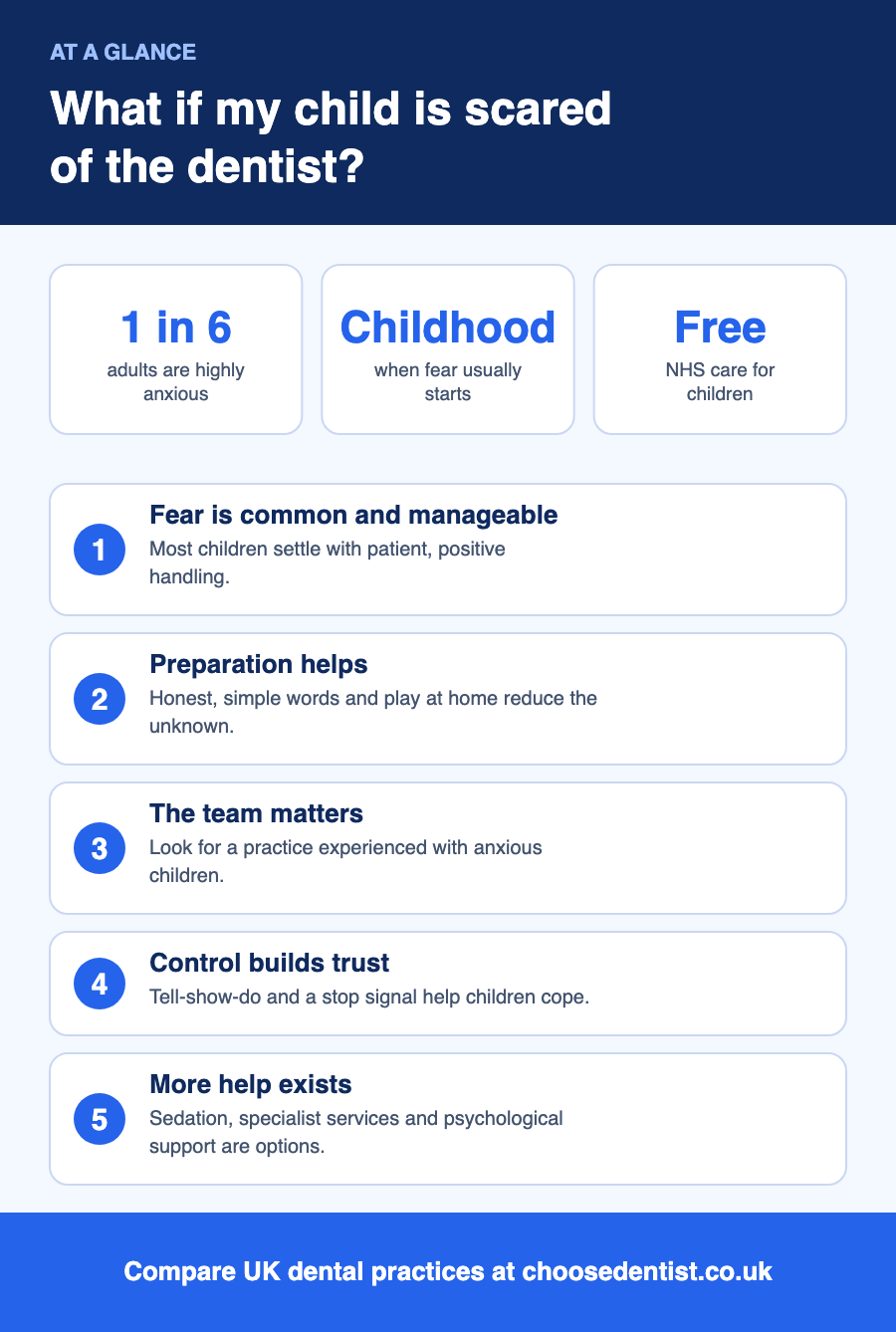
Many children are frightened of the dentist at some point, and most grow out of it with patient handling. Fear of the unknown, a previous uncomfortable experience, or simply picking up anxious signals from a parent can all play a part. The most helpful response is usually calm, consistent and unhurried: choosing a team that is good with children, preparing the child honestly and keeping visits short and positive in the early stages.
Dental fear has a recognisable pattern. The Wikipedia article on dental fear says that it typically begins in childhood, that traumatic early experiences and observing fearful reactions in others, especially parents, are common causes, and that a lack of communication is one of the biggest contributors, with fear of the unknown and loss of control being major triggers. That points straight to what helps: explaining things, giving the child some control and avoiding unpleasant surprises at a children’s dentist.
Preparing the child at home
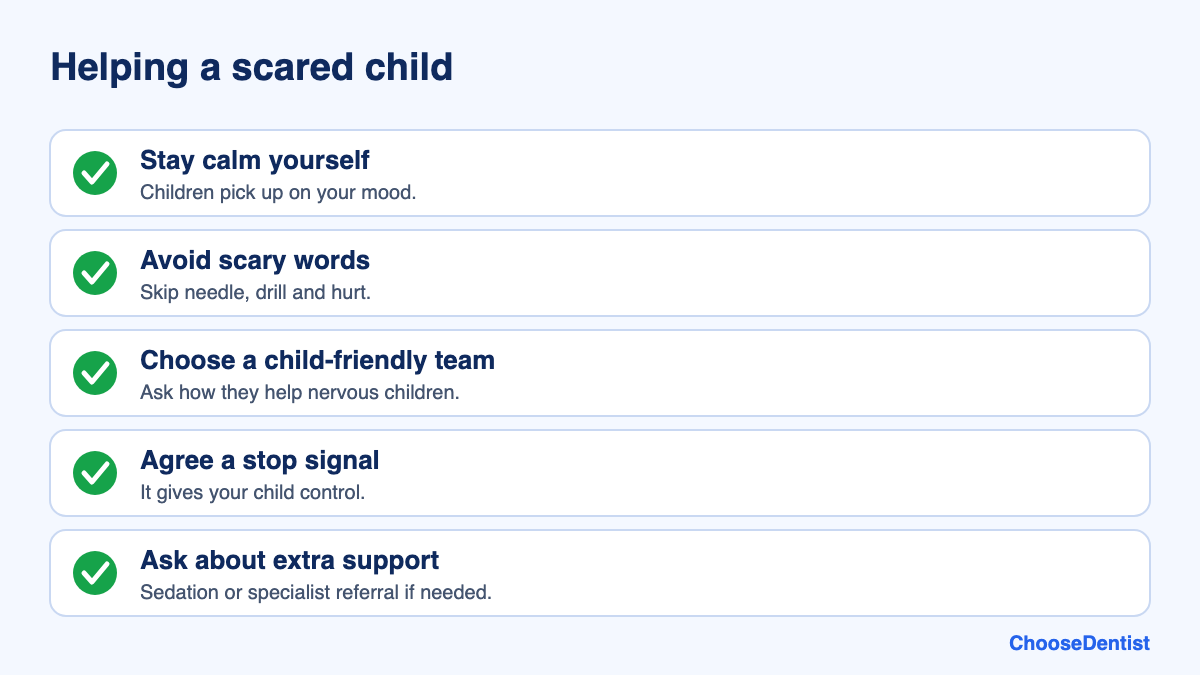
How a parent talks about the dentist matters. Using simple, positive and truthful words, such as telling a child that the dentist will count their teeth and check that they are healthy, avoids both false promises and frightening detail. Words such as hurt, needle, drill and pain are best avoided, and so is saying that there is nothing to be afraid of, which can have the opposite effect. Reading a picture book about visiting the dentist, or playing at dentists at home with a toy and a toothbrush, helps to make the experience familiar.
Parents’ own feelings are infectious. Someone who is nervous about the dentist should try to stay calm and neutral in front of their child, and may find it helpful to let the other parent take the child to the first appointments. Children who see their parents attend check-ups without fuss tend to take it as normal.
| Situation | What may help | Who can help |
|---|---|---|
| First visit | A short, treatment-free introduction | A family-friendly dental practice |
| Fear of the unknown | Tell-show-do and simple, honest explanations | The dental team and parents |
| Need for control | A stop signal such as a raised hand | The dentist and dental nurse |
| Fear that blocks treatment | Inhalation sedation or specialist referral | Paediatric or community dental services |
| Persistent severe fear | Psychological support such as CBT | A clinical psychologist or trained dentist |
Choosing a practice and an appointment time
A friendly, patient team is the single biggest factor. Practices that see many children generally have a routine for anxious patients, with a welcoming reception, toys or books in the waiting area and staff who speak to the child and not just the parent. A short introductory visit, where the child can meet the dentist, sit in the chair and leave without any treatment, is often offered if asked for.
Timing helps too. Morning appointments, when a child is rested, are often easier than the end of a long school day, and a visit that is not squeezed between other commitments reduces tension. Avoid booking a first appointment for a time when the child is likely to be hungry or tired.

What the dental team can do
Dentists use a graded approach with nervous children. The Wikipedia article describes tell-show-do, a stepwise introduction to each procedure in which the dentist explains what is going to happen, shows the instrument or sensation and then carries out the step. It also notes that giving the patient a stop signal, such as raising a hand, gives a sense of control and builds trust.
Other techniques include distraction, such as asking the child to count or watch a ceiling screen, and praise for cooperation. Treatment is broken into small stages where possible, so that a child who copes with an examination one week can progress to a polish or a filling when ready. Where needed, local anaesthetic is applied after a numbing gel, and parents can usually stay in the room.
When more help is needed
A small number of children are too frightened, too young or too distressed to cope with necessary treatment even with these approaches. In such cases, dentists may offer inhalation sedation, which is a mix of nitrous oxide and oxygen breathed through a nasal mask, or refer the child to a specialist paediatric or community dental service for further options. Our guide on children and dental sedation explains the choices in more detail.
Persistent, severe fear that stops a child from attending at all may respond to psychological approaches. The Wikipedia article reports that cognitive behavioural therapy appears to reduce dental fear and improve attendance and that, although it is usually delivered by psychologists, trained dentists can also deliver it effectively. A dentist or GP can advise on where to find support.
Keeping fear from returning
Prevention is the best protection. Children who attend regularly and have healthy teeth tend to have only simple, painless procedures, which keeps fear from building. The NHS advises that parents brush a child’s teeth for about two minutes twice a day with fluoride toothpaste of the right strength for their age, and that children go to the dentist when the first milk teeth appear or before they are twelve months old.
Things that tend to make fear worse
A few well-meant habits backfire. Promising that something will not hurt, when a child may feel a pinch, damages trust if it does. Bribes and threats, such as the dentist will take your teeth out if you do not brush, associate the surgery with punishment. Talking in front of the child about one’s own bad experiences, or dwelling on what might go wrong, passes the fear on. Forcing a child into the chair or holding them down is also counterproductive and is best left to occasions when treatment is essential and a specialist team is involved.
A realistic timescale
Confidence builds slowly, often over several visits. A typical pattern is a first appointment that consists of meeting the team and sitting in the chair, a second in which the dentist counts the teeth and polishes one or two, and further visits in which gradually more is done. Rushing the process can undo progress, whereas a child who is allowed to proceed at their own pace usually overcomes the fear. Parents who feel that nothing is improving should talk to the practice about other options.
NHS and private options across the UK
NHS dental care for children is free in all four nations, with different age limits, and that includes treatment for children who need extra help to cope. Practices that accept NHS children vary in how they support anxious ones, and a child who needs specialist behaviour management or sedation is often referred to a community or hospital dental service. Waiting times for those services depend on the area.
Private practices may offer longer appointments, more time for an introductory visit or sedation for a fee, which some families find helpful, but fees and availability vary and the team’s experience with children should be checked. Charges for adults using NHS services differ between the nations: England and Wales use numbered bands and an urgent charge, Scotland provides free examinations and charges a share of the cost up to a cap to most adults over 26, and Northern Ireland charges a percentage of the fee up to a ceiling.
Finding a practice that suits an anxious child
When looking for a practice, it is worth phoning to ask how they handle nervous children, whether a short introductory visit is possible and whether the same dentist will see the child each time. Reviews from other parents can show how a team behaves in practice.
The ChooseDentist directory of practices for children and families can be searched by postcode, with CQC and Google ratings shown where available, and two practices can be compared side by side. The details of NHS availability, sedation and appointment times should be confirmed directly with the practice.