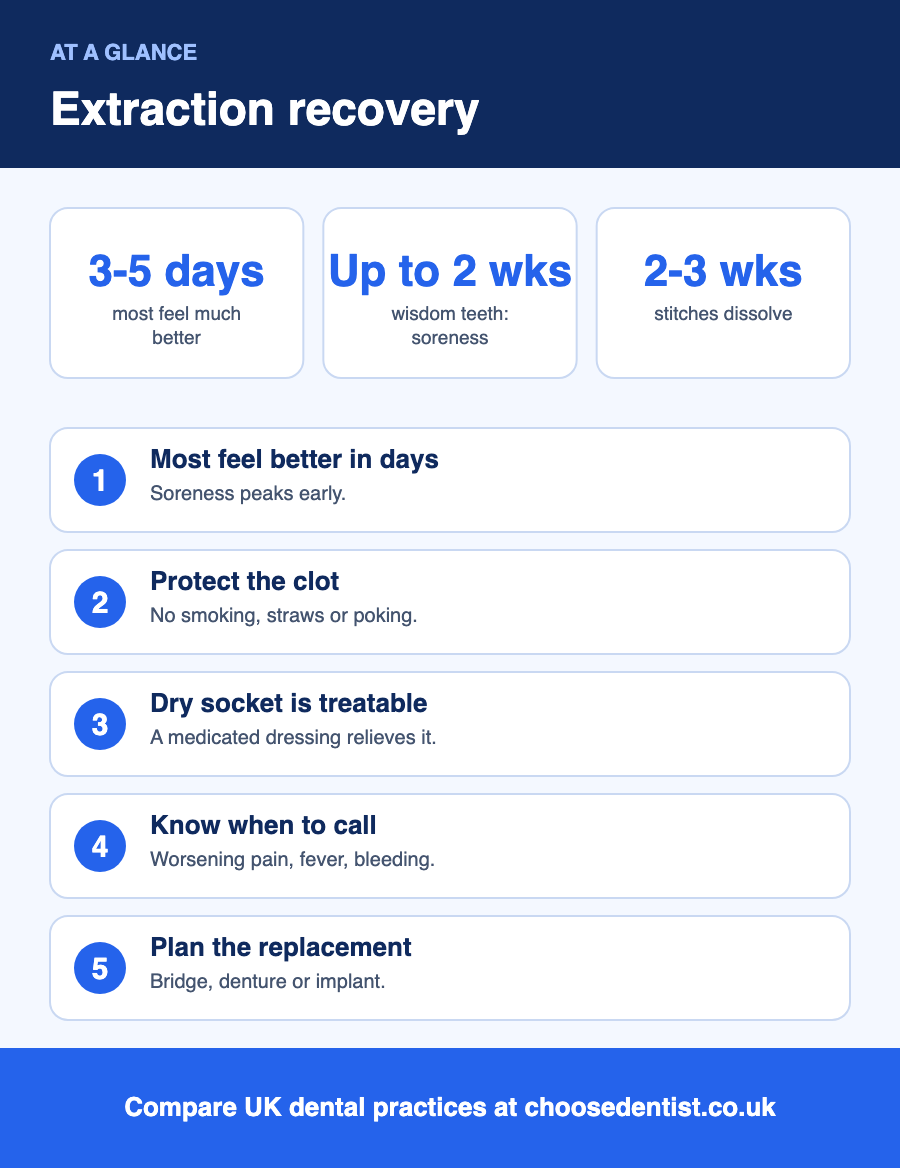
Most people feel much better within three to five days of a tooth extraction, and the gum takes a few weeks to heal fully, while the bone beneath takes longer to remodel. Soreness, swelling and mild bruising are normal at first. Recovery after a simple extraction is usually quicker than after removing an impacted wisdom tooth, which can leave the jaw sore and stiff for up to two weeks.
Looking after the socket in the first days makes the biggest difference. This guide sets out what to expect day by day, what to do and avoid, and when to seek help after a tooth extraction.
A rough timetable
The NHS says on its page about wisdom tooth removal that for up to two weeks you may have pain, swelling, bruising on your cheek, a sore and stiff jaw and discomfort when chewing or swallowing, with the swelling starting to improve after one or two days. Most people can resume normal activities the next day, though you may need one to three days off work after a harder removal or after a general anaesthetic.
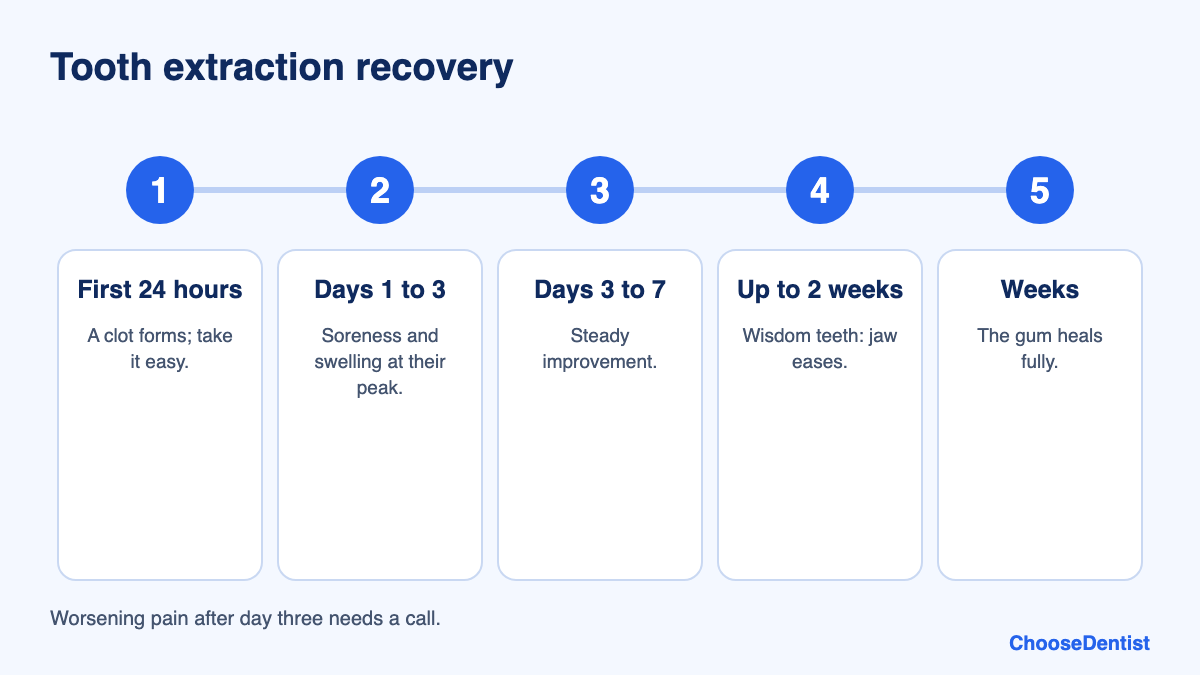
For a straightforward extraction, expect the worst of the soreness in the first day or two, improvement by day three to five, and little more than a tender spot after a week. The gum surface heals over a few weeks, and dissolvable stitches, if used, usually fall out within two to three weeks.
| Time | What to expect | What to do |
|---|---|---|
| First 24 hours | Clot forms; slight oozing | Bite on gauze; no rinsing hard, smoking or alcohol; soft food |
| Days 1 to 3 | Soreness and swelling peak | Painkillers; cold pack; rest with head raised |
| Days 3 to 7 | Steady improvement | Gentle salt-water rinses; keep avoiding the wound |
| Up to 2 weeks | Stiff jaw and bruising ease (wisdom teeth) | Back to normal activity |
| Increasing pain after day 3 to 5 | Possible dry socket or infection | See a dentist or call NHS 111 |
The first 24 hours
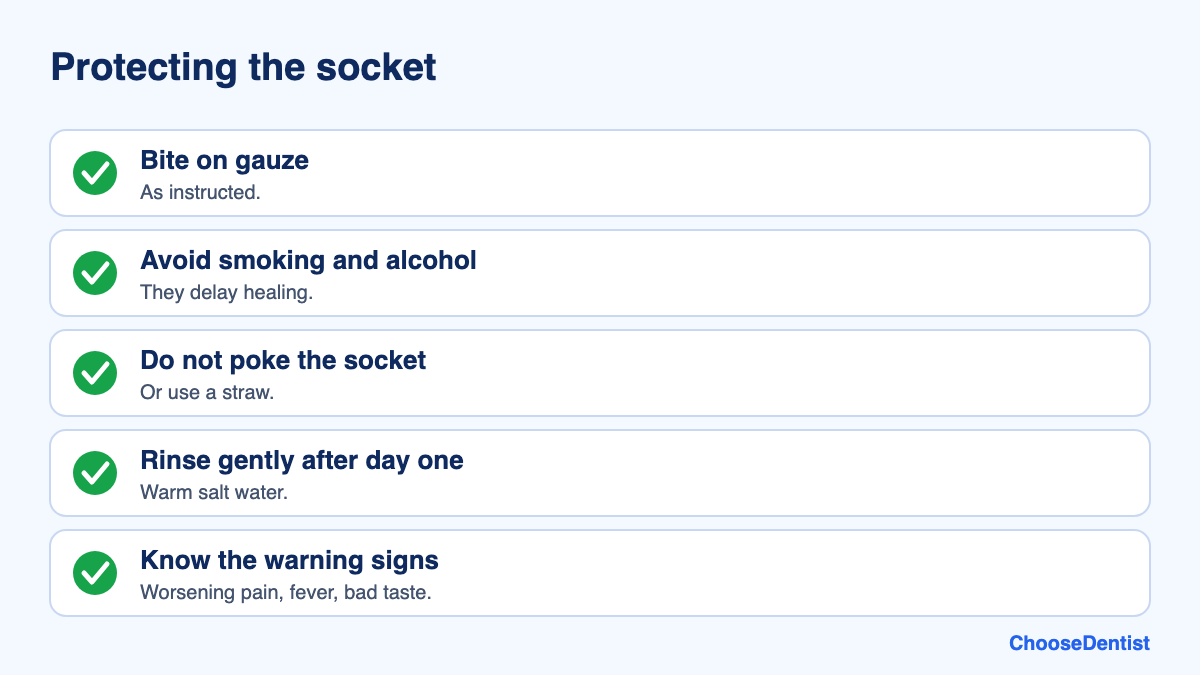
The first day is when the blood clot forms in the socket, and it is the foundation for healing. Bite on the gauze the dentist gives you for the recommended time, avoid spitting, rinsing hard or touching the socket, and do not smoke or drink alcohol. A little oozing is normal. If it bleeds, the NHS advises pressing a clean cloth on it for at least ten minutes.
Rest, keep your head slightly raised when lying down, and take painkillers as directed. Stick to soft, lukewarm food and chew on the other side.
Days two to seven
From the second day, the NHS advises gentle rinsing with warm salt water or mouthwash and brushing the other teeth carefully, avoiding the wound. Continue to avoid hard or crunchy food and small particles such as nuts or seeds that can lodge in the socket, hot drinks, alcohol and smoking. Swelling usually begins to subside, and bruising may appear on the cheek and then fade.
Most people feel noticeably better by the end of the first week. If pain is growing instead of fading, it may be a sign of a complication.
Dry socket
Dry socket is the commonest complication. The NHS describes it in its page on complications as a painful condition in which the blood clot over the socket does not form properly or is dislodged before healing. It typically causes increasing pain a few days after the extraction, often with a bad taste or bad breath, and it can feel like toothache. Smoking, a difficult extraction and failure to follow the aftercare raise the risk.
It is easily treated. The dentist cleans the socket and places a medicated dressing, which relieves the pain quickly, and antibiotics are not usually needed. Do not ignore worsening pain after the first few days.
Infection and nerve problems
Infection can cause increasing pain, swelling, a bad taste, fever and a general feeling of being unwell, and may need antibiotics. The NHS lists infection and nerve damage as possible complications. Nerve damage, seen mostly with lower wisdom teeth, can cause numbness or tingling of the tongue, lips and chin, which usually improves but can last weeks or months.
The NHS advises contacting an urgent dentist or NHS 111 if bleeding will not stop, if pain and swelling are severe or worsen despite painkillers, or if there is a bad taste, high temperature or you feel unwell. For serious swelling affecting breathing or swallowing, the NHS says to call 999 or go to A&E.
Getting back to normal
Most people can return to work or school within a day or two. Avoid strenuous exercise for a couple of days, because it raises blood pressure and may restart bleeding. After a general anaesthetic, the NHS says not to drive for 48 hours, and after a sedative injection for 24 hours. Eating returns to normal gradually, starting with soft foods and moving on as the socket feels comfortable.
Recovery after wisdom tooth surgery
Lower wisdom teeth that are impacted usually take longest to heal, with swelling that peaks around the second or third day and jaw stiffness lasting up to a couple of weeks. A cold pack in the first day, then gentle warmth, can ease it, and opening the mouth gently through the day keeps the jaw from stiffening. Plan to take things easy for a few days, sleep with your head raised and keep up fluids and soft foods.
Children and older adults
Children heal quickly, and recovery after a baby tooth extraction is usually brief. Older adults, people with diabetes and those who take certain medicines may heal more slowly or be more prone to infection, so the dentist may give extra advice. Tell the dentist about all your medicines, including blood thinners, before the extraction, because they affect bleeding and healing.
Follow-up and review
Most simple extractions need no review, but your dentist may ask to see you again if stitches need checking or if the tooth was difficult. If you are due to have a denture, bridge or implant, the gum needs time to heal first, often several weeks to months. Keep any appointments that are made, and phone the practice if anything worries you, because dealing with a problem early is much easier.
NHS and private options across the UK
Follow-up care after an extraction is part of the treatment, and a dentist should deal with problems such as dry socket without a new course of charges where the care falls within the original course. Extractions are in band 2 in England, according to the NHS guide to how much NHS dental treatment costs and urgent extractions may be treated under the urgent charge. Charging for NHS dentistry differs across the four nations. England has three bands and an urgent charge, Wales numbered bands and an urgent charge with a contract reform under way, Scotland free examinations and free treatment under 26 with a capped share of the cost for other adults, and Northern Ireland a percentage of the dentist’s fee up to a ceiling per course. Private practices usually include a review visit and may offer sedation or general anaesthetic for a fee.
Planning for a replacement
A gap left by an extracted tooth can allow neighbouring teeth to drift, so the dentist may discuss a bridge, denture or implant once the gum has healed. Bone healing continues for months, and implants are normally placed after that or at the same time in some cases. It helps to raise this before the extraction. Our guide to dental bridges compares the options.
The ChooseDentist directory of practices offering extractions can be searched by postcode, with CQC and Google ratings shown where available. Two practices can be compared side by side, and details of aftercare and costs should be confirmed directly with the practice.