
Yes. Tooth extraction is available on the NHS whenever it is clinically necessary, for example when a tooth is too decayed, infected or damaged to be saved. In England, an extraction is charged within band 2, together with fillings and root canal treatment, and urgent extractions can be carried out under the urgent treatment charge. Many people pay nothing because they are exempt, and children’s care is free across the UK.
What the NHS provides is determined by clinical need, and the dentist will normally explain whether the tooth can be saved first. This guide explains how a tooth extraction is provided on the NHS, how the charges work and what private care adds.
What the NHS says
The NHS page on tooth decay says that treatment depends on severity: early decay may be managed with fluoride, a cavity needs a filling, decay that reaches the pulp may need root canal treatment, and in severe cases the tooth may need to be extracted. The NHS page on root canal treatment adds that without root canal treatment an infected tooth may need to be extracted.
The NHS guide to how much NHS dental treatment costs lists extractions and other oral surgery in band 2, along with fillings, root canal treatment and sealants.
| Nation | How NHS charges work | Extractions |
|---|---|---|
| England | Three bands plus an urgent charge | Band 2; urgent charge covers removing up to two teeth |
| Scotland | Free examinations; free treatment under 26; others pay a share up to a maximum | Charged within the capped share for adults who are not exempt |
| Wales | Numbered bands plus an urgent charge; contract reform under way | Similar band structure to England |
| Northern Ireland | Generally a percentage of the dentist's fee up to a ceiling per course | Charged within the ceiling |
Urgent extractions
If a tooth is causing severe pain or infection, an extraction may be done as urgent care. The NHS says you can call your dentist or NHS 111 for an urgent appointment, and describes the urgent band as covering the removal of up to two teeth, among other emergency treatments. The aim is to relieve pain and deal with infection quickly, and the dentist may offer to remove the tooth the same day if it cannot be saved.
If swelling is spreading or affects breathing or swallowing, the NHS advises calling 999 or going to A&E. The NHS page on a dental abscess says an abscess will not go away on its own and may need drainage, root canal treatment or removal of the tooth.

Wisdom teeth
The NHS page on wisdom tooth removal explains that wisdom teeth are removed when they cause problems, such as being blocked by another tooth or partly covered by gum, and that a dentist may remove them or refer you to a specialist. The procedure usually takes no more than 40 minutes under local anaesthetic, with sedation or general anaesthetic used only for harder cases or anxious patients.
Wisdom teeth that are not causing problems are generally left alone, and removal is on clinical grounds, not routine. A referral to a hospital oral surgery department may involve a waiting list.
How charges work
In England you pay one charge for a course of treatment, set by the highest band involved. A course that includes an extraction as well as fillings or a root canal is a band 2 course, and if a crown or denture is also needed, the course is band 3. Further treatment in the same or a lower band within two months costs nothing extra. Exemptions apply to children, young people in full-time education under 19, pregnant women, new mothers and people on certain benefits.
Hospital-based oral surgery is arranged through referral, and the charging rules vary by area.
Differences across the UK
NHS charging differs. England and Wales use numbered bands, with Wales reforming its contract. Scotland offers free examinations and free treatment under 26, while adults over 26 pay a capped share of the cost, and Northern Ireland charges adults a percentage of the dentist’s fee up to a ceiling. Charging for NHS dentistry differs across the four nations. England has three bands and an urgent charge, Wales numbered bands and an urgent charge with a contract reform under way, Scotland free examinations and free treatment under 26 with a capped share of the cost for other adults, and Northern Ireland a percentage of the dentist’s fee up to a ceiling per course. In every nation, extractions that are clinically necessary are provided on the NHS.
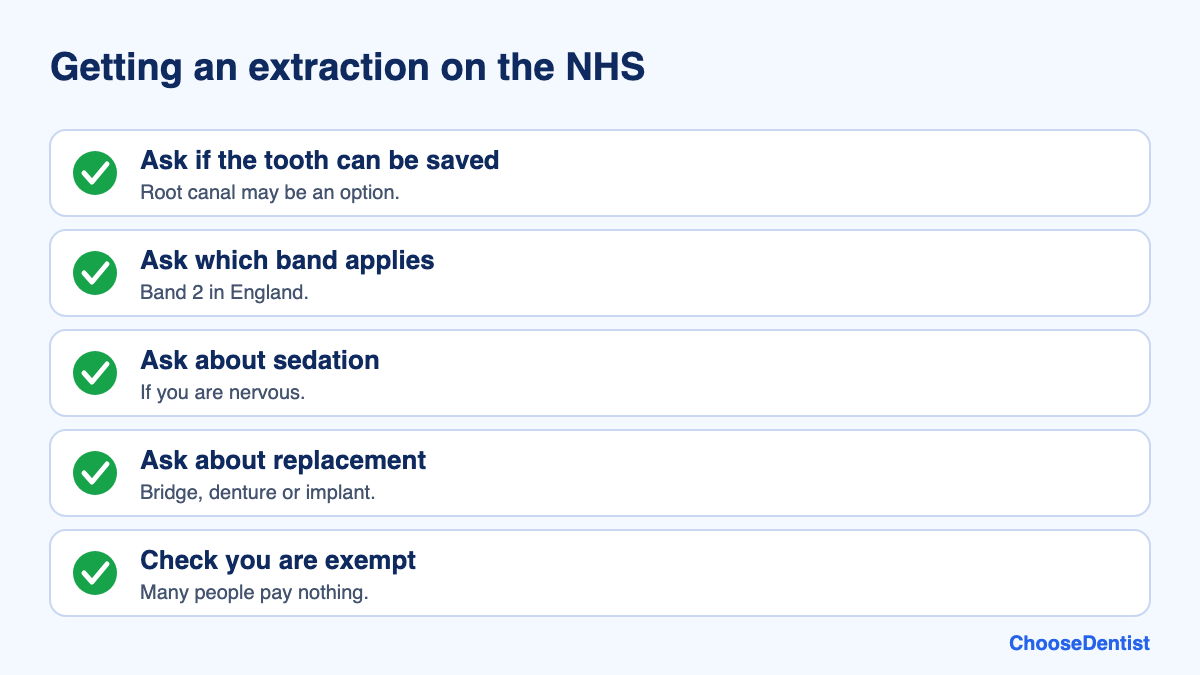
Can the tooth be saved?
Dentists try to keep natural teeth where they can, so before offering an extraction they will usually consider whether a filling or root canal treatment could save the tooth. The NHS says that root canal treatment can save a tooth that would otherwise need to be removed. If the tooth is too damaged, cracked below the gum or loosened by advanced gum disease, extraction is the right choice, and you should be told why. It is reasonable to ask what the alternatives are.
Anaesthetic and sedation on the NHS
Local anaesthetic is always part of an NHS extraction, and costs nothing extra. Sedation and general anaesthetic are provided when they are clinically needed, often through referral to a specialist or hospital service, and may involve a wait. Private practices commonly offer sedation for an additional fee, which can be worthwhile for people with strong dental anxiety.
Aftercare and complications
The dentist should give you aftercare advice and a number to ring, and problems such as dry socket should be managed without a new course of charges where they fall within the original course. If you develop spreading swelling, a high temperature or difficulty breathing or swallowing, the NHS advises seeking urgent help immediately.
Questions worth asking your dentist
Before you commit, it helps to have a short list of questions. Ask what the treatment will involve, how many visits it needs, what the realistic outcome is, what could go wrong and what it will cost in total, including any follow-up. Ask what you would need to do at home and how to reach the practice if something worries you. A dentist who answers clearly, without pressure, and puts the plan in writing, is giving you what you need to make an informed choice, and you are free to compare more than one practice before deciding.
Keeping a record for the future
Keep a note of the date of treatment, the dentist who carried it out, the materials used and the cost. If you later need a repair, a second opinion or a different practice takes over your care, this record saves time and helps with any questions about guarantees. Photographs taken before and after treatment, where relevant, are also a useful reference for you and for any dentist who sees your teeth in future years.
Private extractions
Private practices set their own fees. As a rough guide, a simple extraction commonly costs from about £100 to £250 and a surgical extraction from about £200 to £600 or more, with sedation or general anaesthetic extra. Private care may offer shorter waits, the choice of dentist and the option of immediate replacement planning, such as an implant placed at the same visit in some cases.
After the extraction
An extracted tooth leaves a gap, and the dentist can discuss replacement options, including a bridge, a denture or a dental implant. NHS bridges and dentures are in band 3, and implants are mostly private. Our guide to dental implants on the NHS explains when they are provided.
The ChooseDentist directory of practices offering extractions can be searched by postcode, with CQC and Google ratings shown where available. Two practices can be compared side by side, and NHS availability and costs should be confirmed directly with the practice.
