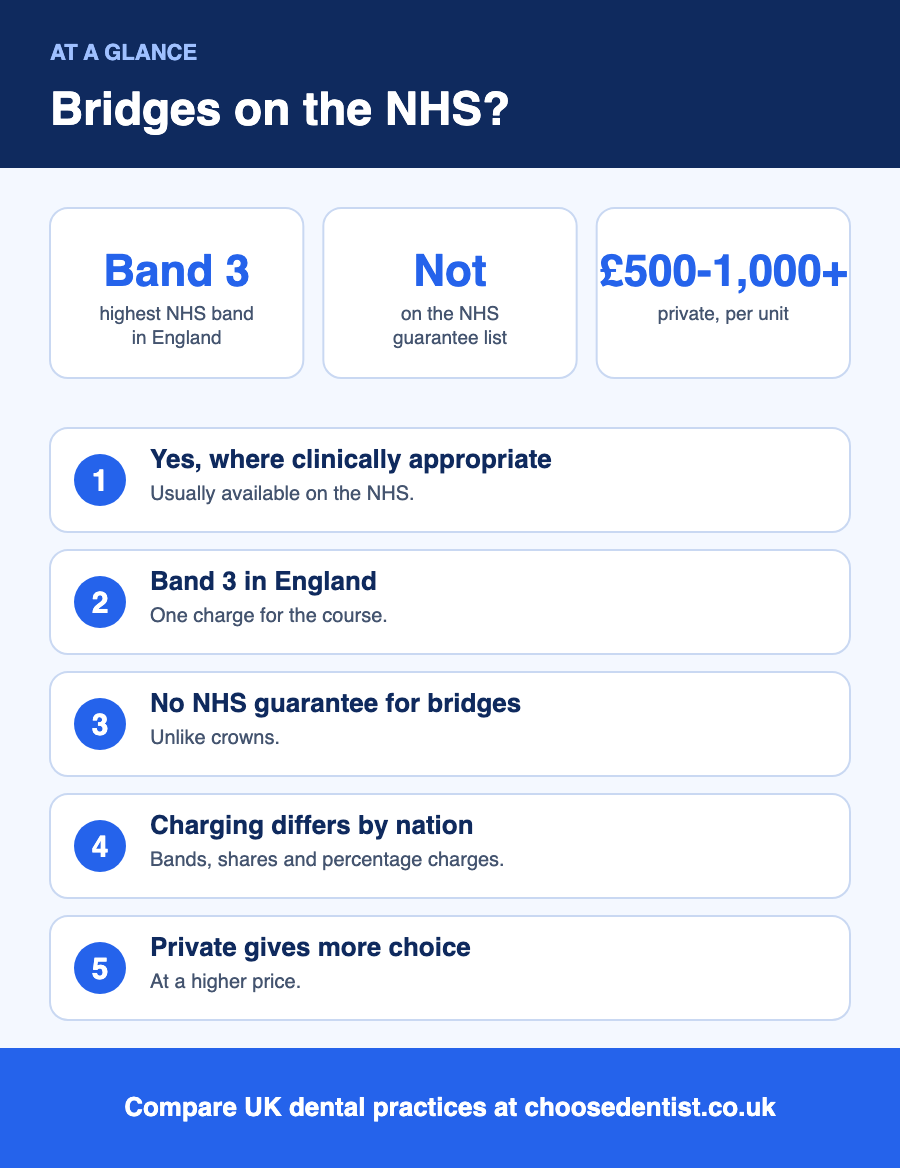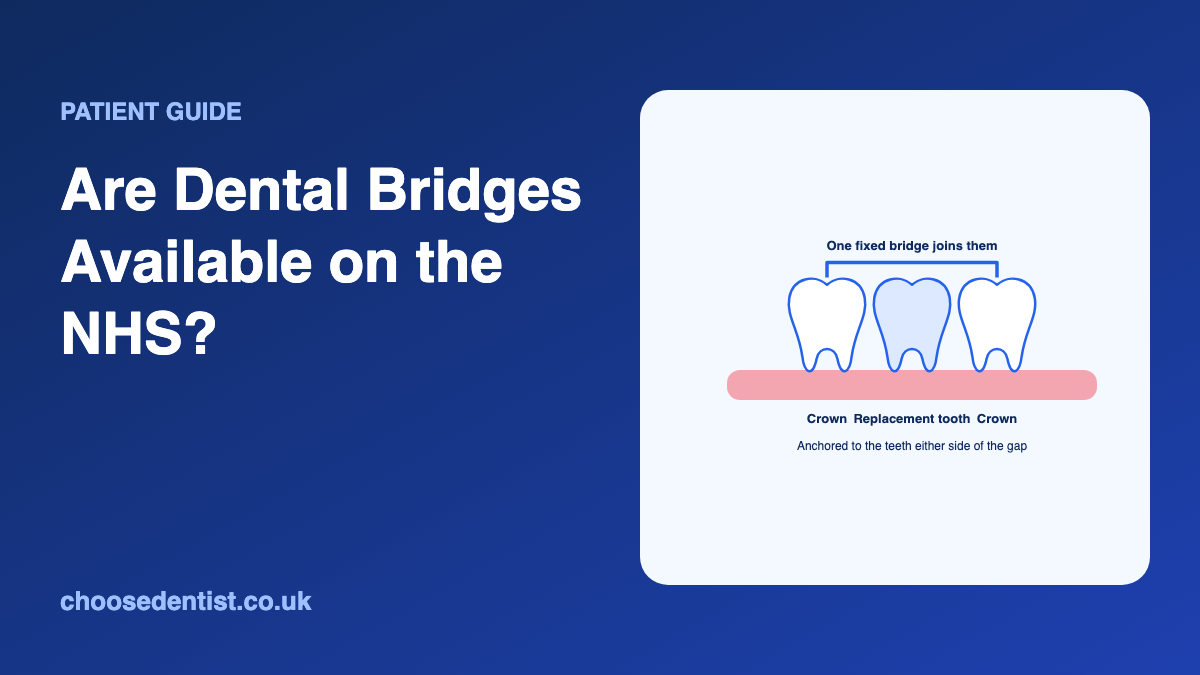
Yes. Dental bridges are available on the NHS where they are clinically appropriate, and in England they fall within the highest charge band, alongside crowns and dentures. An NHS dentist assesses whether a bridge is a suitable way of replacing a missing tooth, bearing in mind the health of the neighbouring teeth, and may suggest a denture or leaving the gap if a bridge would put those teeth at risk. Dental implants, by contrast, are mostly private.
How much a bridge costs, and what is covered if it fails, depend on where you live and whether you are exempt from charges. This guide explains what the NHS says about dental bridges, how charges work and what the private alternative looks like.
What the NHS says
The NHS page on dental treatments says that, apart from whitening, implants and veneers, the treatments it describes, including dentures, crowns, bridges and fillings, are usually available on the NHS. Its guide to how much NHS dental treatment costs places crowns, bridges and dentures in the highest band, band 3, which also covers orthodontic treatment.
A bridge is offered where the dentist judges it clinically necessary and suitable. That depends on there being healthy teeth on either side of the gap, good gum health and good oral hygiene.
| Nation | How NHS charges work | Bridges |
|---|---|---|
| England | Three bands plus an urgent charge | Band 3, the highest band |
| Scotland | Free examinations; free treatment under 26; others pay a share up to a maximum | Charged within the capped share for adults who are not exempt |
| Wales | Numbered bands plus an urgent charge; contract reform under way | Highest band, as in England |
| Northern Ireland | Generally a percentage of the dentist's fee up to a ceiling per course | Charged within the ceiling |
How the charge works
In England a patient pays one charge for a complete course of treatment, which is set by the highest band involved. A course that includes a bridge therefore costs the band 3 charge, whatever other treatment is done in the same course, and further treatment within two months in the same or a lower band costs nothing extra. Many people are exempt: children, young people in full-time education under 19, pregnant women and those with a baby under twelve months, and people on certain benefits pay nothing.
The bridge is usually made across at least two visits, with a temporary bridge in between, and is paid for within the course rather than per visit.
What is not covered by the NHS guarantee
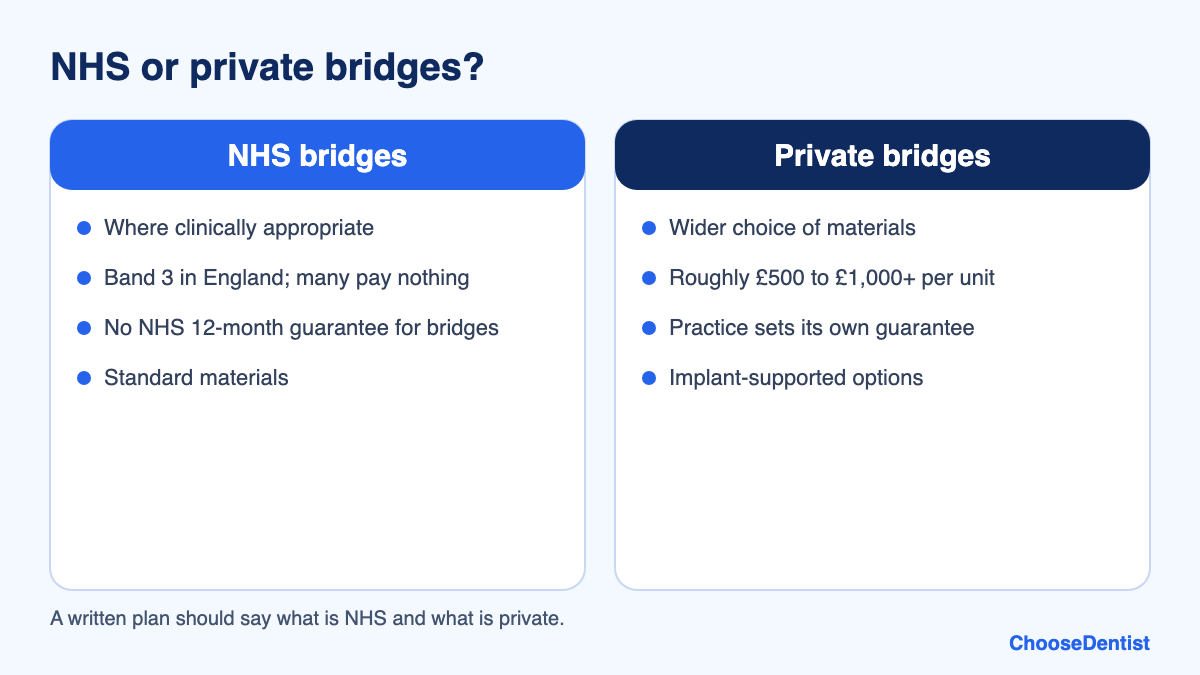
Some NHS treatments are guaranteed for twelve months, so a repair or replacement is free if it fails in that time. The NHS Business Services Authority lists fillings, root fillings, inlays and onlays, porcelain veneers and crowns, but not bridges or dentures, on its page about guaranteed items. In practice, many practices will help with a problem soon after fitting, but patients should not assume a bridge is covered, and should ask.
This is a good reason to ask the dentist at the outset what the practice’s policy is if the bridge comes loose or fails.
Types of bridge on the NHS
The Leeds Teaching Hospitals leaflet on bridges describes conventional bridges, in which the adjacent teeth are reduced to pegs and crowned, and adhesive bridges, in which a metal wing is bonded to a neighbouring tooth with little or no drilling. Which type is offered depends on the clinical situation: a conventional bridge is usually advised when the supporting teeth are already crowned or have large fillings, and an adhesive bridge suits teeth that are healthy and where the bite is gentle.
Alternatives on the NHS include a denture, which is a removable plate usually recommended when several teeth are missing, or leaving the gap if it does not affect appearance or eating.
Differences across the UK
The structure of charges differs. England and Wales use numbered bands, with Wales reforming its dental contract. Scotland provides free NHS examinations and free treatment for people under 26, and adults over 26 pay a capped share of the cost, according to NHS Inform. Northern Ireland charges adults a percentage of the dentist’s fee up to a ceiling per course of treatment. Charging for NHS dentistry differs across the four nations. England has three bands and an urgent charge, with crowns, bridges and dentures in the highest band, Wales numbered bands and an urgent charge with a contract reform under way, Scotland free examinations and free treatment under 26 with a capped share of the cost for other adults, and Northern Ireland a percentage of the dentist’s fee up to a ceiling per course.
Availability of NHS appointments also varies. Some areas have long waits, and an NHS practice may be unable to take on new patients, so it is worth phoning several.
What if a bridge is not offered?
Not every patient who asks for a bridge is offered one. A dentist may decide that the neighbouring teeth are too weak or heavily restored, that gum disease must be controlled first, or that a denture or leaving the gap is more appropriate. The NHS says the dentist offers the treatment that is clinically appropriate. If you disagree, you can ask for the reasons to be explained, seek a second opinion or consider private treatment, which offers more options.
Waiting and appointments
NHS capacity varies. Some practices can start a bridge within weeks, and others have long waiting lists or are not taking new NHS patients. Patients can phone several practices, ask about waiting times and join lists. A temporary or short-term measure, such as a temporary denture, may be offered while you wait. If you are in pain or the situation is urgent, NHS 111 can direct you to urgent dental care.
Who pays nothing
Many people are exempt from NHS dental charges, including children, young people in full-time education under 19, pregnant women, new mothers and people on certain benefits. For a bridge, which is in the highest band, exemption can save a considerable sum, so it is worth checking entitlement before the course starts and bringing evidence. Scotland offers free treatment to people under 26.
Keeping the bridge healthy
After a bridge is fitted, the care instructions matter as much as the treatment. The Leeds hospital leaflet advises brushing the bridge as normal and sweeping floss under the false tooth along the gum line, and a hygienist can demonstrate it. Regular check-ups let the dentist look at the margins and the supporting teeth, and early repair of a small problem is usually simpler than replacing a failed bridge. Patients should ask about the practice’s policy on repairs, since bridges are not on the NHS guarantee list.
Combining NHS and private care
Some patients have their check-ups and routine treatment on the NHS but pay privately for a particular treatment, such as an implant-supported bridge. This is allowed provided the practice keeps the two clearly separate, explains the charges for each and gives you a written plan. You should not be asked to pay privately for something that is clinically necessary and available on the NHS, and if you are unsure which category a treatment falls into, you can ask the dentist to explain.
Private bridges
Private practices set their own fees, and as a rough guide a bridge commonly costs from about £500 to £1,000 or more per unit, so a three-unit bridge may cost from around £1,500 to £3,000. Prices depend on the materials, the laboratory and whether the bridge is supported by implants. A private bridge may offer more choice of materials and appearance, and a private guarantee in writing.
Questions to ask
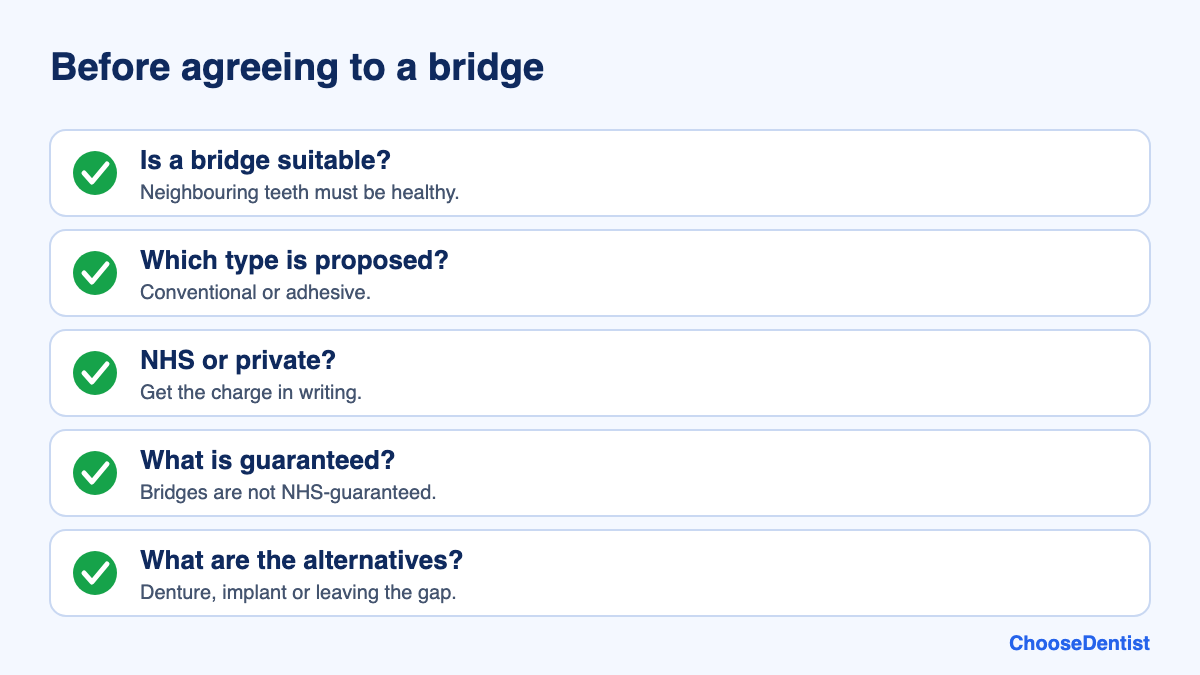
Useful questions include whether a bridge is the right option, which type is proposed, what the neighbouring teeth need, whether the treatment is NHS or private, what the charge will be, what the guarantee is and what happens if it fails. A clear written plan helps to compare options.
The ChooseDentist directory of practices providing bridges can be searched by postcode, with CQC and Google ratings shown where available. Two practices can be compared side by side, and NHS availability should be confirmed directly with the practice.