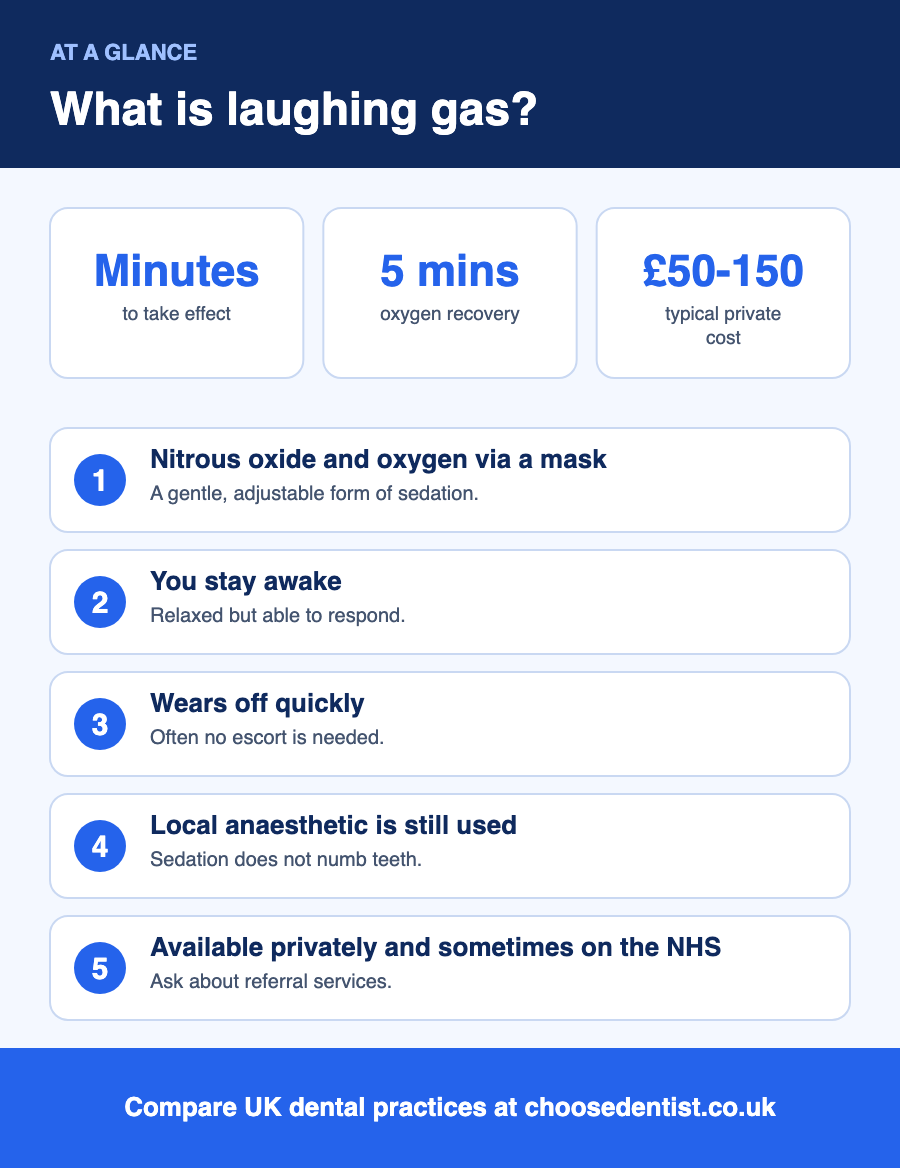
Inhalation sedation is a way of helping nervous patients relax during dental treatment by breathing a mixture of nitrous oxide and oxygen through a small mask placed over the nose. It is often called laughing gas, though most people do not laugh, and it produces a calm, slightly detached feeling within a few minutes. It wears off quickly once the gas is switched off, so most patients can leave the surgery unaccompanied soon afterwards.
Of the main forms of dental sedation, it is generally the gentlest and the most flexible, which makes it a common first choice for anxious adults and for children who are old enough to cooperate with the mask.
How it works
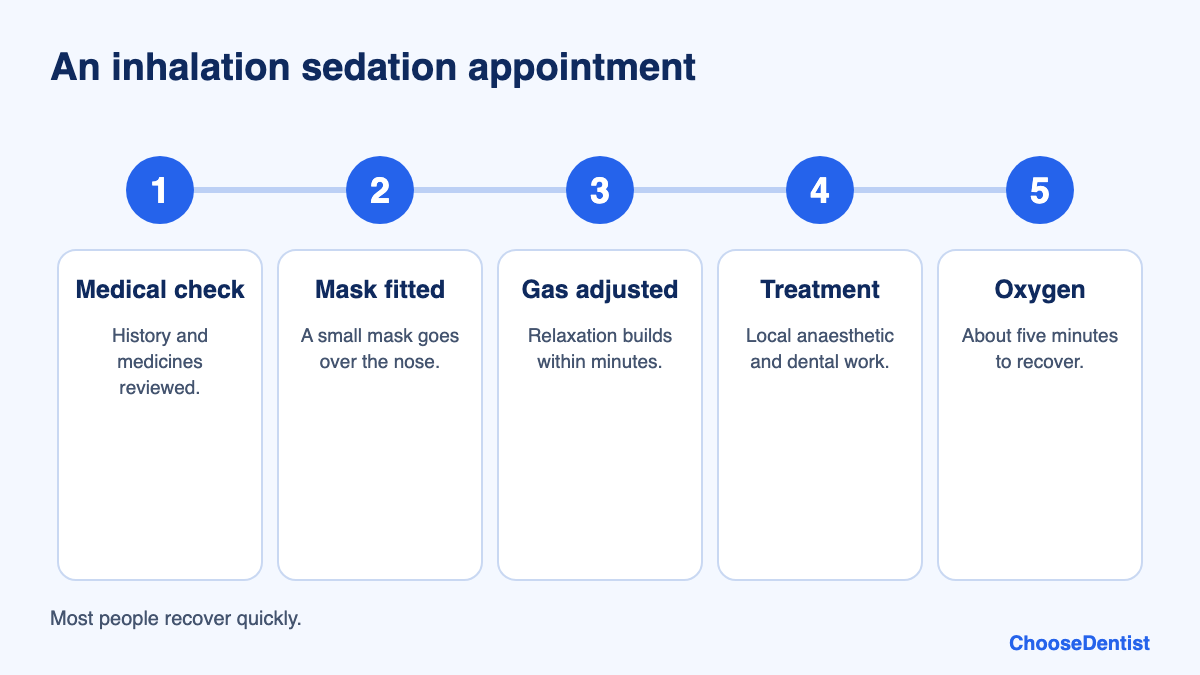
The Wikipedia article on sedation dentistry describes inhalation sedation, using nitrous oxide and oxygen, as the most nearly ideal technique for managing anxiety, noting that it is readily controllable and so suitable for a wider range of procedures than typical moderate sedation. The dentist or a trained team member adjusts the proportion of nitrous oxide to oxygen, increasing it gradually until the patient feels relaxed and reducing it when the treatment finishes.
Because the gas is absorbed and eliminated through the lungs, it takes effect within a few minutes and clears just as fast. At the end, the patient breathes pure oxygen for about five minutes, which the same article describes as part of recovery, to flush the nitrous oxide out of the body.
| Feature | Inhalation sedation | Notes |
|---|---|---|
| How it is given | Nitrous oxide and oxygen through a nose mask | Dose adjusted continuously |
| Onset | Within a few minutes | Patient stays awake and responsive |
| Recovery | Oxygen for about 5 minutes; usually quick | Often no escort needed, but follow the practice's advice |
| Best suited to | Mild to moderate anxiety; children who accept a mask | May not suit severe phobia or blocked nose |
| Typical private cost | About £50 to £150 per session | Additional to treatment |
What it feels like
Most people describe a pleasant, floaty relaxation, with tingling in the fingers or toes, a sense of warmth and a feeling that time is passing quickly. Worries seem less important, and sounds may seem distant. The patient remains awake, can talk, and can respond to the dentist’s instructions throughout, so it is a form of conscious sedation, not a general anaesthetic.
It does not numb the teeth. Local anaesthetic is still needed for most treatment, and many people find that the injection feels much less daunting while they are relaxed. Some patients feel slightly light-headed, nauseous or giggly, and a few do not respond well, in which case the dentist can stop the gas immediately.
Who it suits
Inhalation sedation is useful for people with mild to moderate dental anxiety, for those who find certain procedures stressful, such as injections or extractions, and for patients with a strong gag reflex. It is often used for children and teenagers who are old enough to wear the mask, since it is quick, adjustable and wears off rapidly. It is also appropriate for short procedures, as the effect can be started and stopped within minutes.
It may be less effective for people with severe phobia, who might need a deeper form of sedation, and it does not work well for those who cannot breathe through the nose, for instance because of a cold or blocked sinuses. It is generally avoided in some medical conditions, such as certain lung diseases and in early pregnancy, and the dentist will take a medical history first.
Safety and side effects
Nitrous oxide has a long record of use, and when administered by trained clinicians to suitable patients, it is considered a safe technique. Common minor effects are light-headedness, nausea, sweating and, occasionally, headache after the gas is stopped, and these generally pass quickly. The Wikipedia article lists the more general side effects of sedation as drowsiness, nausea, vomiting, dry mouth, headache and dizziness.
Equipment is designed to ensure that a minimum proportion of oxygen is always delivered, and the patient is observed throughout. The guidance from the Scottish Dental Clinical Effectiveness Programme sets out the standards for staffing, monitoring and training in conscious sedation, and is used widely across the UK.
Before and after the appointment
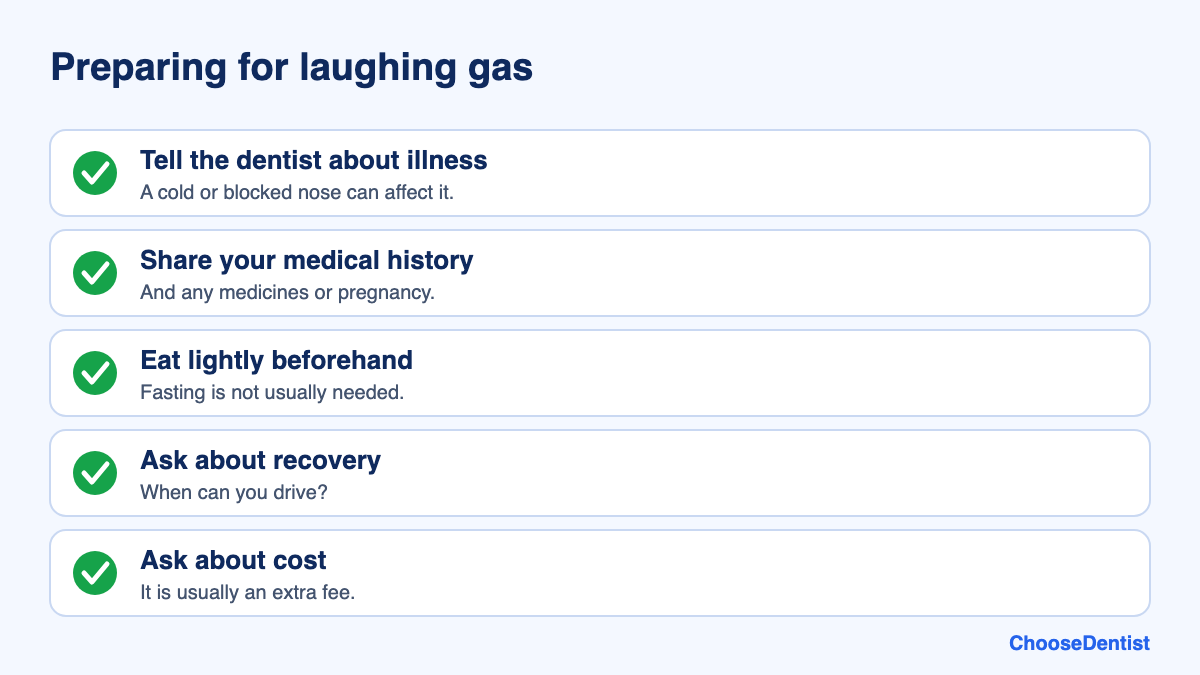
Preparation is minimal. Unlike oral or intravenous sedation, patients are not usually asked to fast, though a light meal beforehand is sensible, and they can generally take their usual medicines. They should tell the dentist about any illness, such as a cold, and about medicines and pregnancy.
Afterwards, a short rest and oxygen are normal. Many patients feel completely normal within minutes, although some practices advise waiting a little before driving or making important decisions, so the dentist’s instructions should be followed. There is generally no need for an escort, though it depends on the practice and the patient.
Laughing gas for children
Inhalation sedation is widely used with children who are old enough to accept a small mask, often from around the age of five or six, and who are able to breathe through the nose. It is quick to take effect, easy to adjust and wears off in minutes, which makes it popular with paediatric dentists and parents. The mask is often introduced as a game, and the gas may be described as a special air to help the child feel relaxed. Our guide to children and dental sedation explains when it is used and what else is available.
What it cannot do
Laughing gas will not make a patient unconscious, and it will not remove pain. Some people with strong anxiety find that it takes the edge off but does not remove their fear completely, and others do not experience much of an effect at all. If it is not enough, the dentist may suggest oral or intravenous sedation on a later visit, or combine it with other techniques. Patients should not be disappointed if the first attempt is only partly successful, since many people find that their response improves as they become more familiar with it.
Common questions
Patients often ask whether it is addictive, and when used occasionally in the dental setting it is not considered so. Others ask whether it can be used while pregnant, and dentists generally avoid it in early pregnancy and would discuss any alternatives. People with a blocked nose or breathing difficulty may be unable to use it, and those with certain medical conditions may be advised against it, which is why a medical history is always taken first.
NHS and private options across the UK
Inhalation sedation is available both privately and, in some areas, on the NHS. Sedation within the NHS is mainly provided through referral to community or hospital dental services for patients with severe anxiety, medical complexity or special needs, and availability in ordinary NHS practices varies, so it is worth asking the dentist and checking whether any extra charge applies. Charging for NHS dentistry differs across the four nations. England has three bands and an urgent charge, Wales numbered bands and an urgent charge with a contract reform under way, Scotland free examinations and free treatment under 26 with a capped share of the cost for other adults, and Northern Ireland a percentage of the dentist’s fee up to a ceiling. Private fees are set by each practice, and as a rough guide inhalation sedation commonly costs from about £50 to £150 per session on top of the treatment itself.
Questions to ask
Useful questions include whether the dentist is trained in inhalation sedation, how much it costs, whether it is suitable for the planned treatment, what to do beforehand and how long recovery takes. Patients can also ask whether the practice has experience of treating anxious patients and whether a short introductory visit is possible.
Finding a practice
A practice that explains the process and does not rush an anxious patient is a good sign. Reading reviews from other nervous patients offers a useful view.
The ChooseDentist directory of sedation practices can be searched by postcode, with CQC and Google ratings displayed where available. Two practices can be compared side by side, and the sedation service and cost should be confirmed directly with the practice.