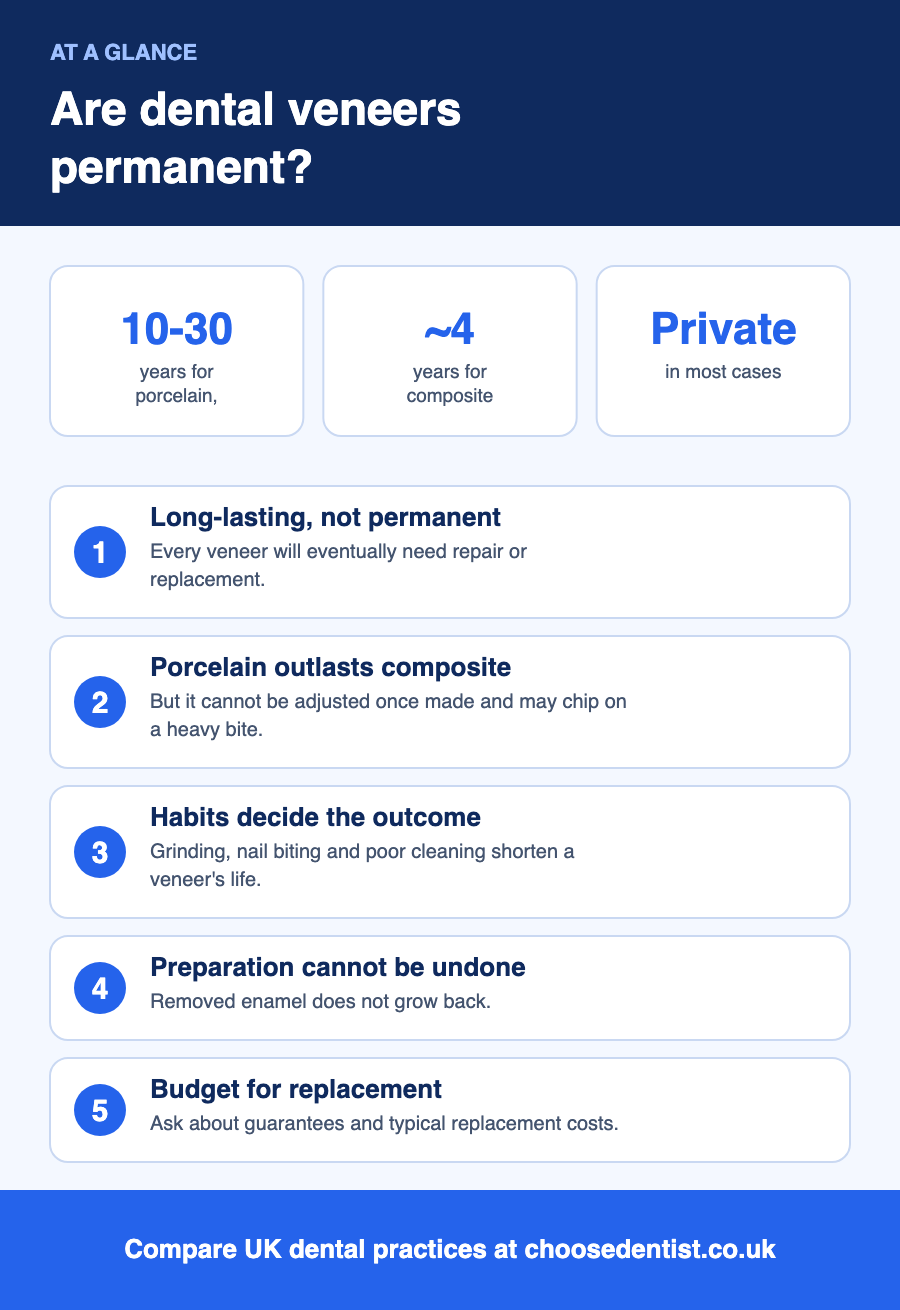
Dental veneers are long-lasting but not permanent. A well-made porcelain veneer can serve for ten years or more, and some last a good deal longer, but every veneer is a manufactured restoration that will eventually chip, wear, stain at the edges or come loose. Anyone considering veneers should treat them as a commitment to a cycle of maintenance and, in time, replacement, instead of a once-and-for-all fix.
The word permanent can also mean something else, which is whether the procedure can be undone. In that sense the answer depends on how the teeth were prepared. A veneer that required the removal of a layer of enamel changes the tooth for good, even though the veneer itself is not meant to last for ever. Both meanings matter when deciding whether to go ahead.
How long veneers last
The Wikipedia article on dental veneers states that veneers in general typically last between ten and thirty years with modern cements and bonding agents, and that composite veneers last approximately four years. Porcelain is described as more durable and less likely to stain than composite. The range is wide because so many factors are involved: the skill of the dentist and the laboratory, the strength of the bond, the patient’s bite, and the way the teeth are cared for.
The Oral Health Foundation says in its guide to veneers that they can last many years if they are looked after properly, but that they can chip, crack or come loose, and that small chips can sometimes be repaired while on other occasions a new veneer is needed. That is a more cautious way of putting it than the Wikipedia range, and it reflects what dentists tell their patients: the figures are typical, not promised.
| Type of veneer | Typical lifespan | Can it be repaired? |
|---|---|---|
| Composite (resin) | Roughly 4 years | Often, in the mouth and in a single visit |
| Porcelain | Commonly 10 to 30 years | Small chips sometimes; otherwise replaced |
| Ultra-thin or minimal-preparation porcelain | Depends on the case and the bond | Replaced if damaged |
| Any veneer, with night-time grinding | Shorter without a night guard | Chips and cracks are more likely |
What shortens a veneer's life
Grinding and clenching are the main enemies. Porcelain is hard but brittle, and repeated heavy loading, particularly on the edges of the front teeth, causes small fractures that gradually extend. Patients who grind at night are commonly advised to wear a night guard, and many dentists consider it close to essential. Habits such as biting nails, chewing pens or opening packets with the teeth have a similar effect.
Decay and gum recession are the second group of problems. A veneer protects only the front surface of the tooth, and plaque that collects at its edges can cause decay, which leads to the bond failing. If the gum recedes, the margin of the veneer or the darker root surface may become visible. The Wikipedia article lists cracking, leaking, chipping, discolouration, decay and shrinkage of the gum line among the reasons for replacement.

What happens when a veneer reaches the end of its life
Replacement is a planned event for most patients. A worn or chipped veneer is removed and a new one made, and because the tooth beneath has already been prepared, there is no question of returning to the natural enamel. In some cases the dentist may suggest a crown instead, particularly if the tooth has been weakened or if the bite has changed. The cost is similar to the original, and it is reasonable to ask at the outset what a typical replacement would cost.
Composite veneers have a different pattern. They can often be repaired in the mouth, and polished or added to, which is part of their appeal, but they tend to need attention more frequently. Some patients start with composite, which is less expensive and sometimes requires little preparation, and move on to porcelain once they are sure of what they want.
Looking after veneers
Aftercare is simple but important. Brushing twice a day with fluoride toothpaste, cleaning between the teeth daily and having regular check-ups and hygiene visits protect both the veneer and the tooth underneath. Non-abrasive toothpaste is often recommended, because heavily abrasive products can dull the surface of a composite veneer. Smokers and those who drink a lot of tea, coffee and red wine should expect staining at the edges, where the veneer meets the tooth, even though the porcelain itself resists stain.
Dentists often record the shade and take photographs at the end of treatment so that replacements can be matched, and keep the details in the patient’s notes.

Signs that a veneer needs attention
Certain changes should prompt an appointment sooner than the next routine check. A veneer that feels loose or rocks slightly, a rough or sharp edge that catches the tongue, a dark line appearing at the gum margin, sensitivity that had not been there before and persistent bad taste or bleeding around a veneered tooth are all worth reporting. Early repair of a small chip or re-bonding of a loose edge is much easier than dealing with decay that has spread beneath the veneer, and the dentist will usually look carefully at the seam between veneer and tooth at every check-up.
Veneers compared with other long-term options
Some patients find it useful to compare veneers with the alternatives. Composite bonding is less expensive and removes little tooth, but it is shorter-lived and more prone to stain. Crowns are stronger and appropriate where a tooth is heavily broken down, though they involve far more preparation. Orthodontic treatment can straighten teeth without any enamel removal at all, albeit over a longer time, and whitening alone may be enough for colour concerns. A good dentist will help the patient to weigh up these trade-offs against the goals and the budget.
NHS and private options across the UK
Veneers are generally a private treatment. The NHS says that veneers are usually private unless there is a clinical need, and in practice the NHS funds restorations only where a tooth needs repair for health or function. Where an NHS dentist does provide a veneer or a crown because a tooth is damaged, the cost falls within that nation’s charging system, which differs across the UK: England and Wales use numbered bands, Scotland provides free examinations and charges a share of the cost, up to a cap, to adults over 26, and Northern Ireland charges a percentage of the fee up to a ceiling.
Private fees are set by each practice. As rough guides, composite veneers often cost from about £250 to £500 per tooth, and porcelain veneers from about £600 to £1,200 or more, with laboratory costs and the number of teeth making a large difference. Because replacement is a normal part of the cycle, it is worth asking whether the practice offers a guarantee, how long it lasts and what conditions apply, such as attending regular hygiene visits.
Judging a quote
Quotes for veneers vary so widely that the cheapest and the dearest can differ several times over. The difference is not always a reflection of quality, but it often reflects the laboratory, the materials, the time spent on design and the experience of the dentist. A useful quote lists the number of teeth, the material, the consultation, any mock-up, temporary veneers, a night guard and the follow-up appointments, and states what the guarantee covers. Comparing quotes line by line is the only fair way to see what is actually being offered.
Questions to ask before committing
Sensible questions include how long the dentist expects the veneers to last in the patient’s case, what the replacement policy is, whether a night guard will be needed, whether more conservative alternatives would meet the goal, and how much enamel will be removed. The answers say a good deal about how carefully the case has been thought through.
The ChooseDentist directory of veneer practices can be searched by postcode, with CQC and Google ratings displayed where they are available. Two practices can be compared side by side before booking a consultation, and the details of any treatment and its cost should be confirmed directly with the practice.