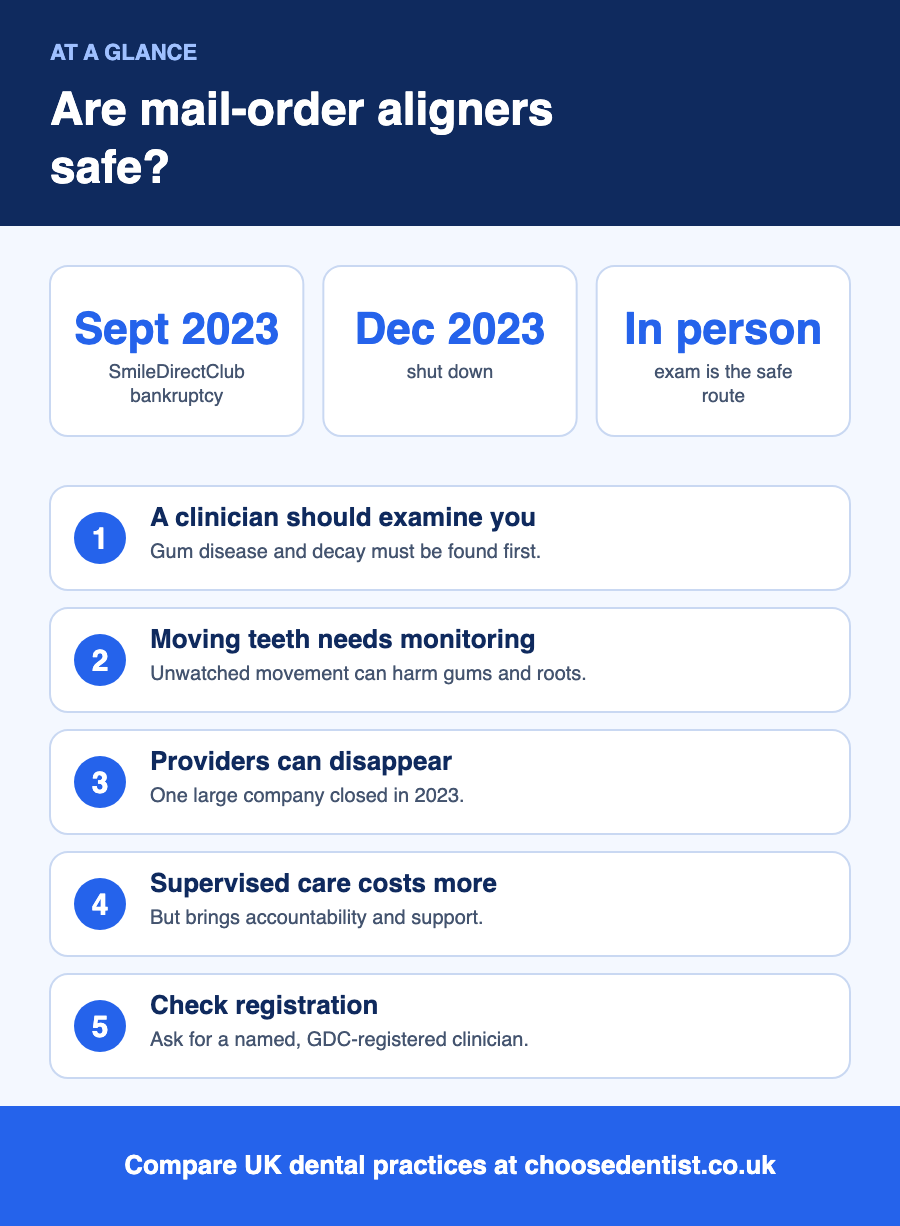
Clear aligners supplied by post, with little or no face-to-face supervision, carry more risk than treatment overseen in person by a dentist or orthodontist. Moving teeth is a clinical procedure, and a proper examination beforehand is the only reliable way to spot problems such as gum disease, decay or unhealthy roots that could make treatment unsafe. For this reason dental professionals are generally cautious about services in which a patient takes their own impressions or scans at home.
The convenience and lower price are attractive, and some people have had acceptable results. The concern is what happens when things go wrong, because no one on hand is positioned to notice or to correct them. This guide explains the main risks and how to choose clear aligners with proper oversight.
What the concern is
The Wikipedia article on clear aligners records that direct-to-consumer services, which had no in-office dentist involvement, drew criticism from the orthodontic community, and that the American Association of Orthodontists issued a consumer alert about the risks of such services. The core of the objection is that the diagnosis, the treatment plan and the monitoring are not carried out by a clinician who has examined the patient’s mouth.
Teeth are attached to bone by ligaments, and moving them applies forces to the gums, the roots and the bone. If those tissues are already unhealthy, orthodontic forces can accelerate damage, and without an examination and X-rays, the problem may go unnoticed.
| Feature | Supervised treatment | Mail-order only |
|---|---|---|
| Examination and X-rays | In person, before treatment | Often none; home impressions or scans |
| Treatment plan | Made and explained by a clinician | Often remote and automated |
| Monitoring | Regular reviews with a dentist | Photos or app checks, if any |
| If a problem arises | Dealt with in the practice | Contact the company |
| If the provider closes | Local practice remains | Patients may be left without support |
What can go wrong
Several problems have been reported. Undiagnosed gum disease may worsen, loosening teeth. Decay that was not found at the start can progress beneath the aligners, which hold sugars and bacteria against the enamel. Teeth may move in ways that do not match the plan, causing an uneven bite, and the patient may not know until it becomes uncomfortable.
Not everyone is suitable for aligners at all. The Wikipedia article notes that they are suggested for mild to moderate crowding and spacing, so someone with a complicated bite who is sold a mail-order programme may be disappointed or harmed.
What happened to one large provider
The same article reports that SmileDirectClub, which operated largely without an in-office dentist, filed for bankruptcy in September 2023 and shut down in December 2023, leaving thousands of customers without support. Patients part-way through treatment had to find a new clinician to complete it, often at additional cost, and some had no records of the planned movements.
This episode illustrates a broader risk: treatment takes a year or more, and the continuity of care depends on the provider being there throughout. A local practice that you can visit is more likely to remain available.

How supervised treatment differs
With a dentist or orthodontist, the process starts with an examination, X-rays and a scan, and the clinician treats any decay or gum disease before starting. A treatment plan is explained, the patient attends reviews in person, and attachments and interproximal reduction, where needed, are carried out by the clinician. If a tooth does not move as expected, a refinement can be planned, and any problem can be dealt with quickly.
Cost can be higher, but the patient is protected by a clinician who is accountable for the care and registered with the General Dental Council.
Checking a provider
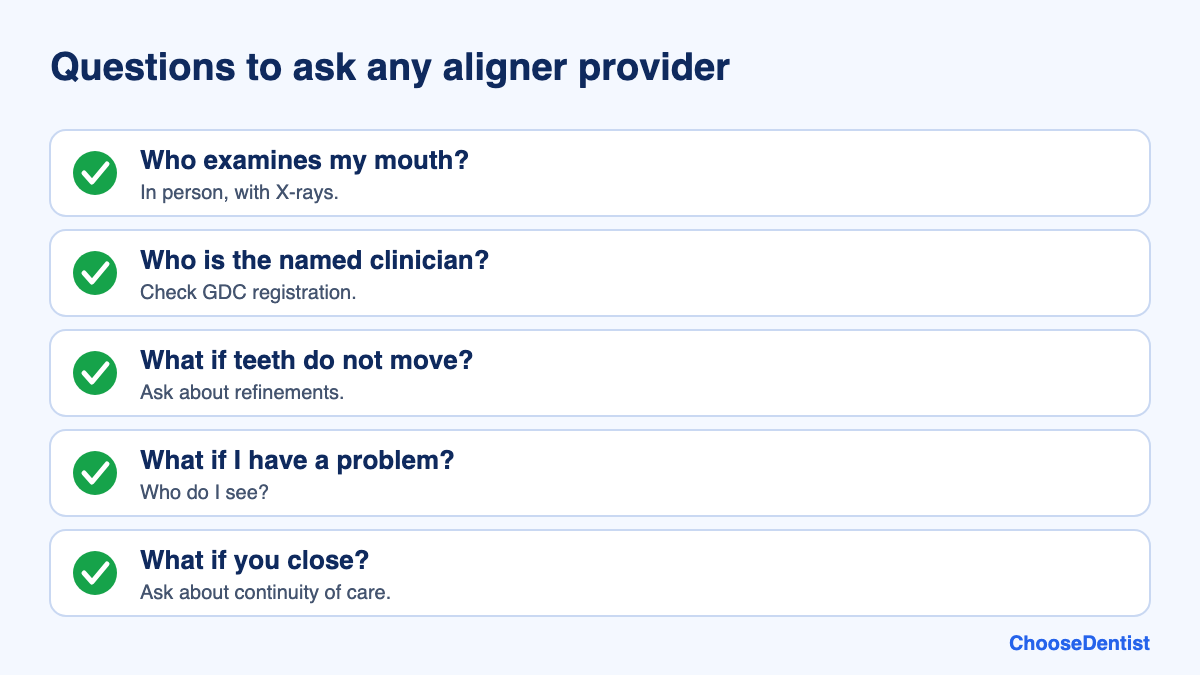
Patients can protect themselves by asking a few direct questions. Who examines my mouth, and is it in person? Who is the named clinician, and are they registered with the General Dental Council? Will X-rays be taken? What happens if I have a problem or if teeth do not move as planned? Who will see me if the company closes? A reputable provider answers these without difficulty.
The General Dental Council’s register shows whether a dentist is registered, and the Care Quality Commission’s reports show how a practice in England is regulated and rated.
Warning signs of an unsafe service
Be cautious if there is no examination or X-ray before treatment, if a patient is encouraged to take impressions at home and send them off, if the service promises a very quick result or if it is difficult to find who is clinically responsible. Pressure to pay in advance and vague refund terms are further reasons for care.
What dental professionals say
Professional bodies and regulators have repeatedly stressed that tooth movement should be supervised by a registered dentist or orthodontist, who should examine the patient, take appropriate records and monitor progress. The General Dental Council’s position is that the practice of dentistry, including treatment planning, is for registered professionals, and a service that relies on a remote reviewer may fall short of this. Patients considering a remote service should find out exactly who is clinically responsible and what the registration status of that person is.
Cost savings and false economies
The attraction of mail-order aligners is often price. A cheaper course can look sensible, but it may exclude the examination, the X-rays, the attachments and the retainers, and it may leave the patient to pay for any correction elsewhere. If treatment goes wrong, a dentist may need to repair the damage, and the overall cost may exceed what supervised treatment would have been. Weighing the total cost, not just the headline price, is wise.
If you have already started
Anyone who has begun a remote programme and is unsure about it can arrange an examination with a local dentist, who can check the gums, teeth and bite, take X-rays and advise on whether it is safe to continue. If the provider has closed, a dentist may be able to take over, and records of the planned movements, if available, make this easier. Stopping aligners abruptly can allow the teeth to drift, so it is better to seek advice than to give up.
Reporting problems
Patients who have had a poor experience with a provider can raise it with the company first, and then with the relevant regulator. Complaints about a registered dentist can be made to the General Dental Council, while concerns about advertising or consumer rights can be directed to Trading Standards or the Advertising Standards Authority. Keeping all records, including photographs, messages and receipts, makes it easier to explain what happened, and a local dentist can document the condition of the teeth.
NHS and private options across the UK
Clear aligners are not part of the standard NHS offer in any of the four nations, so mail-order services are private and sit outside NHS regulation. The NHS describes braces for eligible under-18s with a clinical need, usually fixed metal appliances, on its page about braces. Charging for NHS dentistry differs across the four nations. England has three bands and an urgent charge, Wales numbered bands and an urgent charge with a contract reform under way, Scotland free examinations and free treatment under 26 with a capped share of the cost for other adults, and Northern Ireland a percentage of the dentist’s fee up to a ceiling. Patients who cannot afford supervised private treatment may prefer to wait, or to ask a practice about a shorter programme, instead of choosing an unsupervised service.
Finding a supervised provider
Choosing a local practice with a dentist or orthodontist who will examine the patient, plan the treatment and see them regularly is the safest route. Comparing practices, reading reviews and checking inspection reports give a rounded picture.
The ChooseDentist directory of practices offering clear aligners lets visitors search by postcode, view CQC and Google ratings where they are available and compare two practices side by side. Costs and arrangements should be confirmed directly with the practice.