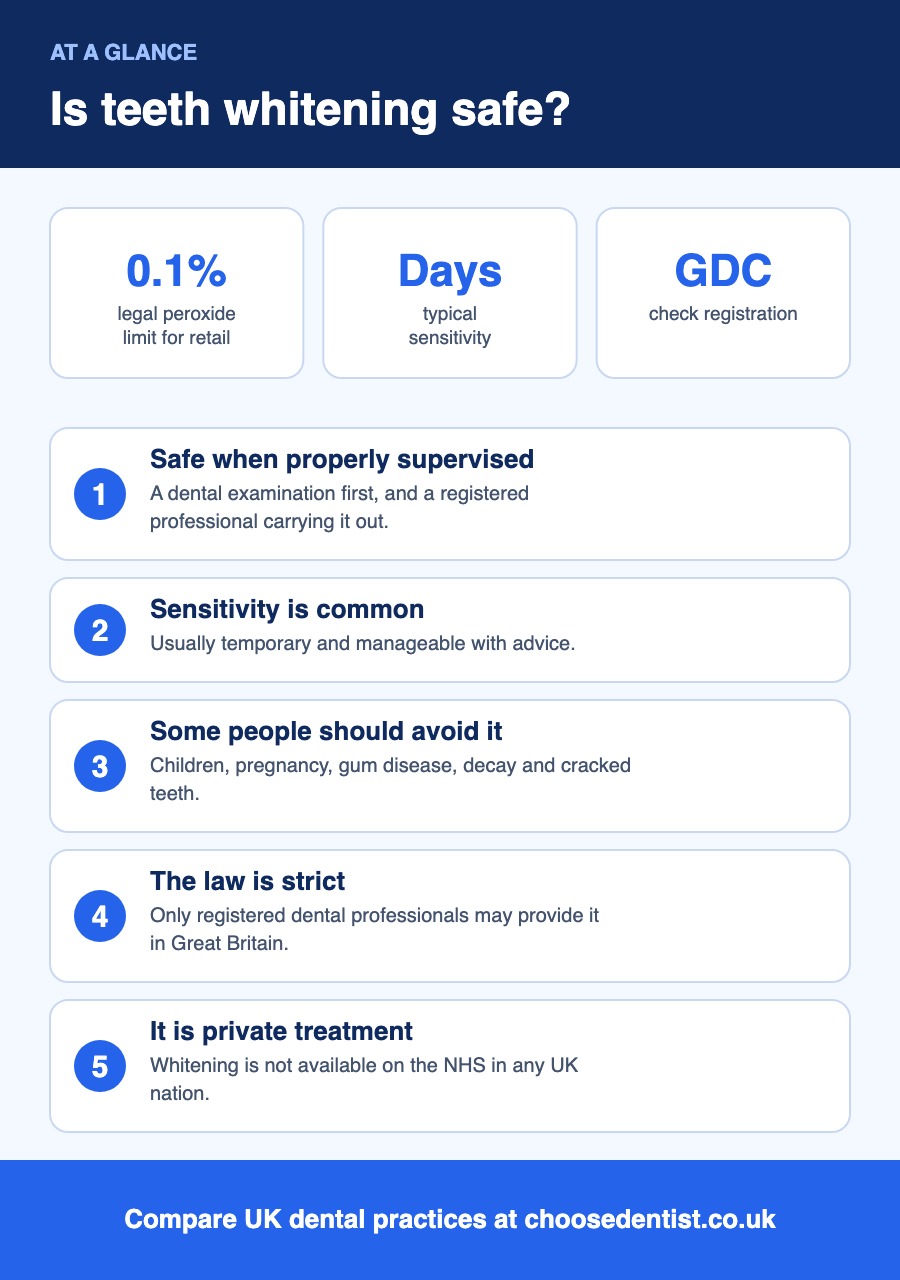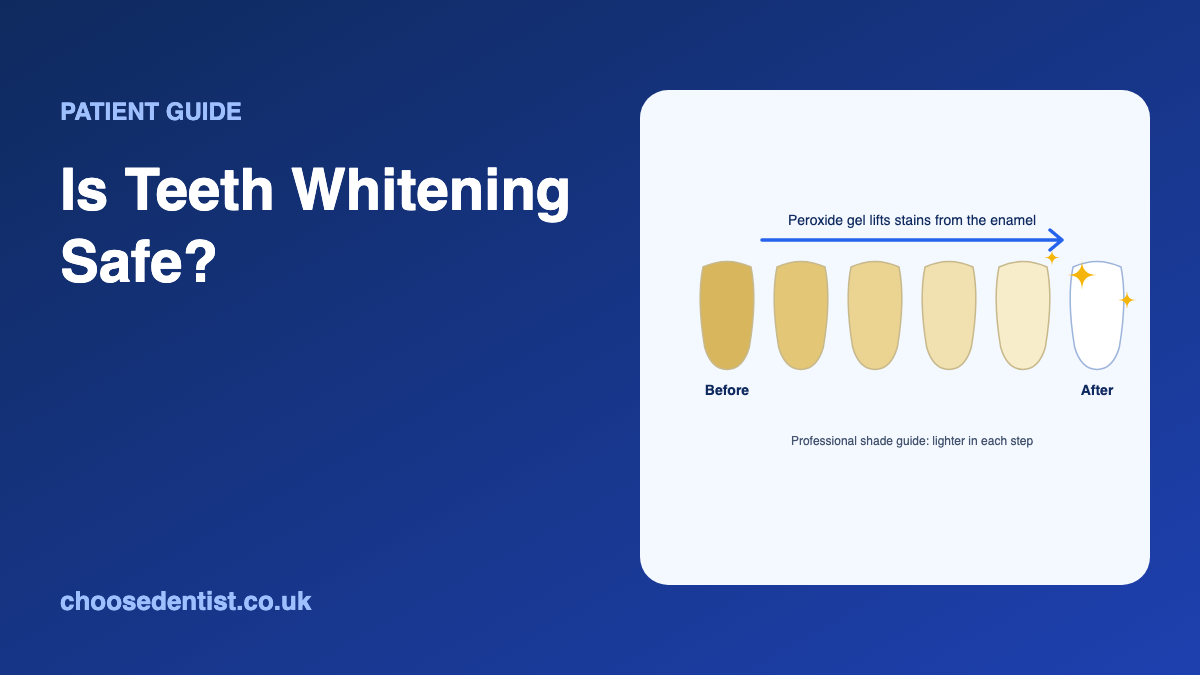
Professional teeth whitening is considered safe for most people when it is carried out by a registered dental professional after an examination. The gels used are strong enough to lighten enamel, which also means they can irritate the gums and make the teeth sensitive, so the question is not so much whether whitening is safe in the abstract as whether it is being done properly, on suitable teeth, by someone who is qualified to do it.
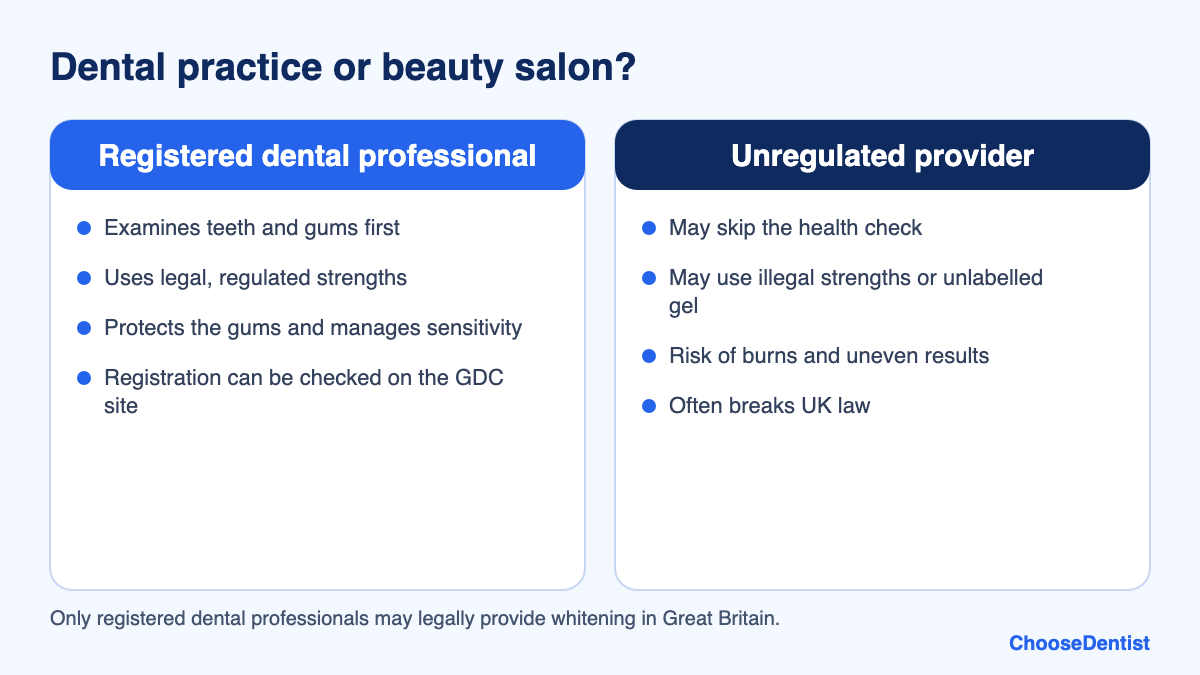
The risks rise sharply when those conditions are not met. Treatment given in a beauty salon, by an unqualified operator, or with kits bought from unregulated sources has caused burns to the lips and gums, and in the United Kingdom it is also against the law in most circumstances. The sections below explain the effects patients may notice, the groups who should not be treated and the legal framework.
Common side effects
The NHS website explains that the chemicals used in whitening are strong and can cause tooth sensitivity, sore gums or throat, and white patches on the gums. A protective shield or paste is used to limit contact with the soft tissue, but side effects can still occur for a short time. Most of them settle within days of finishing the course.
Sensitivity is by far the most frequently reported. The Wikipedia article on tooth whitening cites figures of between 67 and 78 per cent of patients experiencing sensitivity after in-surgery treatments that combine hydrogen peroxide with heat or light, lasting anywhere from four to thirty-nine days. It adds that home-based whitening, used according to the manufacturer’s instructions, tends to produce less sensitivity than in-surgery treatment. Toothpastes containing potassium nitrate or fluoride can ease discomfort, although there is no evidence that they prevent it altogether.
| Possible effect | How common | What usually helps |
|---|---|---|
| Tooth sensitivity | The most common; many patients notice it for days to weeks | Desensitising toothpaste, a break from whitening, advice from the dentist |
| Sore or irritated gums | Occasional | Well-fitting trays or gum protection; the effect usually settles |
| White patches on the gums | Occasional and temporary | Usually fade within hours or days |
| Uneven shade against crowns or fillings | Whenever restorations are present | Plan restoration replacement after whitening |
| Chemical burns | Associated with unregulated or misused products | Avoid non-dental providers and unlicensed kits |
What the research says about long-term safety
Concerns are sometimes raised about whether hydrogen peroxide could cause cancer. The Wikipedia article reports that the International Agency for Research on Cancer found insufficient evidence that hydrogen peroxide is carcinogenic to humans, and that a review of genotoxicity concluded that oral products releasing up to 3.6 per cent hydrogen peroxide do not appear to raise cancer risk. The same article is clear that the long-term effects of concentrations above 6 per cent have not been fully clarified, so higher strengths should be used with caution and by trained professionals.
These findings are reassuring but they are not a reason for casual use. The evidence relates to products used in the way they were designed to be used, and misuse, such as leaving gel on for too long or applying it to damaged gums, is where harm tends to arise.
Who should not have whitening
Whitening is not suitable for everybody. The NHS lists people aged 17 or under, those with unhealthy teeth or gums, and people who are pregnant or breastfeeding among those who should not have it, and notes that it does not work on crowns, dentures or implants, since only natural tooth surfaces respond. The Wikipedia article adds peroxide allergy, untreated gum disease, active decay, cracked teeth and exposed dentine to the list of reasons for caution, as well as receding or sensitive gums.
Whitening also has no effect on fillings, porcelain or other restorations, and a change in colour of the natural teeth can leave an obvious mismatch. A dentist will therefore usually discuss any visible restorations before starting, and may suggest replacing them after the teeth have been whitened so that the shades match.
The legal position in the UK
The law on whitening in Great Britain is frequently misunderstood. Under retained regulations, products containing or releasing more than 0.1 per cent and up to 6 per cent hydrogen peroxide can only be sold to dental practitioners and, for the first use in each treatment cycle, only used by them. The General Dental Council’s page on what the law says explains that the High Court confirmed in 2013 that tooth whitening is the practice of dentistry, and so can only be carried out by registered dental professionals. The GDC adds that using products below the 0.1 per cent threshold to provide a whitening service does not make it legal or safe.
The practical message is straightforward: beauty salons and unregistered individuals should not be providing whitening services, and anyone who does so risks prosecution. Patients can check a practitioner’s registration on the GDC website, and the NHS website advises doing exactly that.
Choosing a safe approach
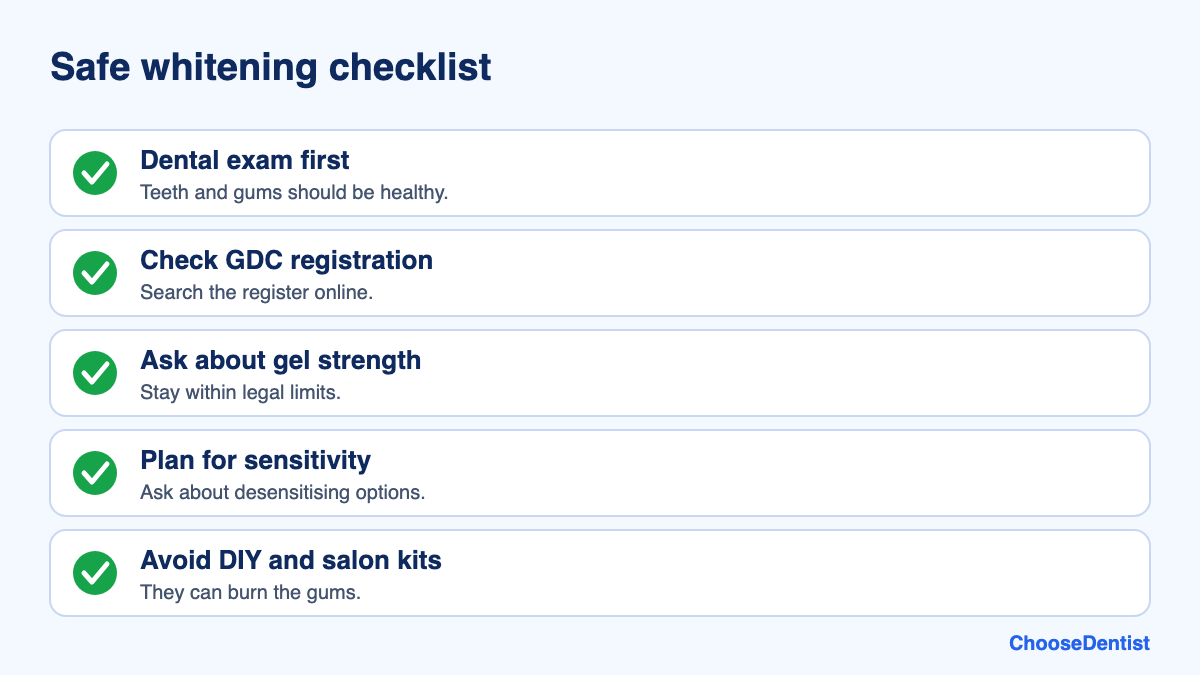
A safe whitening course starts with an examination. The dentist should check that the teeth and gums are healthy, treat any decay or gum problems first, record the starting shade and explain the options. These typically include a home kit with custom-fitted trays and professionally supplied gel, worn for a period of up to a few weeks, or an in-surgery session lasting an hour or two, according to the NHS. Home kits that are made to measure keep the gel against the teeth and away from the gums, which is a reason for preferring them to generic trays.
Patients should ask what strength of gel is used, how long it is to be worn and how sensitivity will be managed. Over-the-counter strips and pastes are legal when they stay under the permitted peroxide level, but the NHS warns that products from pharmacies, online sellers or salons do not work as well and may harm the teeth and gums.
Whitening toothpastes and home products
Many people ask whether over-the-counter products are a safer alternative. Whitening toothpastes mostly work by polishing away surface stain with mild abrasives, and they do not change the colour of the tooth itself, so the effect is modest. Strips and pastes sold on the high street have to stay within the legal limit for peroxide, which is why they lighten teeth less than professional products. They are not risk-free, since overuse can irritate the gums and abrasive pastes can wear enamel over time, and the NHS advises that they do not work as well as treatment from a dentist.
NHS and private options across the UK
Whitening is a cosmetic treatment and is therefore a private service in England, Scotland, Wales and Northern Ireland. The NHS website states that it is not available on the NHS and that patients pay privately at a dental surgery. Costs are set by the practice and commonly range from about £250 to £500 for a home-tray kit and £300 to £800 for an in-surgery treatment, though prices vary by region.
Where whitening is combined with NHS care, the practice must make clear which parts of the visit are NHS and which are private. The charges for ordinary NHS treatment differ across the four nations: England and Wales use numbered bands with an urgent charge, Scotland provides free examinations and charges adults over 26 a share of the cost up to a cap, and Northern Ireland charges a percentage of the dentist’s fee up to a ceiling. None of these arrangements applies to whitening itself.
Finding a trustworthy provider
The most dependable signs of a safe provider are a thorough examination before any treatment, clear information about the product and its strength, and an explanation of the risks in plain language. A practice should be happy to confirm that the person carrying out the treatment is registered.
The ChooseDentist directory of teeth whitening practices allows visitors to search by postcode, see CQC and Google ratings where available, and compare two practices side by side. Details of the treatment, the cost and the appointments should be confirmed directly with the practice.