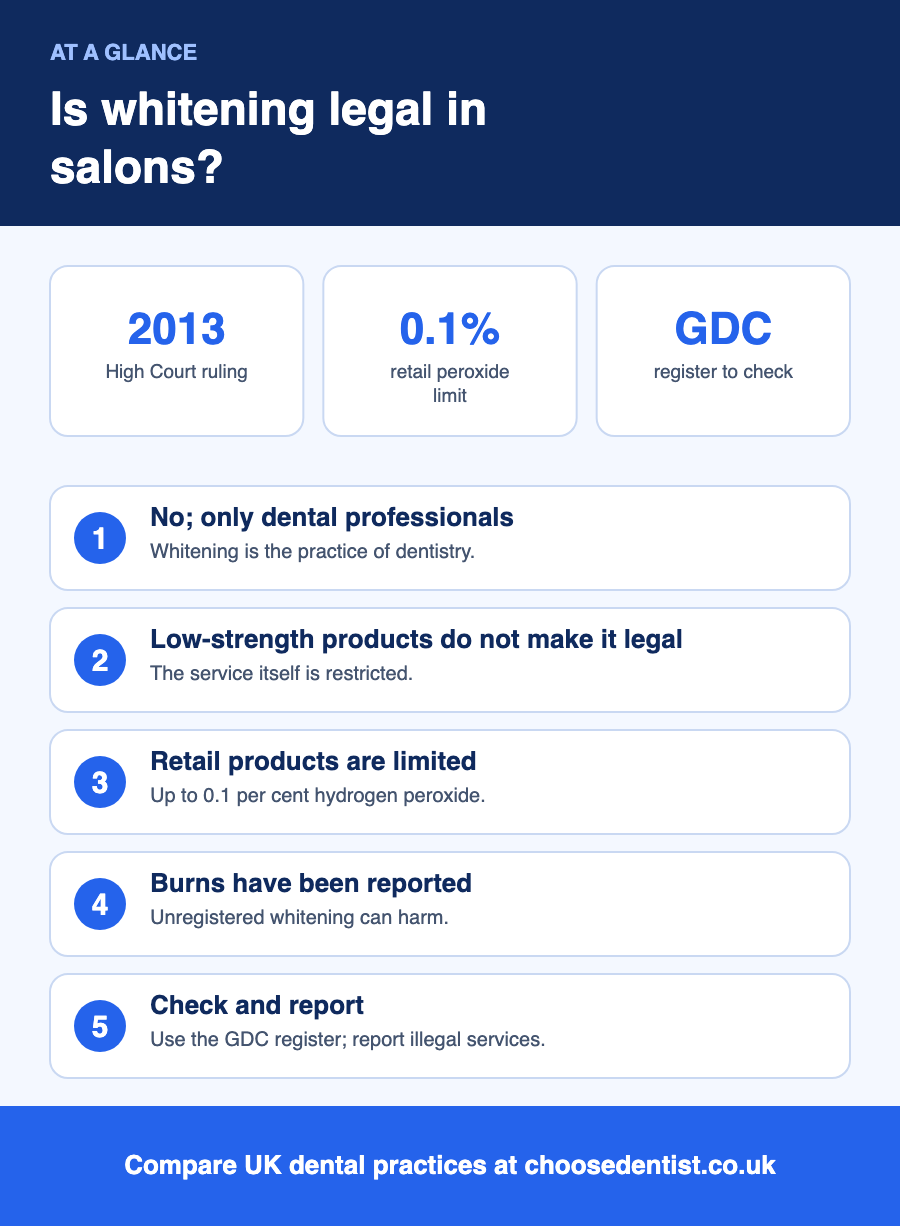
In Great Britain, teeth whitening may only be carried out by registered dental professionals, so a beauty salon offering to whiten teeth with peroxide-based products is acting unlawfully. The position is set out by the General Dental Council, which says that tooth whitening is the practice of dentistry, and it has prosecuted unregistered providers. Anyone considering teeth whitening should know the rules, because the risks of getting it wrong include chemical burns and wasted money.
The law is more precise than the usual summary suggests, and several points are commonly misunderstood. Understanding them helps consumers to recognise an illegal service and to choose a lawful one.
What the law says
The General Dental Council states in its page on what the law says that the High Court confirmed in 2013, in a case brought by the Council, that tooth whitening is the practice of dentistry. Under the Dentists Act 1984, the practice of dentistry is restricted to registered dentists and dental care professionals, so an unregistered person who provides whitening commits an offence.
Separate rules govern the products. Retained European regulations allow retail products to contain or release no more than 0.1 per cent hydrogen peroxide, and products between 0.1 and 6 per cent may be sold only to dental practitioners and used by them, with the first use in each cycle carried out by a dentist. Anything above 6 per cent is not permitted. The Wikipedia article on tooth whitening summarises the European limit of 0.1 per cent for retail products and up to 6 per cent under dental supervision.
| Product strength | Who may supply or use it | Notes |
|---|---|---|
| Up to 0.1% hydrogen peroxide | Sold in shops for use on yourself | Using it to provide a service to others is still unlawful |
| 0.1% to 6% | Dental practitioners only | First use in each cycle by a dentist |
| Above 6% | Not permitted | Not for supply in the UK |
| Whitening service to others | Registered dental professionals only | Beauty salons are not permitted to offer it |
The 0.1 per cent myth
A frequent claim is that salons may whiten legally if they use products with no more than 0.1 per cent hydrogen peroxide. The GDC says that this does not make the treatment legal or safe, because providing a whitening service is itself the practice of dentistry. Low-strength products also produce little effect, so a customer may pay for something that does not work.
Home use of a retail product on oneself is different, and consumer kits below the limit may be bought and used by individuals. The nidirect guidance on tooth whitening in Northern Ireland makes similar points to consumers, cautioning against treatment from unregistered providers.
What can go wrong
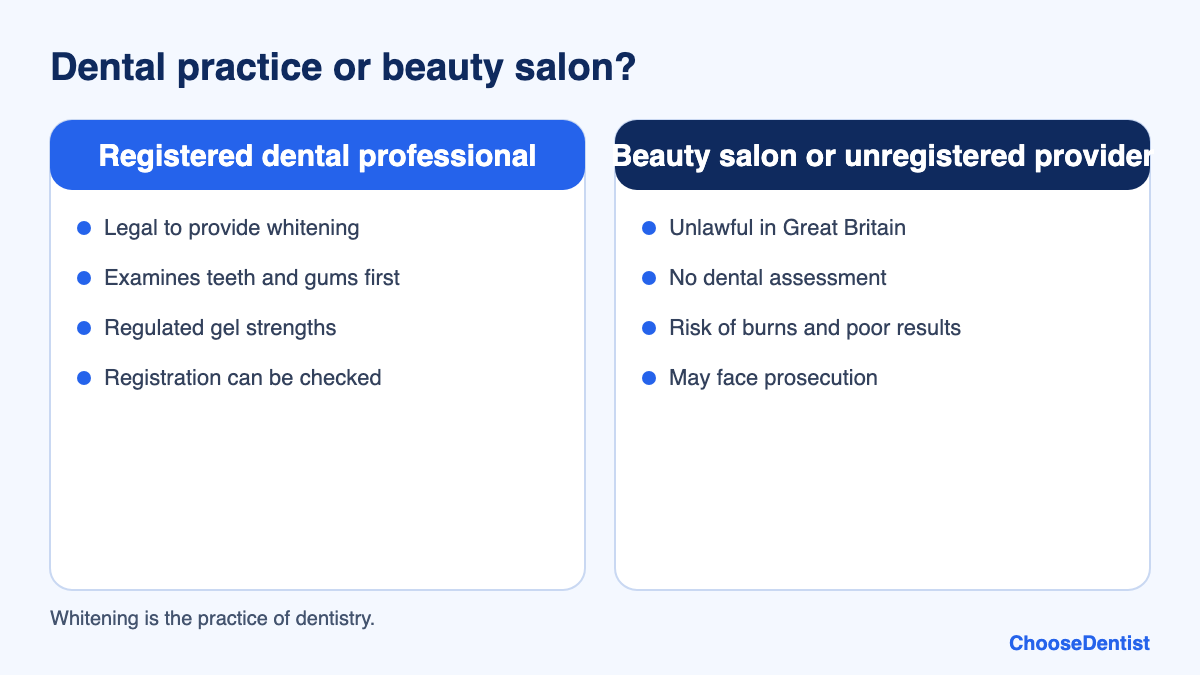
The risks are real. The GDC reports that burns to the mouth, lips and gums have followed unregistered whitening, and that some patients needed hospital treatment. Without a prior examination, decay, cracked teeth or gum disease may not be noticed, and the whitening can aggravate them. Unregulated products may contain gels of unknown strength, and the operator may lack the training to protect the soft tissues.
The NHS website warns that products from pharmacies, online sellers or beauty salons do not work as well and may harm the teeth and gums, and that anyone providing whitening should be checked on the General Dental Council register.
Who can legally whiten teeth
Registered dentists may carry out whitening, and dental hygienists and dental therapists may do so on a dentist’s prescription, within their training. Dental nurses and technicians who are on the GDC register can also carry it out under a dentist’s prescription in some circumstances, but the dentist must have assessed the patient first. In each case the person must be on the GDC register, and the register can be searched online.
A genuine provider will begin with an examination, explain the treatment and risks, record the starting shade and give aftercare advice. Treatment without any assessment is a warning sign.
How to check a provider
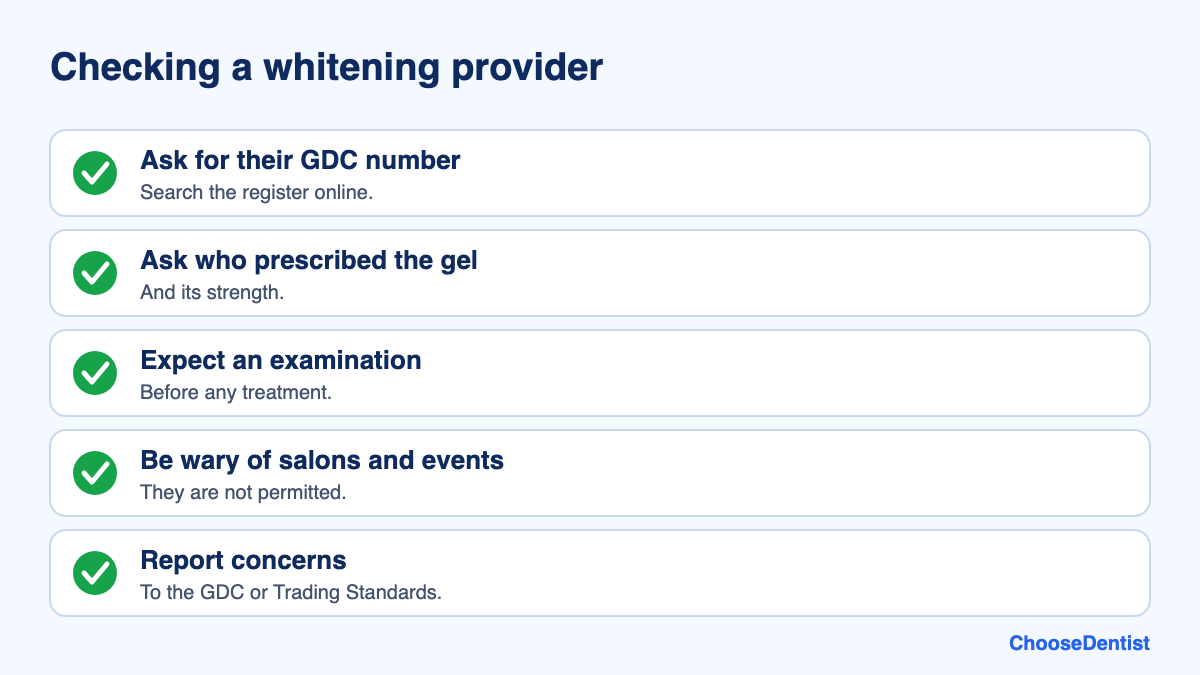
Ask for the name and GDC number of the person carrying out the treatment and check it on the register. Ask who prescribed the gel and what strength it is. Look for the practice’s registration, and, for practices in England, its Care Quality Commission report. Be wary of treatments offered at beauty events, in shopping centres, at home visits or in salons, and of unusually low prices.
If a salon or an individual offers whitening, patients can decline and report concerns to Trading Standards or to the GDC.
Enforcement and reporting
The GDC pursues unregistered providers, and Trading Standards authorities can also take action. The GDC has prosecuted people for illegal whitening, resulting in fines and costs. Consumers who have suffered harm, or who know of an illegal service, can report it, and keeping records such as receipts, photographs and the name of the provider helps.
Why the law exists
The restriction on whitening exists because the products can harm the soft tissues and teeth if misused, and because a proper assessment of the mouth is needed to decide whether whitening is suitable at all. Gum disease, decay, cracked teeth and exposed roots can be made worse by bleaching, and the person providing the treatment needs the training to recognise and manage these problems. A beauty therapist, however skilled in other areas, is not trained in oral health.
Kits sold online
Many whitening products are sold online, some claiming to be professional strength. Those that exceed the legal limit for retail products are unlawful to sell to the public, and products of unknown composition may be unsafe. Even legal kits are less effective than professionally supervised treatment, as the NHS notes. Buying from a dental practice, or following a dentist’s advice on over-the-counter options, is safer than ordering from an unknown seller.
Whitening for under-18s
The NHS advises that whitening is not for people aged 17 or under, and teenagers in particular are sometimes targeted by salons and social media advertisements. The Wikipedia article on tooth whitening adds that the pulp chamber is still enlarging in younger patients. A young person who is unhappy with the colour of their teeth should see a dentist, who can check for causes such as enamel defects, and who may recommend a professional clean or other measures instead.
NHS and private options across the UK
The law applies across Great Britain, and similar protections apply in Northern Ireland, where council Trading Standards services warn consumers about unregistered providers. Whitening is private everywhere. The NHS says that it is not available on the NHS and that patients pay privately at a dental surgery, in its page on teeth whitening. Charging for NHS dentistry differs across the four nations, but none covers whitening. England has three bands and an urgent charge, Wales numbered bands and an urgent charge with a contract reform under way, Scotland free examinations and free treatment under 26 with a capped share of the cost for other adults, and Northern Ireland a percentage of the dentist’s fee up to a ceiling. Private fees from a legitimate practice commonly run from about £250 to £800, and cheaper alternatives from unregulated providers carry risks that are not worth taking.
Choosing a lawful provider
A lawful, safe provider is a registered dental professional who examines the teeth, uses legal products and gives clear information. The Care Quality Commission report for a practice in England adds an independent view.
The ChooseDentist directory of teeth whitening practices can be searched by postcode, with CQC and Google ratings displayed where available. Two practices can be compared side by side, and registration and prices should be confirmed directly with the practice.