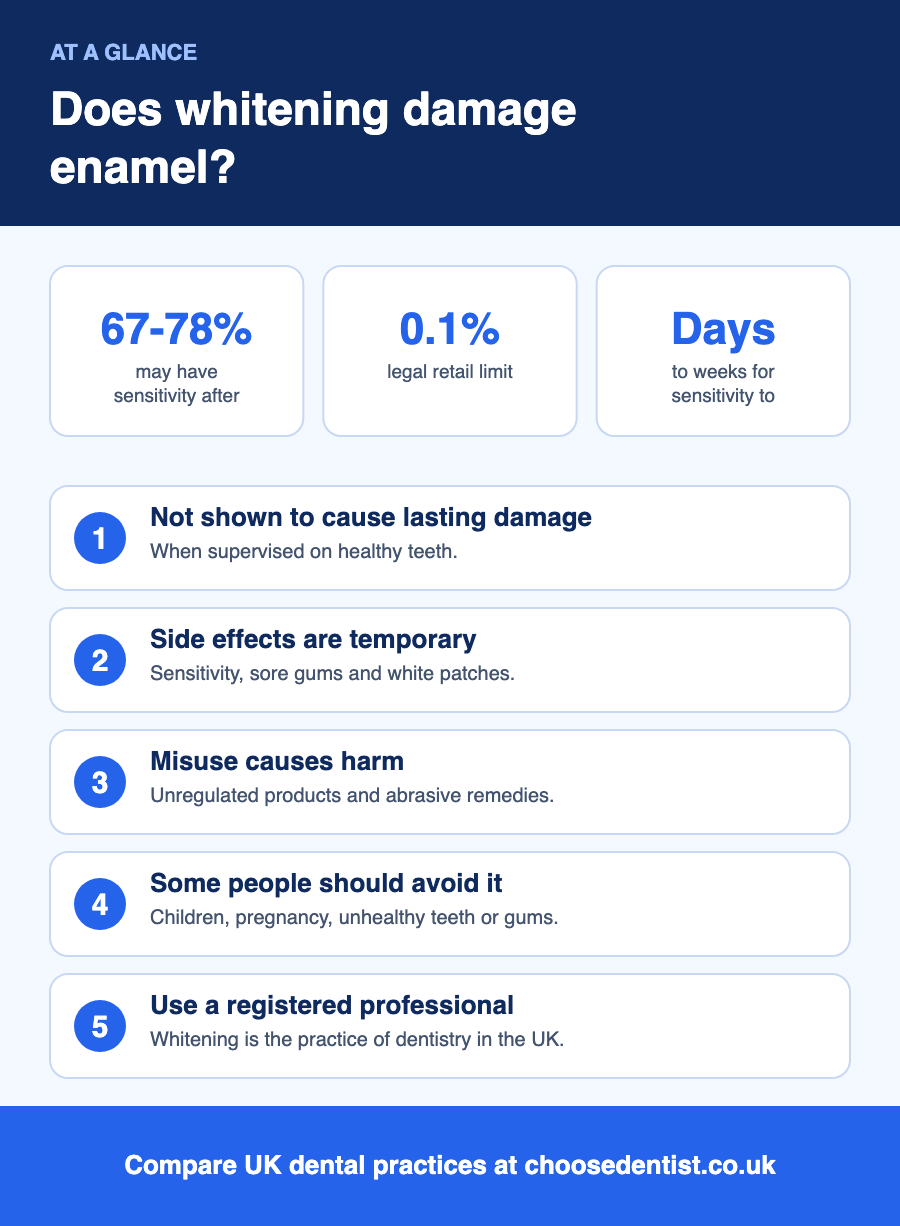
When carried out by a registered dental professional on healthy teeth, teeth whitening is not generally considered to cause lasting damage to enamel, but it can cause temporary side effects, most commonly sensitivity and gum irritation. The popular worry that bleaching weakens teeth stems partly from the fact that the gels are chemically active and partly from misuse of unregulated products, which can burn the gums and harm the teeth.
The evidence is reassuring but not absolute. Studies on professionally supervised treatment indicate that changes to the enamel surface are small, and that the effects are temporary, while the risks rise sharply when products are too strong, used too often or applied to teeth that are already damaged. Knowing the difference between a normal side effect and a warning sign is helpful.
How whitening works
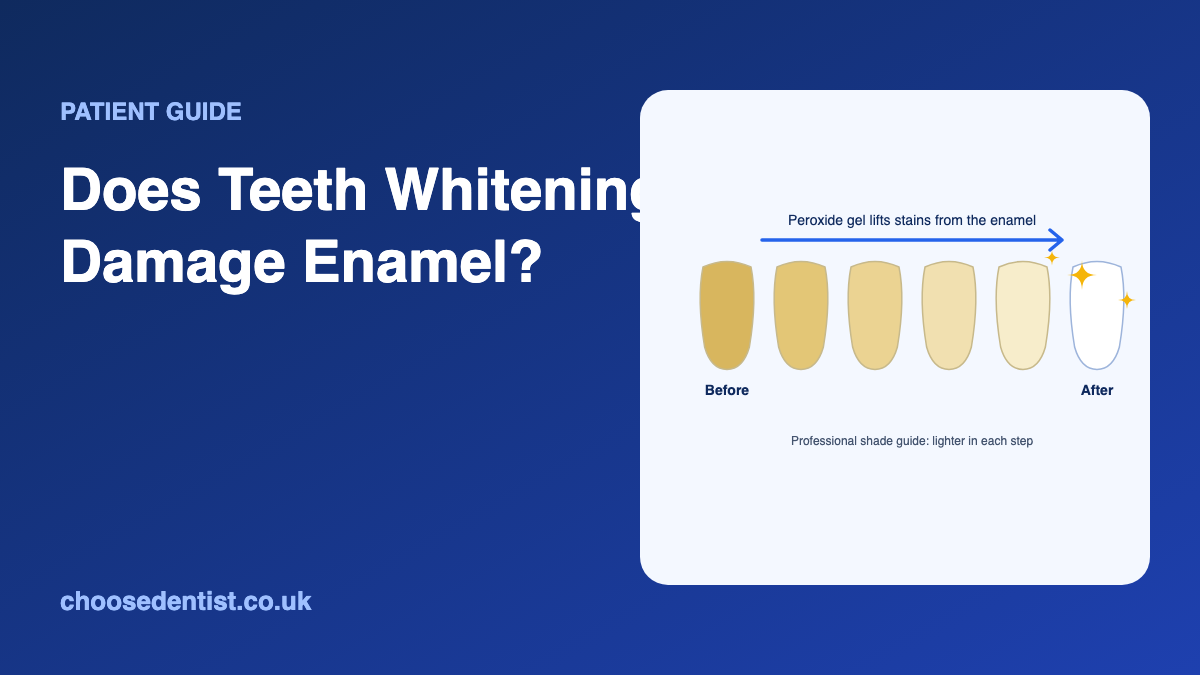
Peroxide gels release oxygen, which breaks down the pigments that stain the tooth. The molecules are small enough to pass through the enamel, so the chemical reaction happens within the tooth, not on its surface. The Wikipedia article on tooth whitening explains that early whitening results are partly due to dehydration of the tooth, which reverses as it rehydrates, and that nearly half of the initial colour change from an intensive in-office treatment may be lost within a week.
Because the process does not involve scrubbing or removing enamel, properly used gels do not thin the tooth in the way an abrasive product might.
| Possible effect | How common | Usual outcome |
|---|---|---|
| Tooth sensitivity | Very common after in-surgery treatment | Settles over days to weeks |
| Sore or irritated gums | Occasional | Usually settles quickly |
| White patches on gums | Occasional | Fade within hours or days |
| Lasting enamel damage | Not shown with supervised use | Risk rises with misuse and abrasive products |
| Chemical burns | Linked to unregulated products | Avoid non-dental providers |
What the research and the NHS say
The NHS says that the chemicals used in whitening are strong and can cause tooth sensitivity, sore gums or throat, and white patches on the gums, usually for a short time, and that a protective shield or paste is used. It does not say that whitening damages the enamel permanently. The Wikipedia article reports that sensitivity occurs in many patients after in-surgery treatment and can last from several days to a few weeks, and that toothpastes containing potassium nitrate and sodium fluoride ease discomfort, though there is no evidence that they permanently prevent it.
On wider safety, the article notes that the International Agency for Research on Cancer found insufficient evidence that hydrogen peroxide is carcinogenic to humans, and that a review of genotoxicity concluded that products releasing up to 3.6 per cent hydrogen peroxide did not appear to raise cancer risk. It also cautions that the long-term effects of concentrations above 6 per cent have not been fully clarified, so strong gels are for professional use only.
Where problems really arise
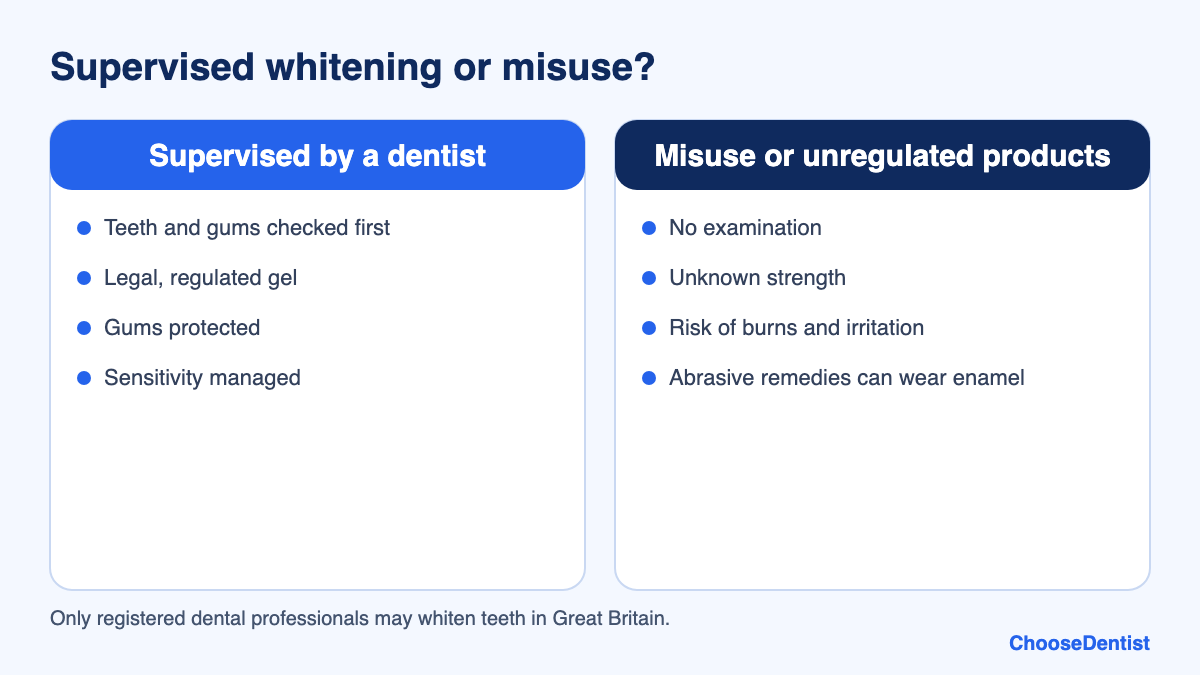
Damage is most likely when whitening is misused. Over-the-counter kits of uncertain strength, products used for longer than directed, abrasive home remedies such as baking soda or charcoal pastes and repeated sessions without a break can irritate the gums, increase sensitivity and, in the case of abrasives, wear enamel. Unregulated treatment in non-dental settings has caused chemical burns, which is one reason the law restricts whitening to registered professionals.
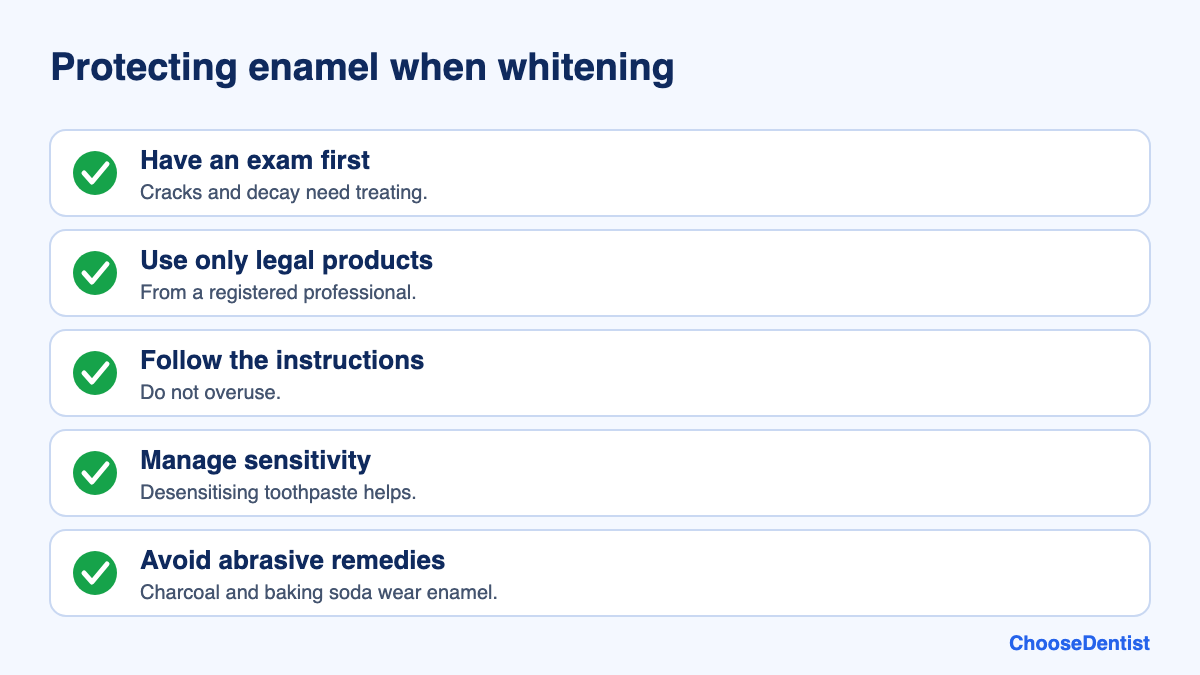
Existing damage can also make whitening uncomfortable. Teeth with cracks, exposed dentine, decay or receding gums are more vulnerable, which is why a dental examination should always come first, and why the Wikipedia article lists these among reasons for caution.
Reducing sensitivity and risk
A dentist can take several steps to reduce side effects. A lower-strength gel, shorter application times and breaks between sessions help, and applying a desensitising agent before or after treatment is common. Patients can use a sensitive-toothpaste for a few weeks beforehand and avoid very hot or cold drinks for a day or two afterwards.
Custom-fitted trays keep the gel on the teeth and away from the gums, which is one reason they are preferred to generic trays. Following the instructions exactly, and not whitening more often than advised, protects the teeth.
Who should avoid whitening
The NHS lists people aged 17 or under, those with unhealthy teeth or gums, and people who are pregnant or breastfeeding among those who should not have whitening, and notes that it does not work on crowns, dentures or implants. The Wikipedia article adds people with peroxide allergy, untreated gum disease, active decay, cracked teeth, exposed dentine or sensitive gums.
Anyone in these groups should speak to a dentist, who may suggest postponing or choosing an alternative such as a professional clean or bonding.
The legal framework
Because of the risks, the law restricts who may whiten teeth. The General Dental Council explains in its guidance on what the law says that tooth whitening is the practice of dentistry and can only be carried out by registered dental professionals, and that products releasing more than 0.1 per cent hydrogen peroxide may be supplied only to dental practitioners.
Common myths
Several myths surround whitening. One is that it makes the teeth permanently weaker, which research on supervised treatment does not support. Another is that natural remedies such as lemon juice, baking soda or charcoal are safer, whereas they can wear or soften the enamel and have little whitening effect. A third is that whitening kills the tooth, which is untrue: the nerve reacts temporarily, but the tooth remains alive. Separating fact from fiction helps patients make calmer decisions.
Whitening and existing dental work
Whitening does not affect fillings, crowns, veneers or other restorations, which can make them stand out as the natural teeth lighten. The Wikipedia article notes that it does not change the colour of fillings, porcelain, other ceramics or dental gold and may slightly affect composite and cements, so a mismatch may develop. A dentist will usually look at existing work before starting and may suggest replacing visible restorations afterwards to match the new shade.
Alternatives for sensitive teeth
Patients who cannot tolerate whitening have other options. A professional clean and polish removes surface stain without any chemical, and composite bonding or veneers can mask discolouration, although they involve more cost and, for veneers, the removal of some enamel. Whitening toothpastes remove surface stain only. A dentist can discuss which approach suits the teeth best and what is realistic to expect from each.
NHS and private options across the UK
Whitening is a private treatment in every nation, and the NHS confirms that it is not available on the NHS. The NHS page on teeth whitening advises checking a practitioner’s registration on the General Dental Council website. Charging for NHS dentistry differs across the four nations, but none covers whitening. England has three bands and an urgent charge, Wales numbered bands and an urgent charge with a contract reform under way, Scotland free examinations and free treatment under 26 with a capped share of the cost for other adults, and Northern Ireland a percentage of the dentist’s fee up to a ceiling. Private fees are set by each practice and commonly run from about £250 to £800, depending on the method.
If a patient develops severe or persistent sensitivity, or any burns, they should contact the practice that provided the treatment, or any dentist, promptly. Mild symptoms usually settle without treatment.
Choosing a provider
A provider who examines the teeth first, explains the risks, uses a legal and appropriate product and gives written aftercare is the safest choice. It is also worth asking what the practice does if a patient has a problem.
The ChooseDentist directory of teeth whitening practices can be searched by postcode, with CQC and Google ratings displayed where available. Two practices can be compared side by side, and the details of treatment and cost should be confirmed with the practice.