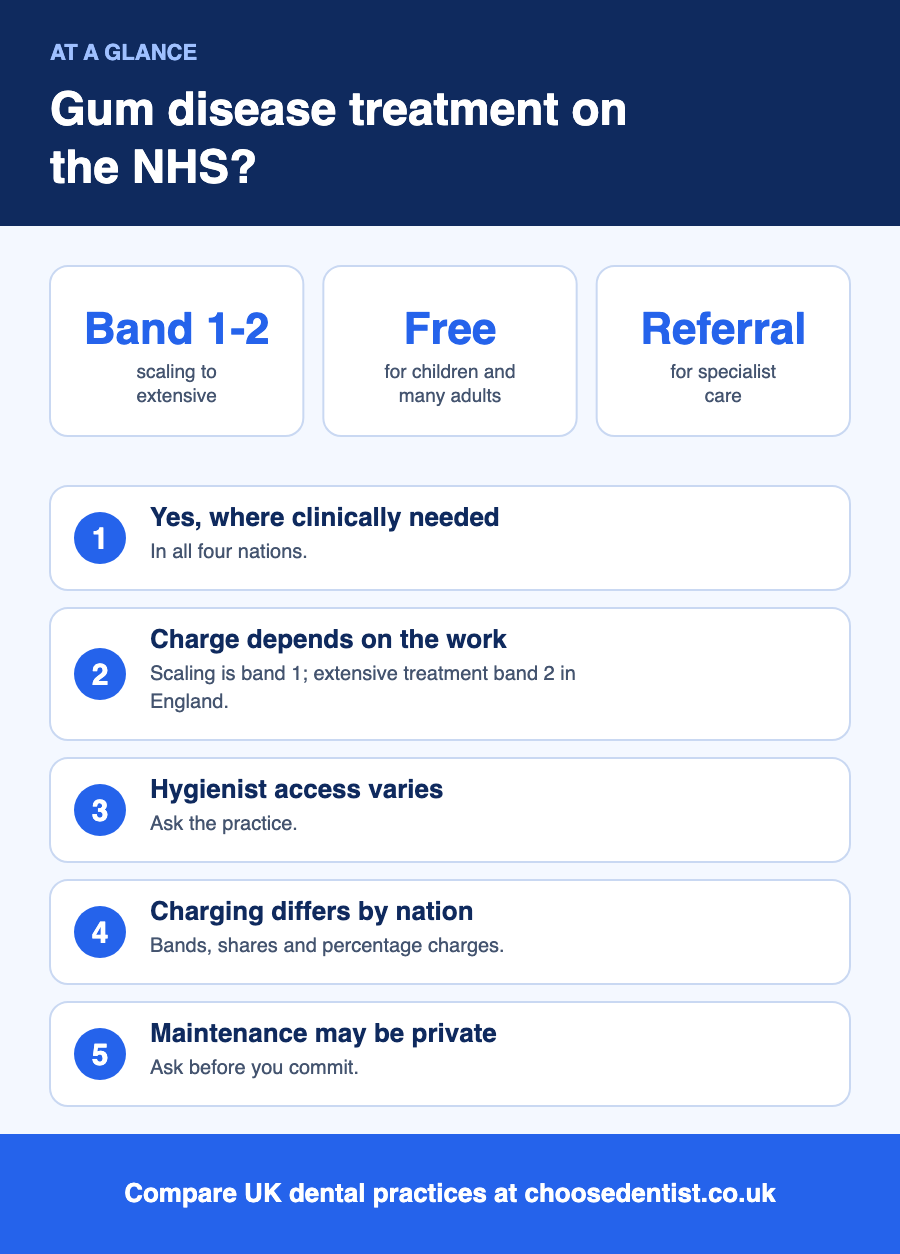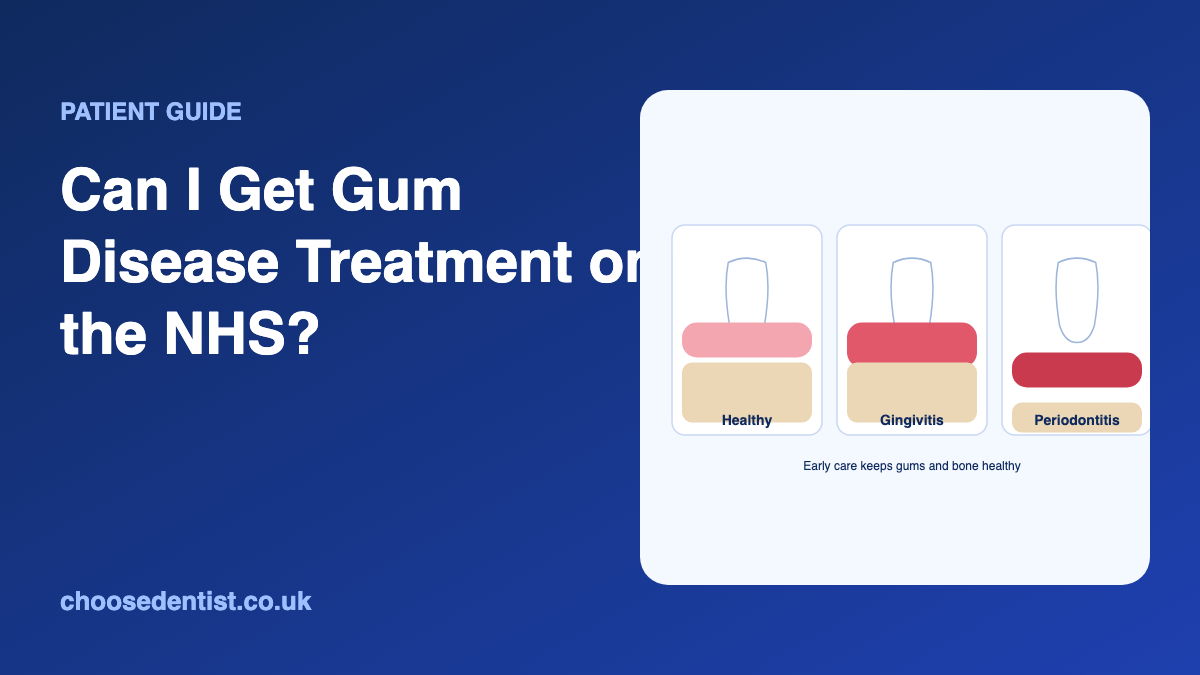
Yes. Treatment of gum disease is available on the NHS where it is clinically necessary, and it forms part of ordinary NHS dental care in all four nations of the United Kingdom. In England, simple gum care such as scaling falls in the lowest charge band, and extensive treatment of gum disease sits in the middle band. What counts as necessary is a clinical decision, so the dentist decides how much cleaning and follow-up your gums need.
How much hygienist time you can get on the NHS varies from practice to practice, and some patients choose private care for longer or more frequent visits. The sections below explain what is covered, what it costs and how to get the best from your care for gum disease treatment.
What the NHS covers
The NHS says on its page about gum disease that treatment in the early stages involves improved tooth-cleaning advice, stopping smoking and a hygienist clean, and in serious cases deep cleaning under the gums, antibiotics, tooth removal or gum surgery. The NHS Business Services Authority explains that a scale and polish is included in the lowest charge band if it is clinically needed, as set out on its page about the band for a scale and polish.
The NHS guide to how much NHS dental treatment costs lists simple gum care such as scaling among the treatments in band 1 in England, and extensive gum disease treatment in band 2.
| Nation | How NHS charges work | Gum disease treatment |
|---|---|---|
| England | Three bands plus an urgent charge | Scaling in band 1; extensive gum disease treatment in band 2 |
| Scotland | Free examinations; free treatment under 26; others pay a share up to a maximum | Charged within the capped share for adults who do not qualify for exemption |
| Wales | Numbered bands plus an urgent charge; contract reform under way | Similar band structure to England |
| Northern Ireland | Generally a percentage of the dentist's fee up to a ceiling per course | Charged within the ceiling |
How charges work
In England a patient pays one charge for a complete course of treatment, determined by the highest band involved. A routine check-up with a scale and polish costs the band 1 charge. If the dentist recommends deep cleaning for gum disease, the course falls into band 2, and if other work from a higher band is needed in the same course, such as a crown, the higher band applies. Further treatment within two months in the same or a lower band costs nothing extra.
Many people pay nothing at all, because children, young people in full-time education under 19, pregnant women, mothers of babies under 12 months and people on certain benefits are entitled to free NHS dental treatment in England.
Seeing a hygienist on the NHS
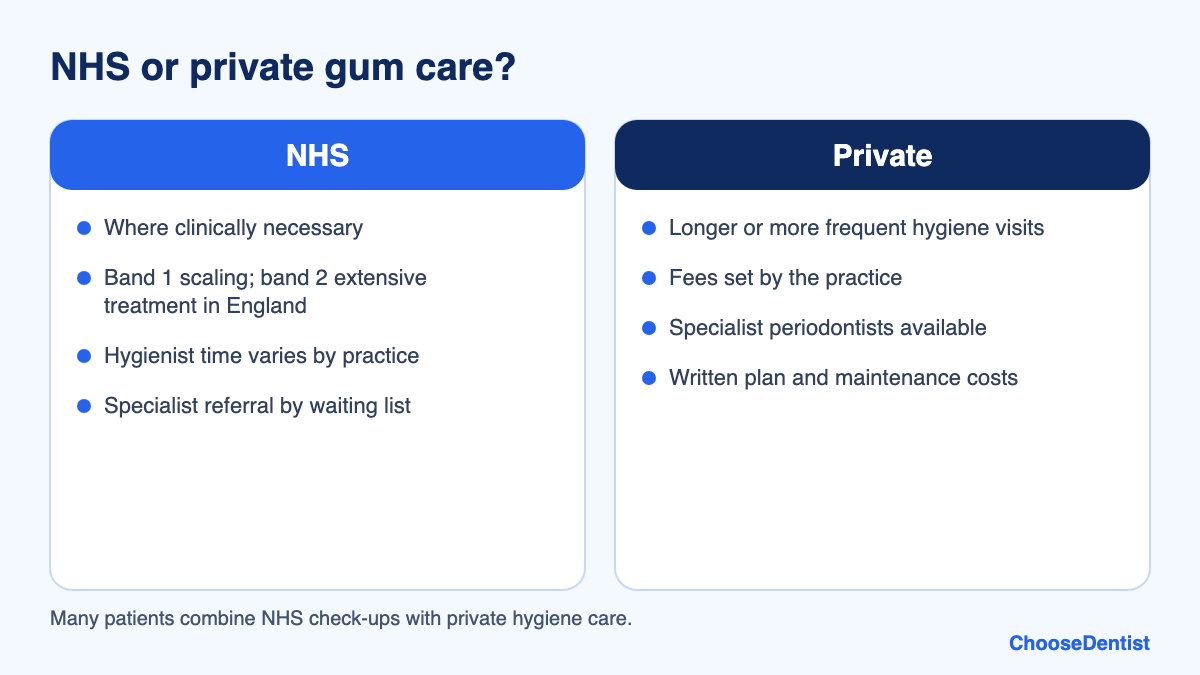
Not every NHS practice has a hygienist, and where one is available, appointments can be limited. The dentist may carry out the cleaning, or refer you to a hygienist working under the same contract. It is reasonable to ask how many visits are included in your treatment plan, how often you would see the hygienist and whether follow-up maintenance visits would be NHS or private.
Because gum disease needs lasting care, some patients find that a mixture works best, with NHS check-ups and private hygiene visits at the frequency the dentist recommends.
Differences across the UK
The way charges are calculated differs. England and Wales use numbered bands and an urgent charge, and Wales is reforming its dental contract. Scotland offers free NHS dental examinations to everyone and free treatment for people under 26, while adults over 26 pay a capped share of the cost, according to NHS Inform. Northern Ireland charges adults a percentage of the dentist’s fee up to a ceiling for each course of treatment. Charging for NHS dentistry differs across the four nations. England has three bands and an urgent charge, Wales numbered bands and an urgent charge with a contract reform under way, Scotland free examinations and free treatment under 26 with a capped share of the cost for other adults, and Northern Ireland a percentage of the dentist’s fee up to a ceiling per course.
Whichever nation you live in, the principle is the same: treatment of gum disease is provided where it is clinically necessary, and the practice should explain what it will cost before starting.

How much treatment is realistic on the NHS
Gum disease is chronic, so it is worth being realistic about what a course of NHS treatment can deliver. A single course can include an assessment, a thorough clean, deep cleaning of the worst areas and advice, but regular long-term maintenance, such as three-monthly hygiene visits, may not be available within an NHS contract. Asking the practice what is included, how long the course lasts and what happens afterwards helps you to plan. Some patients use the NHS for the initial treatment and private care for maintenance.
Smoking cessation support
Because smoking is a risk factor and slows healing, support to stop is often part of gum treatment. The NHS advises people who smoke to stop and lists not smoking as a preventive measure, and hygienists commonly offer advice. Free NHS stop-smoking services are available across the UK, and a dentist or GP can refer you. Patients who stop often see their gums improve noticeably within weeks, and treatment results last longer.
Checking your plan and your bill
For NHS treatment beyond a basic course, the dentist should give you a written plan that says which parts are NHS and which are private, and what each costs. It is wise to keep it, to check that the charge band matches the work and to ask about anything unclear. If you are told that a hygienist visit is private when you expected it to be NHS, ask why, because the NHS says you should only be charged for private treatment that you have agreed to.
Gum disease treatment for children and young people
Gum problems are less common in children, but they do occur, particularly in teenagers with braces or poor cleaning. NHS dental care for children is free, and the dentist or hygienist can treat early gum disease and teach better cleaning. Young adults in Scotland are covered up to the age of 26. Persistent or unusual gum problems in a child, such as severe swelling or loose teeth, should be assessed promptly, because they can point to an underlying condition.
Gum disease treatment in pregnancy
Pregnancy can make gums more sensitive and more likely to bleed, and the NHS recommends regular dental check-ups for people who are pregnant. NHS dental treatment is free during pregnancy and for twelve months after the birth in England, which includes hygiene visits and gum care where clinically needed. Telling the practice that you are pregnant helps them to plan treatment, and routine cleaning is safe and often beneficial.
Specialist treatment
Advanced gum disease may be treated by a periodontist, a dentist with specialist training in gum disease. NHS referral to a specialist is usually through your dentist, and availability varies by area, often with waiting lists. Many patients are referred privately, and fees for specialist periodontal care are higher than for general dental care.
Private gum care
Private practices set their own fees for hygiene visits and gum treatment. As a rough guide, a hygienist appointment commonly costs from about £50 to £100, and a course of deep cleaning from several hundred pounds depending on the extent. A written estimate should say how many visits are planned, what review appointments are included and what maintenance is recommended afterwards.
What to ask
Useful questions include how advanced the disease is, what treatment is needed, whether it can be provided on the NHS, how many visits are included, whether the hygienist is part of the NHS contract and what the long-term maintenance would cost. Asking for the plan in writing helps to compare practices.
The ChooseDentist directory of gum disease practices can be searched by postcode, with CQC and Google ratings shown where available. Two practices can be compared side by side, and NHS availability and costs should be confirmed directly with the practice.