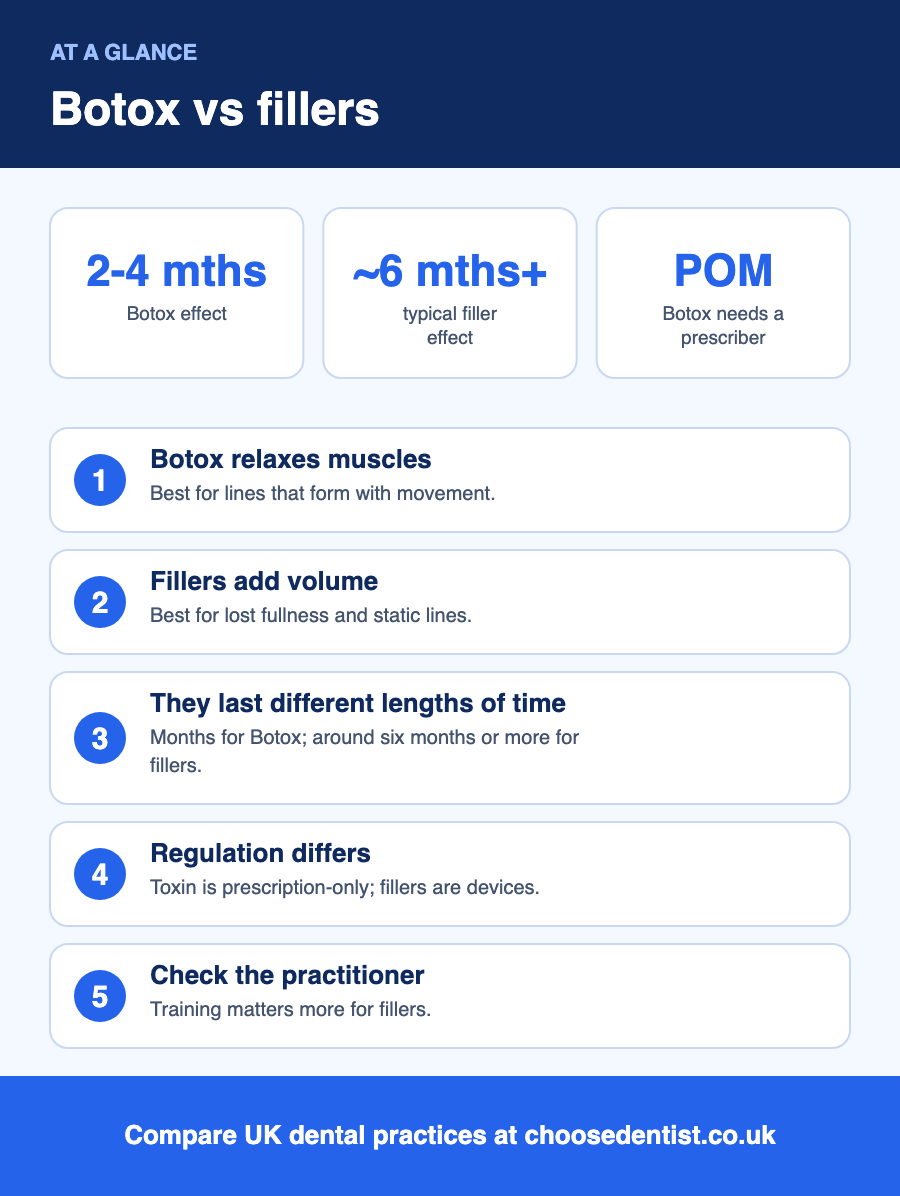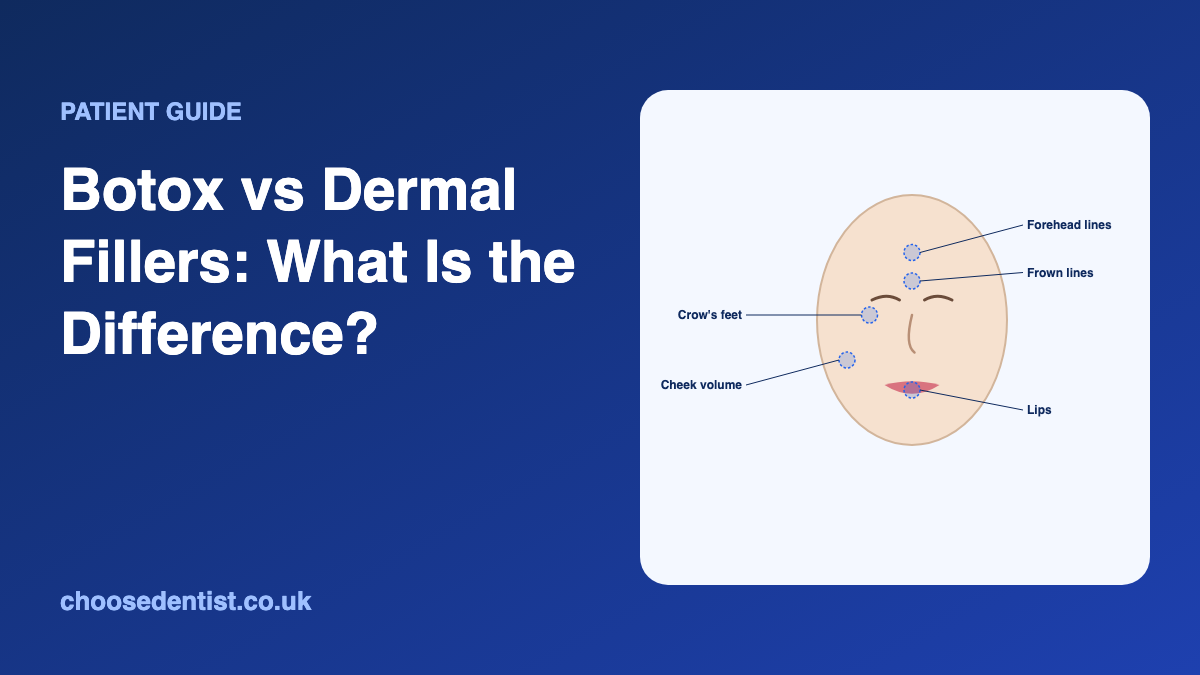
Botox and dermal fillers are different treatments that are often confused. Botox, a brand of botulinum toxin, relaxes the muscles that cause expression lines, such as frown lines and crow’s feet, whereas dermal fillers add volume or smooth lines by injecting a gel, usually hyaluronic acid, beneath the skin. One softens movement and the other restores or creates fullness, and both are temporary.
They are also regulated differently in the United Kingdom, which affects who can provide them and what safeguards apply. Understanding the distinction helps patients to choose the right treatment for their concern and to ask the right questions of any facial aesthetics practitioner.
How Botox works
The Wikipedia article on botulinum toxin describes cosmetic use as injecting the toxin into the muscles between the eyebrows and elsewhere in the upper face, which relaxes them and smooths the overlying skin. Smoothing is usually visible three to five days after injection, with the maximum effect about a week later, and the effect on frown lines typically lasts two to four months, though some products last up to six months or longer.
Because it acts on muscles, it is best for dynamic lines, the wrinkles that form when the face moves. It does not add volume, and it will not fill lines caused by loss of volume or sun damage.
| Feature | Botox (botulinum toxin) | Dermal fillers |
|---|---|---|
| What it does | Relaxes muscles to soften expression lines | Adds volume or fills lines with a gel |
| Best for | Frown lines, forehead lines, crow's feet | Lips, cheeks, jawline, deeper folds |
| How long it lasts | Typically 2 to 4 months | Often around 6 months or longer |
| UK regulation | Prescription-only medicine | Non-prescription medical device |
| Typical private cost | About £150 to £400 per area | About £250 to £500+ per syringe |
| Main risks | Weak nearby muscles, drooping, rarely toxin spread | Bruising, lumps, infection, rarely blocked vessel |
How dermal fillers work
The Wikipedia article on injectable fillers says that fillers are composed of a wide range of natural and synthetic biomaterials, with hyaluronic acid one of the most common. They are injected under the skin to fill lines, add volume to the cheeks, define the jawline or shape the lips, and most are temporary because the body gradually metabolises them, with the effect lasting about six months in general, depending heavily on activity in the area.
Fillers are best for static lines and loss of volume, such as nasolabial folds, hollow cheeks or thin lips. Some are designed to stimulate the body’s own collagen production, with effects that build over several sessions.
Key differences
The first is the target: muscle activity for Botox and volume for fillers. The second is the effect: Botox reduces movement and smooths lines from above, while fillers lift or plump from beneath. The third is the duration: Botox typically lasts two to four months, fillers around six months to a year or more. The fourth is the risk profile, with toxin spread and drooping on one side, and vascular complications, lumps and infection, rarely blocking a blood vessel, on the other.
They are often used together, because lines and volume loss frequently coexist, and a practitioner may recommend both for a balanced result.

Regulation in the UK
The Government’s guidance for enforcement officers states that botulinum toxin is a prescription-only medicine regulated by the Medicines and Healthcare products Regulatory Agency, with the brands licensed for cosmetic use being Azzalure, Bocouture and Botox. A qualified prescriber must assess the patient face to face, and the Joint Council for Cosmetic Practitioners says in its page about unregulated treatments that only a doctor, dentist, prescribing nurse or pharmacist can prescribe toxin.
Fillers are regulated differently. The Wikipedia article states that in the UK and the EU they are non-prescription medical devices that need a CE mark, which does not require a demonstration of medical efficacy, and that more than 140 are on the market. That means there is no legal requirement for a prescription, which makes it even more important to check the injector’s training, experience and the product’s traceability.
Choosing between them
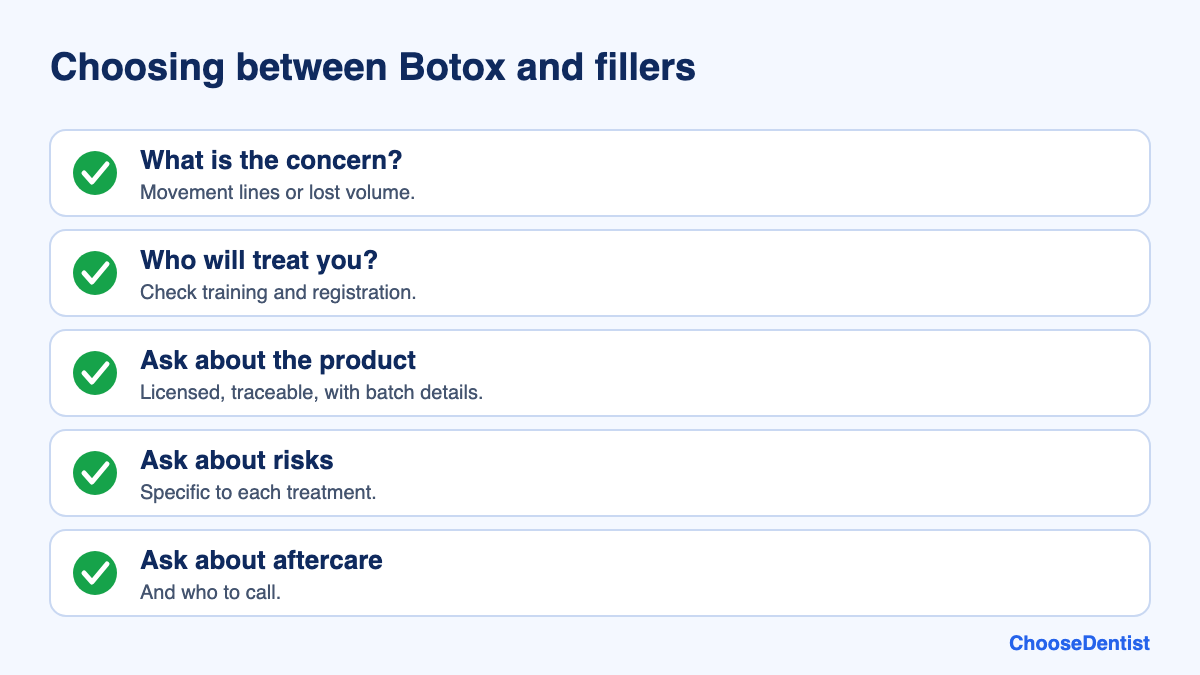
A good practitioner starts with the patient’s concern. Lines that appear when frowning or raising the eyebrows suggest toxin, whereas hollowing, thin lips or deep folds at rest suggest fillers. A consultation should include examination of the face in movement and at rest, discussion of goals and risks, and an honest recommendation, which may be to do less, or to do nothing.
Patients should be cautious about practitioners who push both treatments at once or who promise dramatic transformations.
Risks compared
Both carry risks. The article on botulinum toxin lists weakening of nearby muscles, headache and bruising, with rare serious effects. The article on fillers lists bruising, redness, pain or itching as common, infections and allergic reactions as less common, and vascular complications, in which filler enters a blood vessel, as rare but potentially serious, with vision loss usually permanent when it occurs. Choosing a trained practitioner who knows how to avoid and manage complications is the main safeguard.
Aftercare and recovery compared
Recovery differs. After Botox, there is usually little downtime beyond small bumps and the advice to avoid rubbing the area for a few hours. Fillers can cause more swelling, bruising and tenderness, especially in the lips, and lumps or asymmetry may take a week or two to settle. Patients are commonly advised to avoid strenuous exercise, alcohol and heat for a day or so, and a review appointment allows adjustments. Neither treatment needs a long recovery, but fillers can take longer to look their best.
Reversibility
Reversibility is an important difference. Botox wears off by itself and cannot be removed, so an unsatisfactory result must be waited out over weeks to months. Hyaluronic acid fillers can usually be dissolved by a trained practitioner using an enzyme, which gives some control if the result is unwanted or if there is a complication, though not every filler can be reversed this way. Asking about this before filler is injected is sensible, and knowing who would deal with a problem is part of choosing a practitioner.
Combining treatments
Practitioners often combine the two for balance. Botox may relax the muscles that deepen a line while filler softens the fold it creates, and some aesthetic plans use toxin for the upper face and filler for the mid and lower face. This can give natural results at a lower dose of each, but it also doubles the risks and costs, so the benefits should be clear. A cautious practitioner introduces treatments one at a time.
NHS and private options across the UK
Cosmetic facial aesthetics is private in every nation, and the NHS does not fund injections to improve appearance. Charging for ordinary NHS dentistry differs across the four nations, with England and Wales using numbered bands and an urgent charge, Scotland free examinations and a capped share of the cost for adults over 26, and Northern Ireland a percentage of the dentist’s fee up to a ceiling, but none of these covers cosmetic injectables. Practices are inspected by different bodies across the UK: the Care Quality Commission in England, Healthcare Inspectorate Wales, Healthcare Improvement Scotland and the Regulation and Quality Improvement Authority in Northern Ireland. The legal rules on who may prescribe toxin and on the under-18 ban apply in England, and patients elsewhere in the UK should check the rules in their own nation.
Costs differ: anti-wrinkle injections commonly cost from about £150 to £400 per area, and fillers from about £250 to £500 or more per syringe, with variation by practice and region.
Finding a practitioner
Qualifications, experience of the specific treatment, the practitioner’s registration with a regulator, the premises and the product used are all worth checking. A practice that explains the differences clearly and gives written aftercare is a good sign.
The ChooseDentist directory of facial aesthetics practices can be searched by postcode, with CQC and Google ratings displayed where available. Two practices can be compared side by side, and details of treatments and prices should be confirmed directly with the practice.