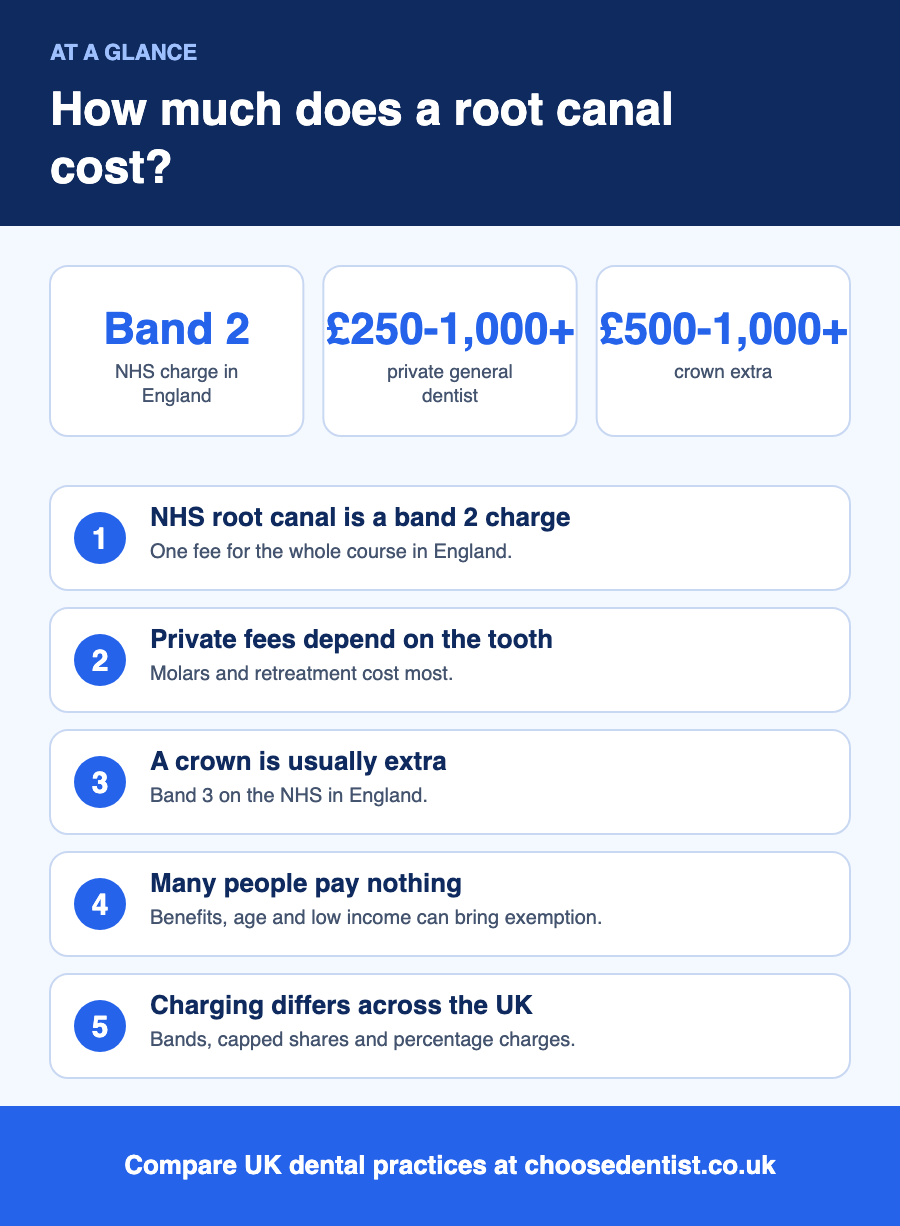
On the NHS in England, root canal treatment is a band 2 charge, a single fixed fee for the whole course of treatment, whereas private treatment commonly costs from a few hundred pounds for a simple front tooth to £1,000 or more for a molar, with a specialist charging more again. The NHS fee does not depend on how many visits the treatment takes, which is one reason it often looks far cheaper than private care, and many patients pay nothing if they qualify for free treatment.
The final bill also depends on what happens after the root filling. Most root-treated teeth, especially back teeth, need a crown or a strong filling to protect them, and that is usually charged separately and at a higher band. Understanding these elements helps patients to compare costs sensibly, whether they are choosing NHS or private care for root canal treatment.
NHS charges
The NHS page on root canal treatment states that it is a band 2 charge and that some people qualify for free treatment or help with costs. According to the NHS guide to how much NHS dental treatment costs, band 2 also covers fillings, extractions and other oral surgery and sealants, and a patient pays one charge for a course of treatment in that band, however many visits it takes.
If the course includes something from a higher band, such as a crown, the patient pays the higher band charge instead, and further work within two months in the same or a lower band costs nothing extra. Emergency root canal work is covered by the urgent treatment charge, which is lower than band 2.
| Item | Typical cost | Notes |
|---|---|---|
| NHS root canal (England) | Band 2 charge | One charge for the course; crown is band 3 |
| Private, front tooth | About £250 to £500 | Single canal; simpler treatment |
| Private, premolar | About £400 to £800 | One or two canals |
| Private, molar | About £500 to £1,000+ | Several canals; longer treatment |
| Specialist endodontist | About £700 to £1,500+ | Often with a microscope; retreatment costs more |
| Crown afterwards | About £500 to £1,000+ | Band 3 on the NHS in England |
Private prices
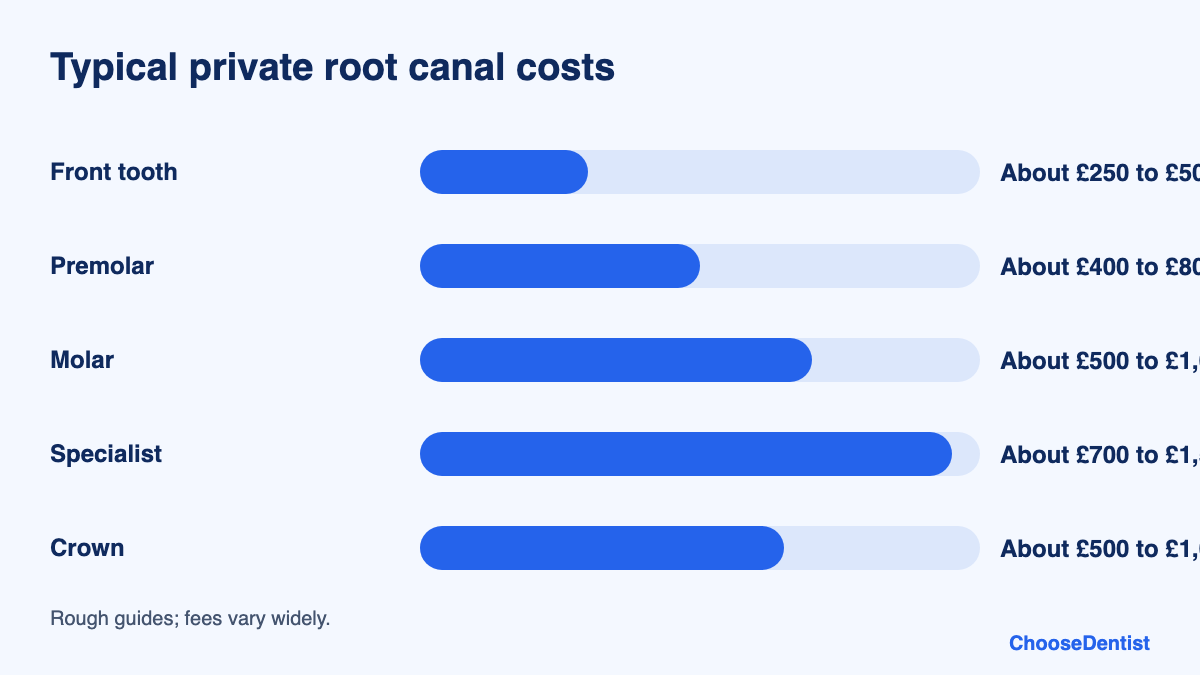
Private root canal fees vary with the tooth, the complexity and who carries out the work. Front teeth, with one canal, are cheapest, premolars cost more and molars, which have several canals, are the most expensive. As rough guides, private treatment by a general dentist commonly costs from about £250 to £500 for a front tooth, £400 to £800 for a premolar and £500 to £1,000 or more for a molar. A specialist endodontist, using a microscope, typically charges more, often £700 to £1,500 or more, and retreatment of a previously treated tooth costs more still.
These figures are only a guide, and they vary by region and practice. A written estimate should say what is included, such as X-rays, anaesthetic, the root filling and any temporary restoration.
The cost of the crown
The root filling is only part of the cost. A tooth that has lost its pulp, and often much of its structure to decay, is more brittle and needs protecting, and the NHS says that a crown may be needed if the tooth was badly infected. On the NHS in England a crown is a band 3 item, so a course that includes root canal treatment and a crown costs the band 3 charge. Privately, a crown commonly costs from about £500 to £1,000 or more.
Patients should ask whether the quoted price includes the final restoration and what material is proposed, because leaving it out can make a quote look cheaper than it is.
What affects the cost
Several factors raise or lower the price. The type of tooth is the main one, and a tooth with unusually shaped or blocked canals takes longer. Retreatment, where a previous root filling has failed, is more complex. Whether the dentist uses a rubber dam, a microscope or specialist equipment can matter, and so do the dentist’s experience, the region and whether the practice includes follow-up in the fee. Emergency appointments may carry an additional charge in private practice.
Who pays nothing
Many people do not pay for NHS root canal treatment. In England, groups commonly entitled to free NHS dental treatment include children, young people in full-time education under 19, pregnant women and those who have had a baby in the last twelve months, and people receiving certain benefits, and the NHS Low Income Scheme can help others. Patients may be asked for evidence, so it is wise to check before the first appointment.
Ways of paying
Private practices commonly offer payment plans or accept finance, and some include root canal treatment in membership schemes that cover routine care. Because many people need treatment urgently, it is worth asking whether a plan can be arranged quickly. Dental insurance may contribute to restorative costs, and some employers provide cash plans, so checking the terms is sensible.
Questions to ask about cost
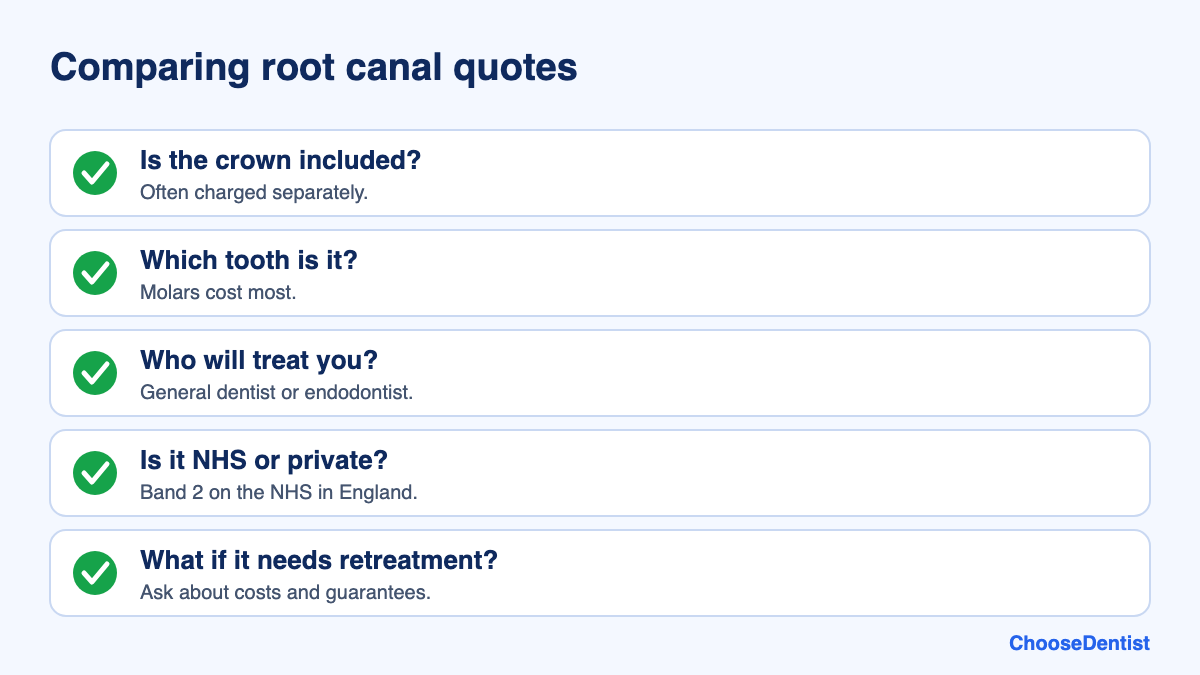
Several questions help to pin down the real price. Does the quote cover the whole course, including X-rays, anaesthetic, the root filling and the temporary filling? Is the final crown or filling included, and what material is proposed? What happens if the tooth needs further work later, and is there a guarantee? Will a specialist be involved, and if so who pays for the referral? Asking for these answers in writing allows an honest comparison between practices.
When treatment is urgent
A painful infected tooth cannot wait, and the cost of emergency care is worth knowing in advance. On the NHS, urgent treatment carries its own charge, which is lower than band 2, and emergency root canal work is covered by it. Privately, an emergency appointment may involve an examination fee and a first-stage treatment to relieve the pain, with the full root filling completed later. Patients should ask what the emergency visit covers and how it fits into the overall plan.
Why a failed treatment adds cost
If a root canal fails and the tooth needs retreatment or surgery, the expense rises. NHS patients may find that a further course falls under a separate charge, while private patients may have a guarantee that covers some of the cost. This is one reason why the quality of the original treatment, including the use of a rubber dam and careful cleaning of every canal, matters more than saving a little money. A dentist who explains how they minimise the risk of failure is giving useful information.
NHS and private options across the UK
Charging for NHS dentistry differs across the four nations. England has three bands and an urgent charge, with root canal treatment in band 2, Wales numbered bands and an urgent charge with a contract reform under way, Scotland free examinations and free treatment under 26 with a capped share of the cost for other adults, and Northern Ireland a percentage of the dentist’s fee up to a ceiling per course. In every nation, treatment to save a tooth is available through the NHS where it is clinically appropriate, and private care offers choice of dentist or specialist, shorter waiting times and equipment such as a microscope.
Patients weighing the two should ask the NHS dentist what is included and what the likely total will be, and ask a private practice for a written estimate that lists the root treatment and the crown separately.
Cost compared with extraction
Extraction is usually cheaper at first, but it leaves a gap that may need replacing with a bridge, a denture or an implant, each with its own cost. Our guide to root canal versus extraction explains the alternatives. In many cases, saving the natural tooth costs less over the long run, though it depends on the tooth.
Finding a practice
When pain is involved, quick access matters as much as price. A practice that offers emergency appointments, explains the cost clearly and provides a written plan is a good choice.
The ChooseDentist directory of root canal practices can be searched by postcode, with CQC and Google ratings displayed where available. Two practices can be compared side by side, and NHS availability and private prices should be confirmed directly with the practice.