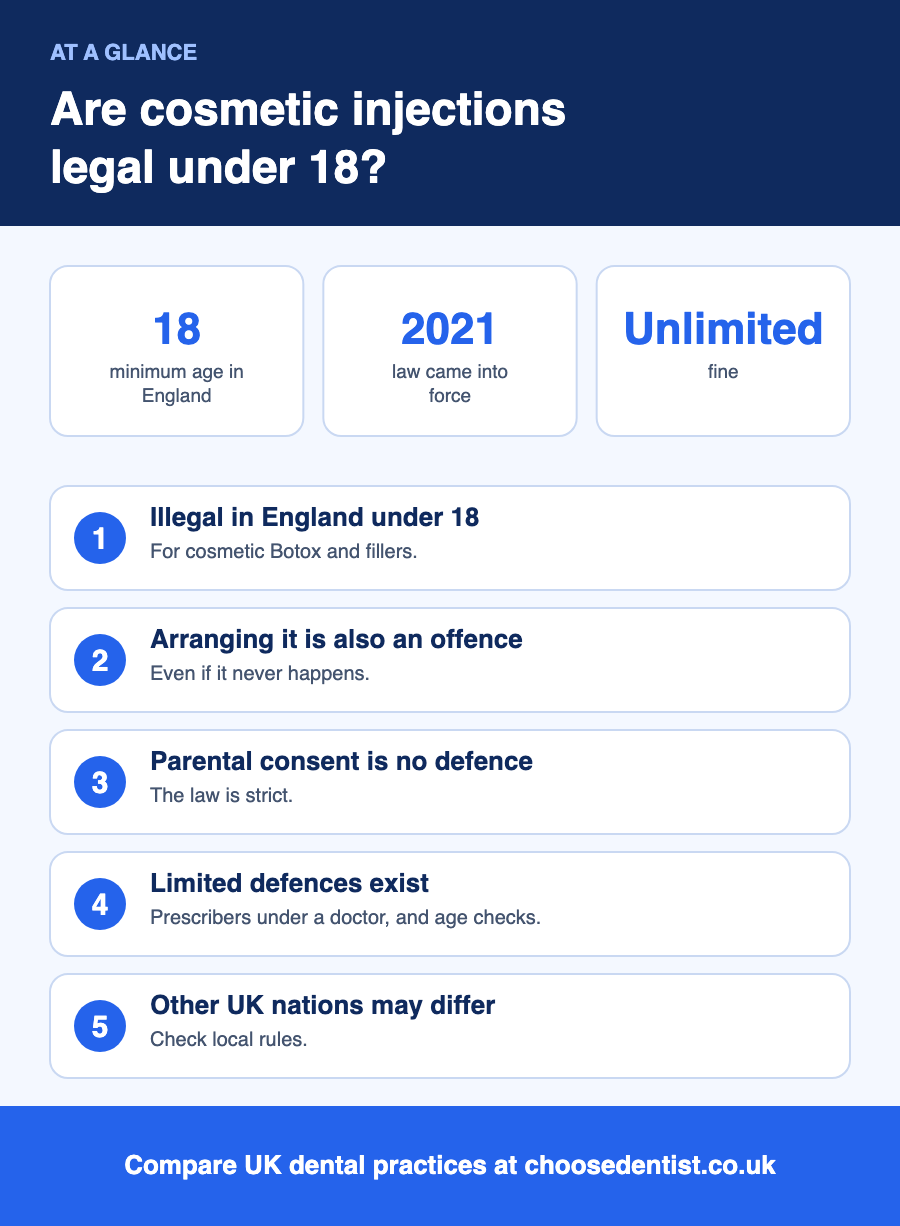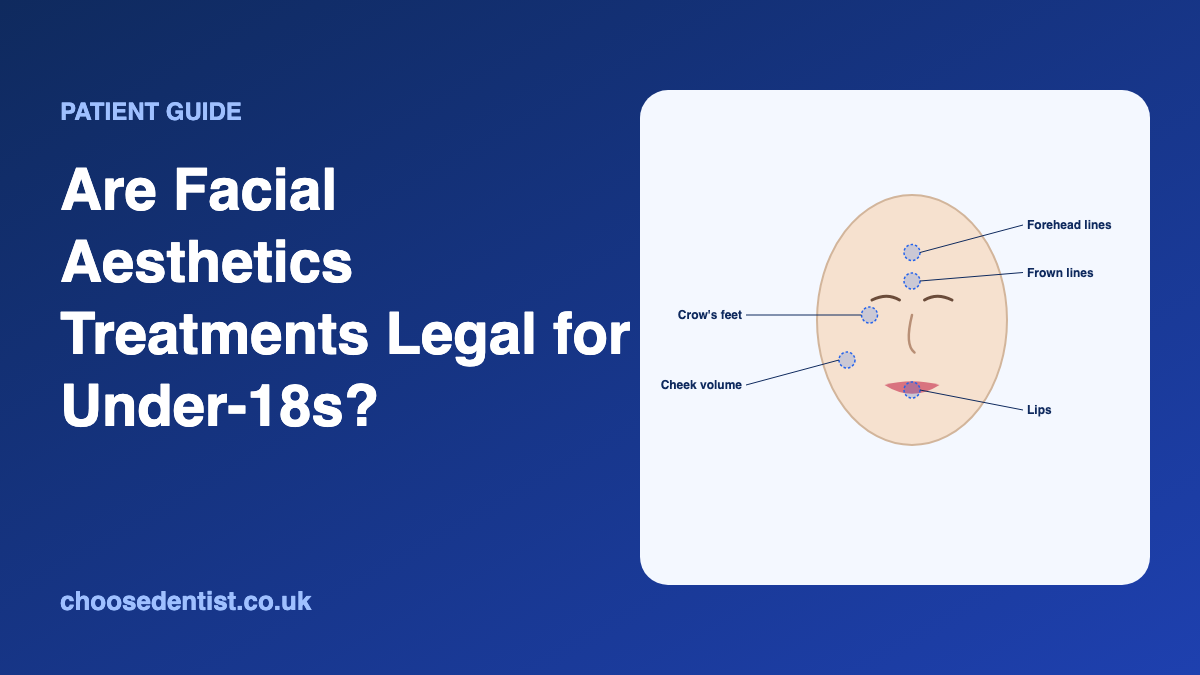
In England, it is a criminal offence to administer botulinum toxin, or a dermal filler by injection, for a cosmetic purpose to anyone under 18, and it is also an offence to make arrangements for such a procedure. The law, which came into force on 1 October 2021, applies to businesses and individuals, and consent from the young person or a parent is not a defence. Anyone offering such treatment to a teenager in England is acting unlawfully.
The rule affects the whole market for facial aesthetics, and it is worth understanding for parents, young people and practitioners alike. The summary below draws on the Government’s guidance for enforcement officers, which sets out the offences and defences in detail.
What the law covers
The Government guidance on botulinum toxin and cosmetic fillers for under 18s explains that the offences are administering botulinum toxin, or a filler by subcutaneous, submucous or intradermal injection, for a cosmetic purpose to a person under 18, and making arrangements, or booking, for such a procedure for a person under 18. A prosecution can proceed even if the procedure never takes place.
It defines botulinum toxin as a naturally occurring substance produced by bacteria and a prescription-only medicine regulated by the MHRA, and a filler as any substance used for dermal or mucous membrane filling, whether or not it was designed for that use. An injection is treated as cosmetic if the filler is generally used for that purpose or its likely effect is to alter appearance.
| Question | Answer in England | Notes |
|---|---|---|
| Is cosmetic Botox or filler legal for under-18s? | No; it is a criminal offence | In force since 1 October 2021 |
| Does parental consent make it legal? | No | Consent is not a defence |
| Is booking or arranging it an offence? | Yes | Even if the procedure never happens |
| What are the penalties? | Unlimited fine | Officers of companies can be liable |
| Are there defences? | Limited | Registered prescribers acting under a doctor's direction; reasonable age checks |
Who it applies to
The guidance says the law applies to anyone, including businesses and individuals, and that it covers under-18s visiting England, who cannot have the procedures performed there. The geography is specific: the guidance applies in England, and it does not address Scotland, Wales or Northern Ireland, so people elsewhere in the UK should check the rules that apply in their own nation.
The offence is committed by the person who carries out the treatment and by anyone who makes the arrangements, so a business owner, a booking agent or a person who helps to organise a treatment could be liable. Consent from the under-18, or from a parent or guardian, is expressly not a defence.
Penalties
The guidance states that individuals and business owners face an unlimited fine on summary conviction, and that directors, managers, secretaries or similar officers of a company can be personally liable where an offence is committed with their consent, connivance or neglect, with the same penalty. These are serious consequences, and they reflect the aim of protecting young people.

Defences
The law contains limited defences. It is a defence if the person administering the treatment was a registered doctor, or a registered nurse, dentist or pharmacist acting under a doctor’s direction. It is also a defence if the person took reasonable steps to establish the age of the person and reasonably believed that they were 18 or over, and for businesses, if the owner took all reasonable precautions and exercised all due diligence.
In practice, responsible practitioners check photo identification, and keep a record of the check. A provider who does not ask for proof of age should be treated with caution.
Why the law exists
The restriction was introduced because of concern about young people seeking cosmetic injections, often influenced by social media, and about the risks. Botulinum toxin is a prescription-only medicine with potential serious effects, and fillers carry risks such as infection, lumps and rarely the blocking of blood vessels, as the Wikipedia articles on botulinum toxin and injectable fillers describe. Young people’s faces are still developing, and treatment for cosmetic reasons carries risks without a medical need.
The Joint Council for Cosmetic Practitioners also warns that unlicensed or counterfeit toxin presents significant risks to patient safety, a danger that applies to anyone, including young people who may be lured by low prices.
Medical and non-cosmetic uses
The law is directed at cosmetic purposes. Botulinum toxin and fillers are used in medicine for other reasons, such as treating certain neurological conditions, which are managed by clinicians within the health service. A young person who needs such treatment for medical reasons is not covered by the cosmetic offence, and will be treated by specialist teams.

What parents and young people can do
Parents who are concerned that a teenager wants cosmetic injections can talk openly about the risks and the law, and point out that no reputable practitioner in England should agree. Young people who are unhappy with their appearance may benefit from speaking to a GP or a trusted adult. Anyone who knows of a provider offering treatment to under-18s in England can report it to Trading Standards or the relevant regulator.
Social media pressure and teenagers
Young people are often exposed to images of filtered faces and cosmetic enhancements, and some feel pressured to seek treatment. Parents and teachers can help by talking about how images are edited, by encouraging a healthy view of appearance and by making clear that reputable practitioners will not treat under-18s. A teenager who is distressed about their looks may benefit from talking to a GP, school nurse or counsellor, and persistent worry about appearance can be a sign of a condition that deserves proper support.
What practitioners must do
Responsible practitioners have clear policies. They ask for photo identification from anyone who looks young, refuse to treat or to book anyone under 18 for cosmetic injections in England, keep a record of the checks they make and train staff to do the same. The guidance notes that taking reasonable steps to establish age and reasonably believing the person is 18 or over is a defence, so good record-keeping protects both patients and practitioners.
Other cosmetic procedures
The offence relates to botulinum toxin and injected fillers. Other cosmetic procedures, such as laser treatments, chemical peels and tattooing, are subject to different rules, and some have their own age limits. Anyone considering a procedure should check what applies and choose a regulated, qualified provider. The safest course for a young person worried about skin or appearance is to start with a conversation with a GP.
NHS and private options across the UK
Cosmetic facial aesthetics is private in every nation, and the NHS does not fund injections to improve appearance. Charging for ordinary NHS dentistry differs across the four nations, with England and Wales using numbered bands and an urgent charge, Scotland free examinations and a capped share of the cost for adults over 26, and Northern Ireland a percentage of the dentist’s fee up to a ceiling, but none of these covers cosmetic injectables. For under-18s in England the question of private cosmetic injections does not arise, since they are illegal. Practices are inspected by different bodies across the UK: the Care Quality Commission in England, Healthcare Inspectorate Wales, Healthcare Improvement Scotland and the Regulation and Quality Improvement Authority in Northern Ireland.
Choosing a responsible practice
A responsible practice checks the age of every patient, refuses treatment to under-18s in England, has qualified practitioners and gives full information. Asking a practice about its age policy is a reasonable question.
The ChooseDentist directory of facial aesthetics practices can be searched by postcode, with CQC and Google ratings displayed where available. Two practices can be compared side by side, and age policies and legal requirements should be confirmed directly with the practice.