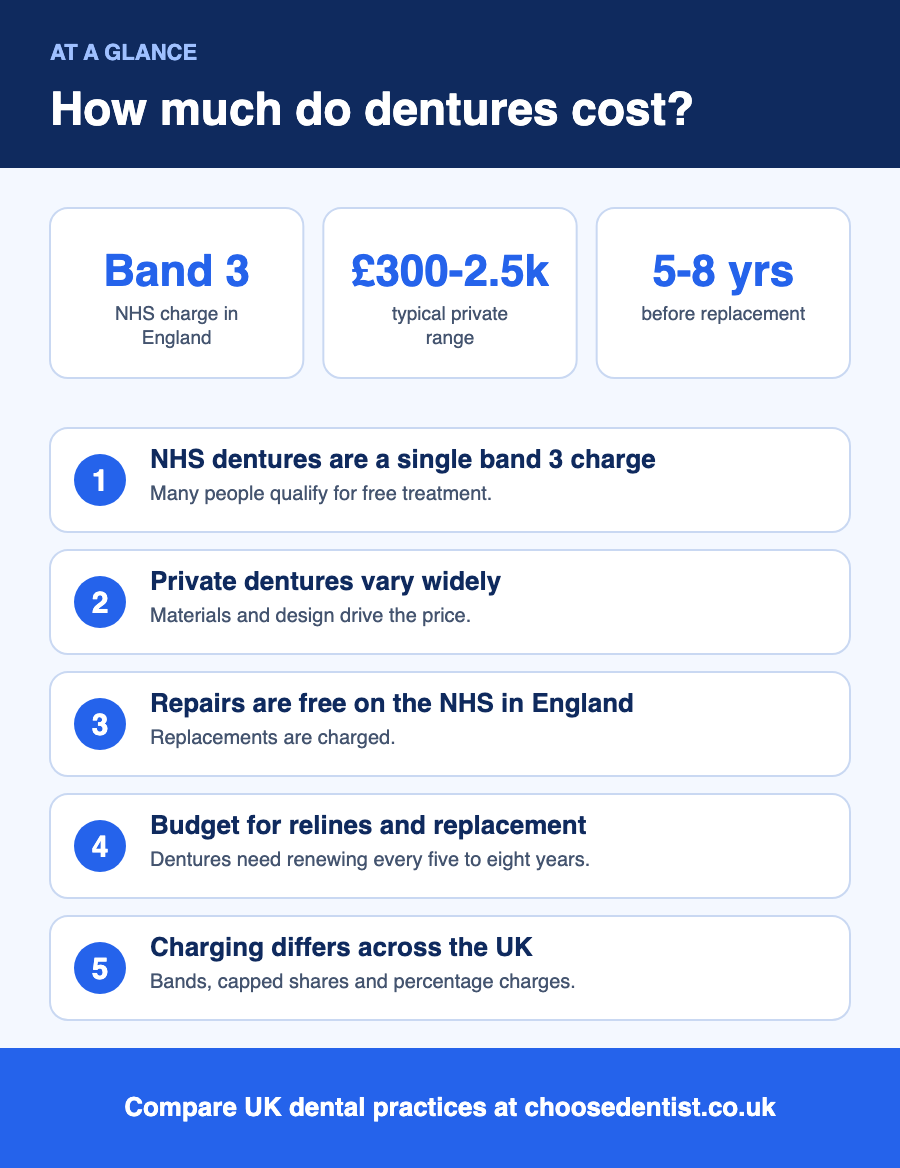
The cost of dentures in the United Kingdom depends mainly on whether they are provided on the NHS or privately. On the NHS in England they fall into the highest charge band, so a patient pays a single fixed charge for the course of treatment, whereas private dentures are priced by the practice and can range from a few hundred pounds for a basic acrylic denture to several thousand for premium or implant-supported designs. Many people pay nothing at all if they qualify for free NHS treatment.
The difference between NHS and private is not only price. Private care offers a wider choice of materials and designs, and the fee depends on those choices. Understanding how each system works, and what affects the total, helps patients to decide which route suits them.
NHS charges
The NHS website says that an NHS dentist may offer dentures if you need them to treat a dental problem, and that dentures fall under charge band 3 in England, as set out on its page about dentures. Band 3 is the highest of the three bands, covering crowns, bridges and dentures, and the patient pays one charge for the whole course of treatment, regardless of how many visits are needed. The NHS page on how much NHS dental treatment costs lists the current band charges, which are revised periodically.
If other work is needed in the same course, the patient pays the single highest band, and further work within two months in the same or a lower band costs nothing extra. Repairs to dentures are always free, according to the NHS, though replacements are charged.
| Type | Typical cost | Notes |
|---|---|---|
| NHS denture (England) | One band 3 charge for the course | Many people pay nothing; repairs are free |
| Basic private acrylic denture | About £300 to £600 | Complete denture, simple materials |
| Private partial denture | About £300 to £800 | Acrylic or metal framework |
| Premium or metal-framework denture | About £1,000 to £2,500+ | More durable and more comfortable |
| Implant-retained denture | Several thousand pounds | Includes the cost of implants |
| Reline or repair | About £50 to £300 | Privately; repairs free on the NHS in England |
Private prices
Private dentures are priced individually. The NHS notes that private dentures vary in cost depending on the type and material, and that private care offers a wider choice. A basic acrylic complete denture may cost from about £300 to £600, a partial denture from about £300 to £800 and a metal-framework or premium denture from about £1,000 to £2,500 or more, with implant-retained dentures costing considerably more because of the implants. These figures are rough guides only, and they vary by region and practice.
The Oral Health Foundation notes in its guide to dentures that metal dentures are usually more expensive than plastic ones, which reflects the cost of the framework and the laboratory work.
What affects the cost
The type of denture matters most: a complete denture replacing a whole arch costs more than a partial one replacing a few teeth, and a pair costs more than one. The materials count, with acrylic being the most common and metal framework or flexible materials costing more. The quality of the teeth and the laboratory work, the number of appointments, whether immediate dentures are needed and the region of the country all play a part.
Add-ons raise the price. Specialist features, such as a thinner metal base, more natural-looking teeth or an upgrade offered by an NHS dentist for an extra fee, may be charged separately. Implants to support the denture are a significant additional cost.

Who pays nothing
Many people do not pay for NHS dentures. In England, the NHS says that some people qualify for free NHS dental treatment, and groups commonly eligible include those receiving certain income-related benefits, pregnant women and those who have had a baby in the last twelve months, people under 18 and students under 19 in full-time education. People on a low income who do not qualify for full exemption may be able to get help through the NHS Low Income Scheme.
Patients can be asked to show evidence of entitlement, so it is sensible to check before the first appointment, and to claim exemption on the form the practice provides.
Relines, repairs and replacements
The initial price is not the whole cost. Dentures need adjusting as the gums change, and relining or replacement is needed over time. The Oral Health Foundation says dentures often need replacing every five to eight years. On the NHS in England, repairs are free, and the dentist can say how a reline would be charged, whereas privately a reline commonly costs from around £100 to £300 and a repair from about £50 to £150, depending on the work.
Cleaning products, adhesive and a denture case are small but regular costs, and a hygiene visit to remove stains and tartar from the remaining teeth adds to the overall budget.
Ways of paying
Private practices commonly offer instalment plans, and some include dentures in membership schemes that cover routine care. Because dentures are a necessity for many people and not merely a cosmetic choice, it is worth asking whether the practice can phase the payments. Dental insurance and cash plans may contribute, and some employers offer them, so checking the terms is sensible.

Dentures compared with other options
Dentures are the least expensive way of replacing several missing teeth, but they are not the only option, and it helps to see how the costs compare. A bridge, which fixes a replacement tooth to neighbouring teeth, may be available on the NHS in the same band as dentures where clinically appropriate, though it depends on healthy teeth either side. Dental implants are mostly private and cost far more, with a single implant and crown often from about £1,800. Our guide to implants and dentures compares the two in more detail.
Questions to ask about price
Useful questions include whether the denture is NHS or private and what the difference is, what the total cost will be, whether adjustments are included and for how long, what a reline or repair costs, what warranty applies and what happens if the denture does not fit well. Asking for a written estimate, with each element listed, avoids surprises and makes comparison between practices straightforward.
Treatment timing and cost
Speed can affect the price. Dentures made on a standard timescale take several weeks, with impressions, a try-in and a fitting, whereas immediate dentures, made in advance to be fitted on the day teeth are removed, need extra planning and adjustment and may cost more privately. Patients who need teeth urgently, for work or appearance, may wish to pay for a faster service, but should check what it includes and whether later relining is covered.
NHS and private options across the UK
Charging for NHS dentistry differs across the four nations. England has three bands and an urgent charge, with dentures in the highest band, Wales numbered bands and an urgent charge with a contract reform under way, Scotland free examinations and free treatment under 26 with a capped share of the cost for other adults, and Northern Ireland a percentage of the dentist’s fee up to a ceiling per course. In every nation, a standard denture to replace missing teeth is available through the NHS where it is clinically needed, and private care is an alternative for those who want a different design, faster treatment or a particular dentist.
Patients choosing between the two can ask the dentist what the NHS denture would be like, what the private upgrade offers and how much more it costs. A written estimate should say which parts are NHS and which are private.
Getting good value
Value lies in a well-fitting, comfortable denture that lasts, with good aftercare, not simply in the lowest price. A practice that takes careful impressions, offers a try-in stage and provides follow-up adjustments is more likely to deliver a good result.
The ChooseDentist directory of denture practices can be searched by postcode, with CQC and Google ratings displayed where available. Two practices can be compared side by side, and NHS availability and private prices should be confirmed directly with the practice.