
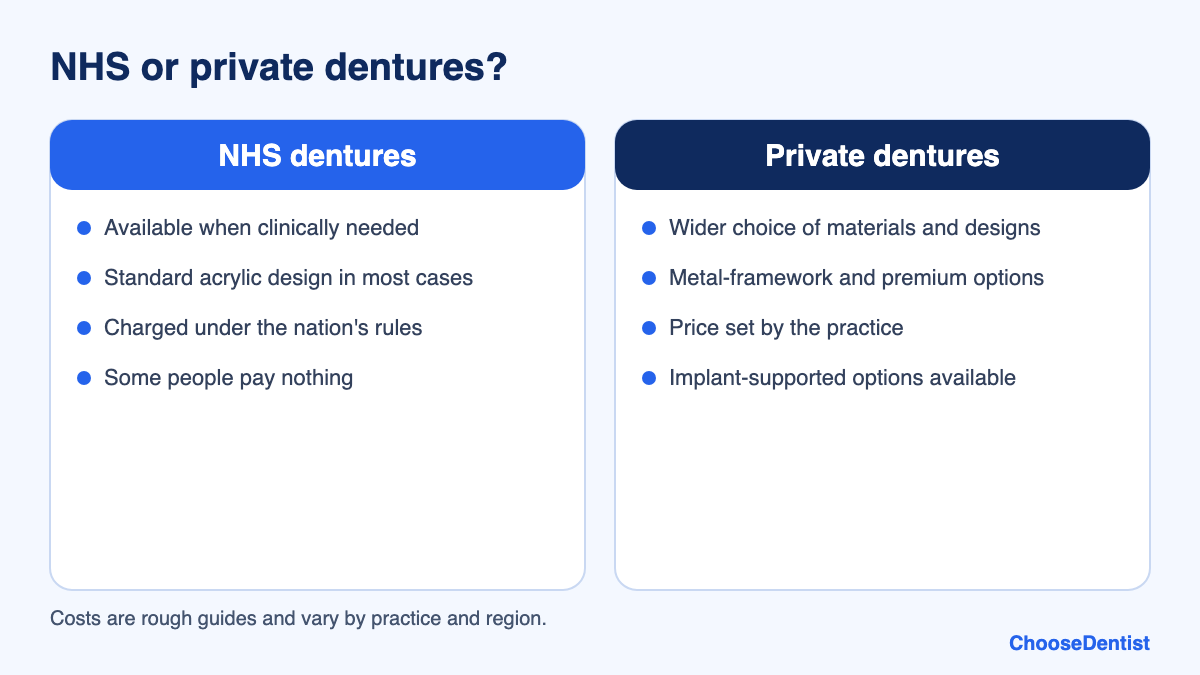
Yes. Dentures are available on the NHS across the United Kingdom when they are needed to treat a dental problem, and most people who need them have the option of an NHS plate made to a standard design. The NHS website says that an NHS dentist may offer dentures if you need them, and that private care offers a wider choice of materials and designs, with some NHS dentists providing upgraded types for an extra fee.
How much they cost depends on where in the UK the patient lives and on whether they qualify for free treatment. The four nations have different charging systems, and recent changes in some of them make it worth checking current details. This page sets out what the NHS covers, how the charges work and what the alternatives look like.
What NHS dentures cover
NHS dentures are intended to restore function: chewing, speaking and a presentable appearance. The NHS describes complete dentures, which replace all the upper or lower teeth, and partial dentures, which replace one or more missing teeth and may clip on to remaining natural teeth. The dentist takes impressions or a scan, the denture is made over a few weeks and a separate fitting appointment follows, with adjustments afterwards as the patient gets used to it.
The standard NHS denture is usually made of acrylic, and in some cases a metal framework is used for a partial denture where it is clinically needed. Dentures with specific features that are chosen for comfort, appearance or convenience, such as more elaborate designs or special materials, are often private options.
| Nation | How NHS dental charges work | Dentures |
|---|---|---|
| England | Three bands plus an urgent charge | Band 3, the highest band; repairs are free |
| Scotland | Free examinations; free treatment under 26; others pay a share up to a maximum | Charged within the capped share for adults who do not qualify for exemption |
| Wales | Three bands plus an urgent charge; contract reform under way | Highest band, as in England |
| Northern Ireland | Generally 80 per cent of the dentist's fee up to a ceiling per course | Charged within the ceiling; repairs are free |
How charges work in England
According to the NHS, dentures in England fall under charge band 3, the highest of the three bands, and the NHS website says that some people qualify for free NHS dental treatment. Band 3 covers crowns, bridges and dentures, and a patient pays a single charge for the whole course of treatment, determined by the highest band involved. Further treatment within two months that falls in the same or a lower band costs nothing extra, according to the NHS page on how much NHS dental treatment costs.
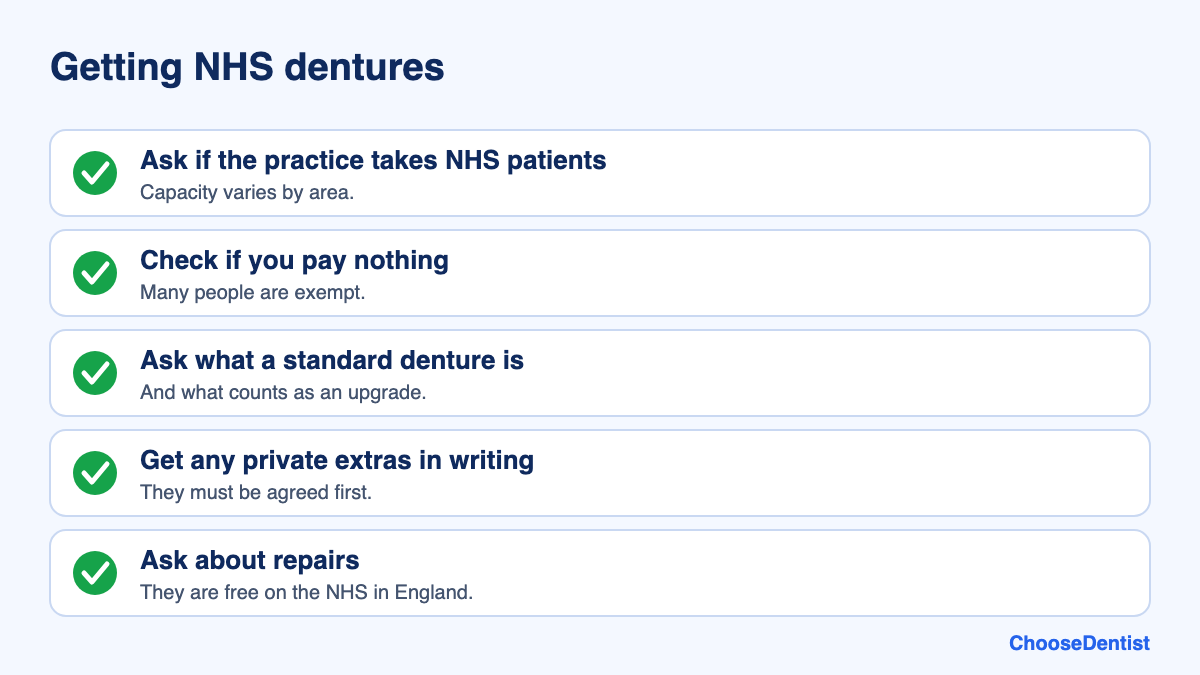
Repairs are treated differently. The NHS lists repairing dentures among the things that are always free, though replacing them is not.
Scotland, Wales and Northern Ireland
Scotland offers some of the most generous arrangements in the UK. According to NHS Inform, NHS examinations are free for everyone and treatment is free for people under 26, though dentures are rarely needed at that age. Adults over 26 who are not exempt pay a share of the cost of treatment up to a maximum for each course, and exemptions exist for people on certain benefits, for pregnant women and for those with an income-related certificate.
In Wales, the Welsh Government describes three bands plus an urgent charge, along with a wider reform of the contract, in its announcement about NHS dental charges. Dentures fall in the highest band in the same way as in England, with exemptions for children and various benefit groups.
In Northern Ireland, nidirect explains that Health Service dental charges are generally 80 per cent of the dentist’s fee up to a ceiling per course of treatment, that a repair to dentures is free and that several benefit groups receive free care. Because the details vary and are updated regularly, anyone planning treatment should check the official pages for current amounts.
Private dentures
Private dentures are priced by the practice and the choice is wider. Fees depend on the number of teeth, the materials and how much laboratory work is involved. As a rough guide, a basic private acrylic denture may cost a few hundred pounds, a more durable heat-cured or metal-framework denture a good deal more, and premium or implant-supported options several thousand. These figures vary by region and are only a guide.
People choose private dentures for several reasons: a wider range of materials, more natural-looking teeth, a metal base that is thinner and more comfortable, shorter waiting times or a preference to see a particular dentist. A written estimate should list the denture, the appointments, any adjustments and what is included in the event of a repair.
Free treatment and help with costs
Many people do not pay for NHS dentures. In England, the NHS website says some people qualify for free NHS dental treatment, and groups commonly eligible include those receiving certain benefits, pregnant women and those who have had a baby in the last year, people under 18 and students under 19 in full-time education, and people on a low income who hold a valid exemption certificate. In Scotland the exemptions are wider still, and in Wales and Northern Ireland similar categories apply. Patients may be asked to show evidence, and it is sensible to check eligibility before the first appointment.
The NHS Low Income Scheme can give help with the cost of dental treatment for people who do not qualify for full exemption but have limited means, and the dental practice can advise on how to apply.
Implants and other alternatives
Dentures are not the only way to replace teeth. Bridges fix a replacement tooth to its neighbours and can be funded on the NHS in the same band as dentures where clinically appropriate, though they depend on healthy teeth either side. Dental implants can support crowns or some types of denture, and the NHS website notes that they can improve stability, but they are mostly private and rarely available on the NHS. Our guide to implants on the NHS explains when they are.
Some patients choose an implant-retained lower denture, in which a few implants are used to clip the denture in place. This is generally private, but it can greatly improve stability and comfort for people who find a conventional lower denture difficult.
Treatment plans and written estimates
For NHS dentures, the dentist should give a written treatment plan setting out the work and the charge, which the patient signs before treatment begins, as the NHS requires for more substantial courses. Where private options such as an upgraded material are offered, they should be listed separately, with their price, so that it is clear what is NHS and what is not. Keeping a copy of the plan makes it easier to question anything that appears on the bill that was not agreed.
Waiting times and what to do while waiting
Waiting times for NHS dentures depend on the practice and the area. Some practices can begin within weeks, while others have long lists. If teeth have to be removed first, the dentist may suggest an immediate denture, which is fitted on the day of extraction so that the patient is never without teeth, though it normally needs adjustment as the gums heal. Patients who cannot find a practice with space can contact their local integrated care board, health board or equivalent for advice, and may be able to use an urgent dental service if they are in pain.
Finding a practice
Availability of NHS denture work depends on the practice’s contract and capacity, so it is important to ask whether it is taking on new NHS patients and how long the wait is likely to be. For private work, comparing quotes, materials and aftercare is worthwhile.
The ChooseDentist directory of denture practices can be searched by postcode, with CQC and Google ratings shown where available, and two practices can be compared side by side. NHS availability and costs should always be confirmed directly with the practice.
